Clear Sky Science · en
Indirect protection and long-term effectiveness of inactivated COVID-19 vaccine: a stepped-wedge randomised trial in Serrana, Brazil
Why a Town-Wide Vaccine Test Matters
Imagine an entire town volunteering to be part of a giant real-world experiment to see how well a COVID-19 vaccine works, not just for each person but for the whole community. That is what happened in Serrana, a small city in Brazil, where researchers offered the inactivated CoronaVac vaccine to nearly all adults and followed them for a year. Their goal was to learn how much this vaccine could prevent illness, hospital stays, and deaths over time, and whether high vaccination coverage could also shield people who were not yet fully vaccinated.
Turning a City into a Living Laboratory
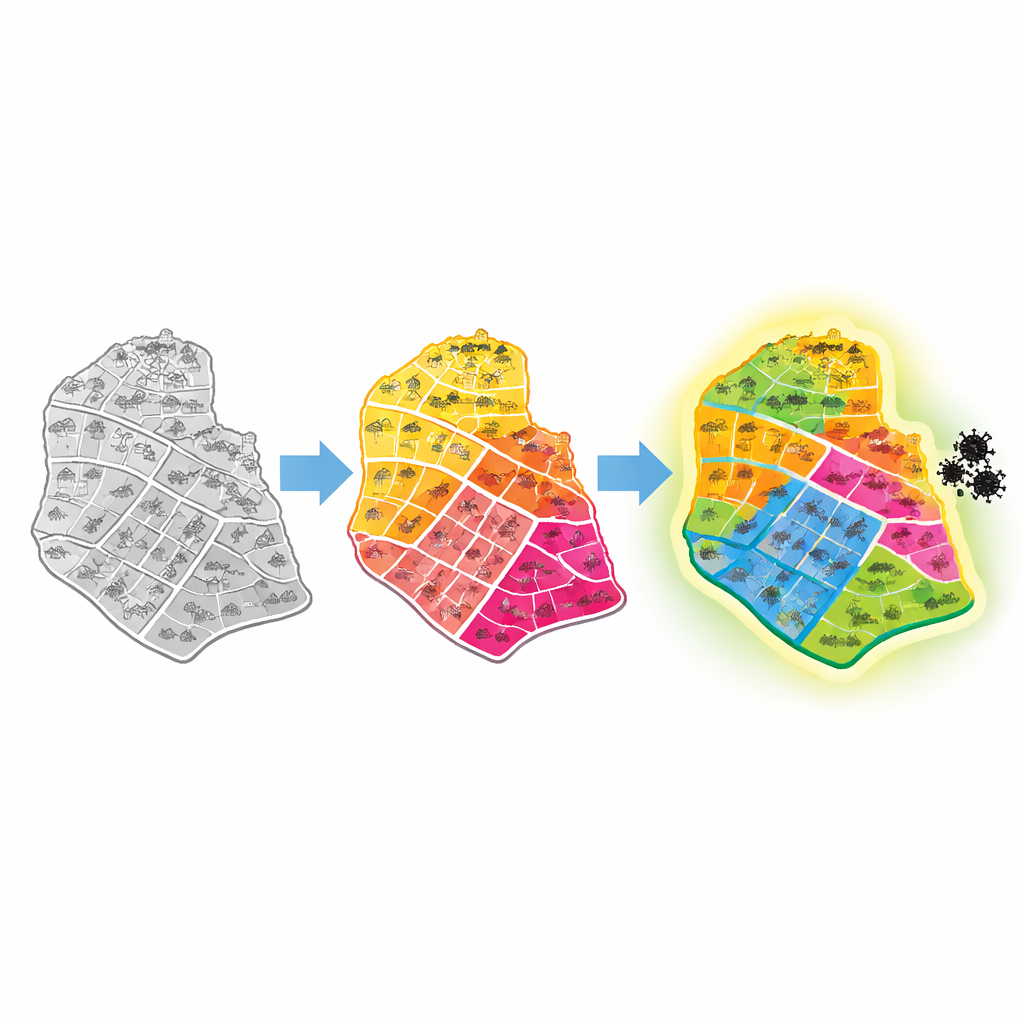
The scientists used a special approach usually seen in public health rather than in classic clinical trials. Instead of dividing people into vaccine and placebo groups, they split the city’s urban area into four groups of neighborhoods. These groups were randomly assigned different weeks to start vaccination with a two-dose schedule of CoronaVac. In this way, everyone eventually got access to the vaccine, which was important during a deadly pandemic, but not all at once. That timing difference let researchers compare infection rates before and after each group was vaccinated, as well as across groups, to see both the direct protection for vaccinated people and the broader community impact.
High Uptake and Early Gains
Participation was strikingly high: more than 27,000 adults received at least one dose, covering about 83% of Serrana’s adult urban population. Over 60% of the entire town, including children who were not vaccinated, lived in households where adults completed the two-dose series. During the first three months after vaccination started—when the Gamma variant dominated—the vaccine sharply reduced symptomatic COVID-19 among people who completed both doses. Compared with unvaccinated adults, fully vaccinated residents had around 80% lower risk of getting sick with symptoms and nearly 90% lower risk of being hospitalized or dying from COVID-19. Overall, when researchers looked at the whole adult population, including those not yet vaccinated, symptomatic cases dropped by about half.
Signs of Community Protection
Because vaccination moved through the town step by step, the team could watch what happened in each neighborhood over time. As more residents in each group received both doses, new symptomatic cases fell not only among the newly vaccinated but also among people in that area who were not yet fully vaccinated. In some groups, case numbers began declining even before most people had received their second dose, suggesting that high local coverage was already reducing the virus’s opportunities to spread. At about the same time, Serrana’s rates of COVID-19 hospitalizations and deaths began to drop compared with nearby cities, even though those neighboring towns continued to see high levels of severe disease.
What Happened as the Virus Evolved
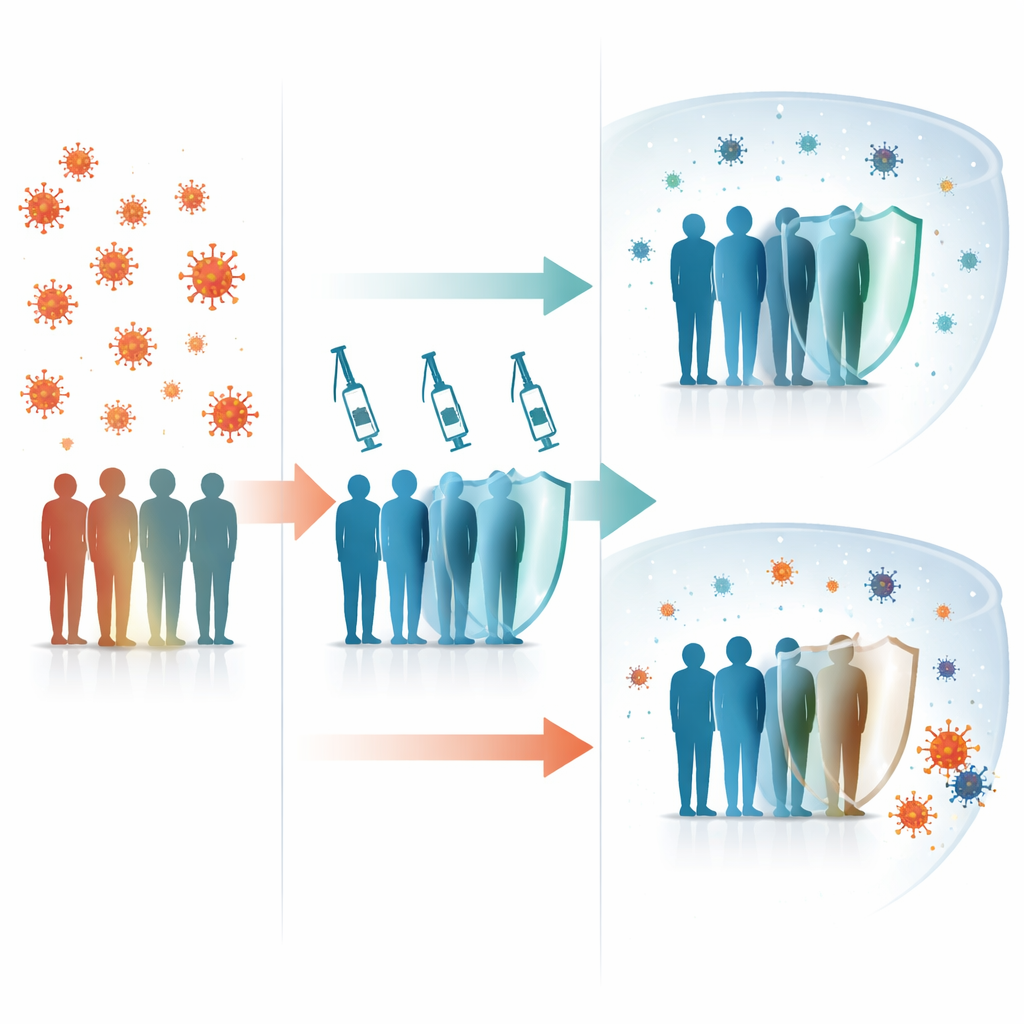
The study continued for a full year, spanning several waves of different SARS-CoV-2 variants: first Gamma, then Delta, and finally Omicron. As months went by, protection against mild or moderate symptomatic infection weakened. A booster dose, given mainly with the same CoronaVac vaccine, restored strong protection against infections during the Delta period but could not hold back a surge of Omicron symptomatic cases. However, the most important finding is that protection against severe outcomes stayed high. Across all four study periods, two doses of CoronaVac continued to prevent roughly 80–90% of COVID-19-related hospitalizations and deaths, and booster doses pushed that protection even higher, despite the changing variants.
Limits, Lessons, and Lasting Protection
Because this was a real-world project rather than a tightly controlled laboratory trial, the study had constraints. Neighboring groups were vaccinated only a week apart, and behavior, previous infections, and changing variants could all influence results in ways that are hard to fully separate. Even so, the Serrana experiment offers rare, detailed evidence that a whole community can dramatically cut severe COVID-19 by reaching very high vaccine coverage, even with an inactivated vaccine that does not fully block infections—especially once highly transmissible variants appear. For a layperson, the message is clear: widespread vaccination may not stop every case of COVID-19, but it can strongly protect people from ending up in the hospital or dying, and it can help shield the community as a whole when enough people roll up their sleeves.
Citation: Borges, M.C., Palacios, R., Conde, M.T.R.P. et al. Indirect protection and long-term effectiveness of inactivated COVID-19 vaccine: a stepped-wedge randomised trial in Serrana, Brazil. Sci Rep 16, 9879 (2026). https://doi.org/10.1038/s41598-026-37815-1
Keywords: COVID-19 vaccines, CoronaVac, community immunity, vaccine effectiveness, SARS-CoV-2 variants