Clear Sky Science · en
The effect of unilateral cortical blindness on lane position and gaze behavior in a virtual reality steering task
Why Losing Part of Your Sight Doesn’t Always Derail Driving
Imagine suddenly losing a large slice of your side vision after a stroke, yet still needing to get around in a car. Many people with “cortical blindness” face exactly this challenge. This study uses an immersive virtual reality driving simulation to ask a practical question with big consequences for independence and road safety: when the brain’s main visual center is damaged on one side, do people steer differently—and less safely—because they can no longer use motion cues from the world as well as fully sighted drivers?
How the Brain Uses Motion to Steer
When we drive, the patterns of motion sweeping across our eyes—known as “optic flow”—help us judge where we are headed and how sharply we should turn the wheel. Lines at the road’s edge, patches of ground texture, and nearby objects all slip past in ways that tell us if we are centered in our lane or drifting. In people with unilateral cortical blindness, damage to the primary visual cortex wipes out conscious vision in a quarter to half of the visual field on one side. Earlier work hinted that these drivers show odd lane positions and more crashes, but it was unclear whether the problem stems from missing motion information, noisy motion processing, or from deliberate strategies, such as leaving extra space on the side they cannot see.
A Virtual Roadway Built to Probe Steering
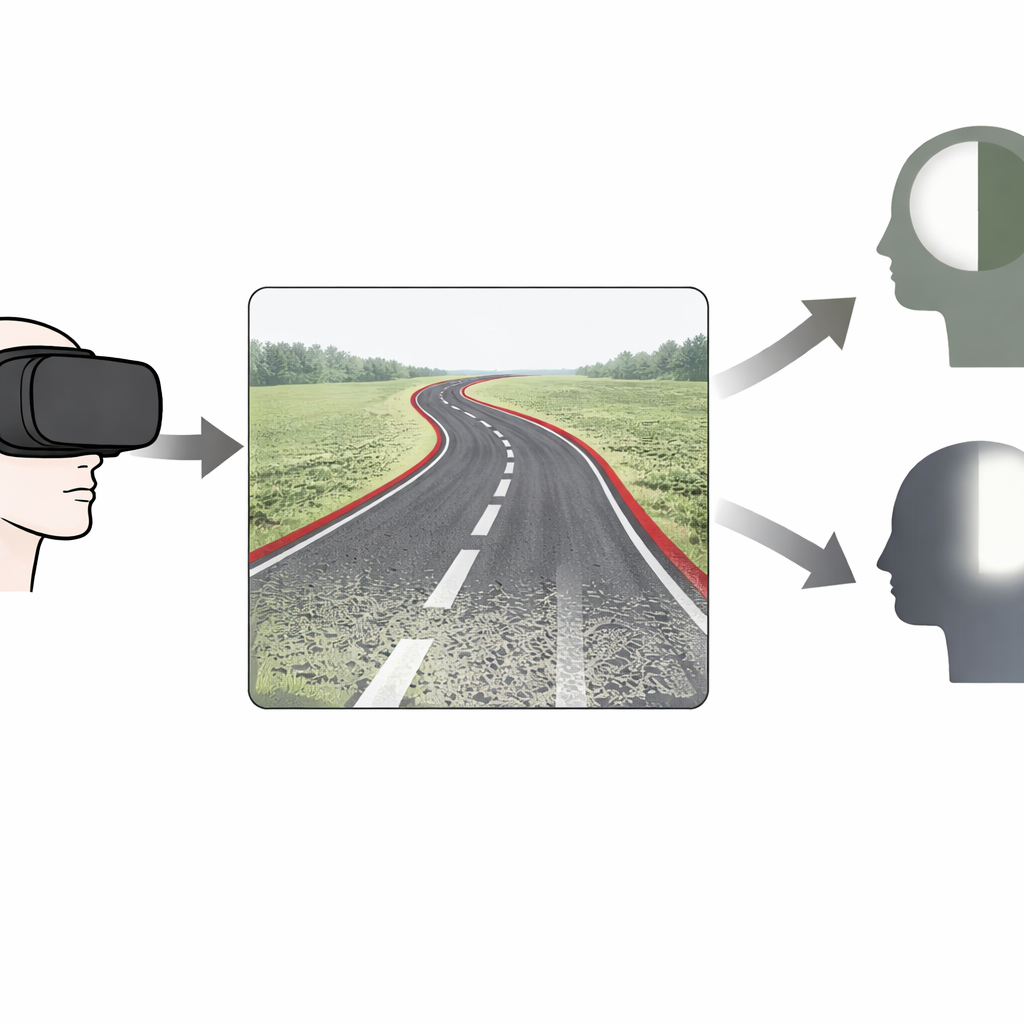
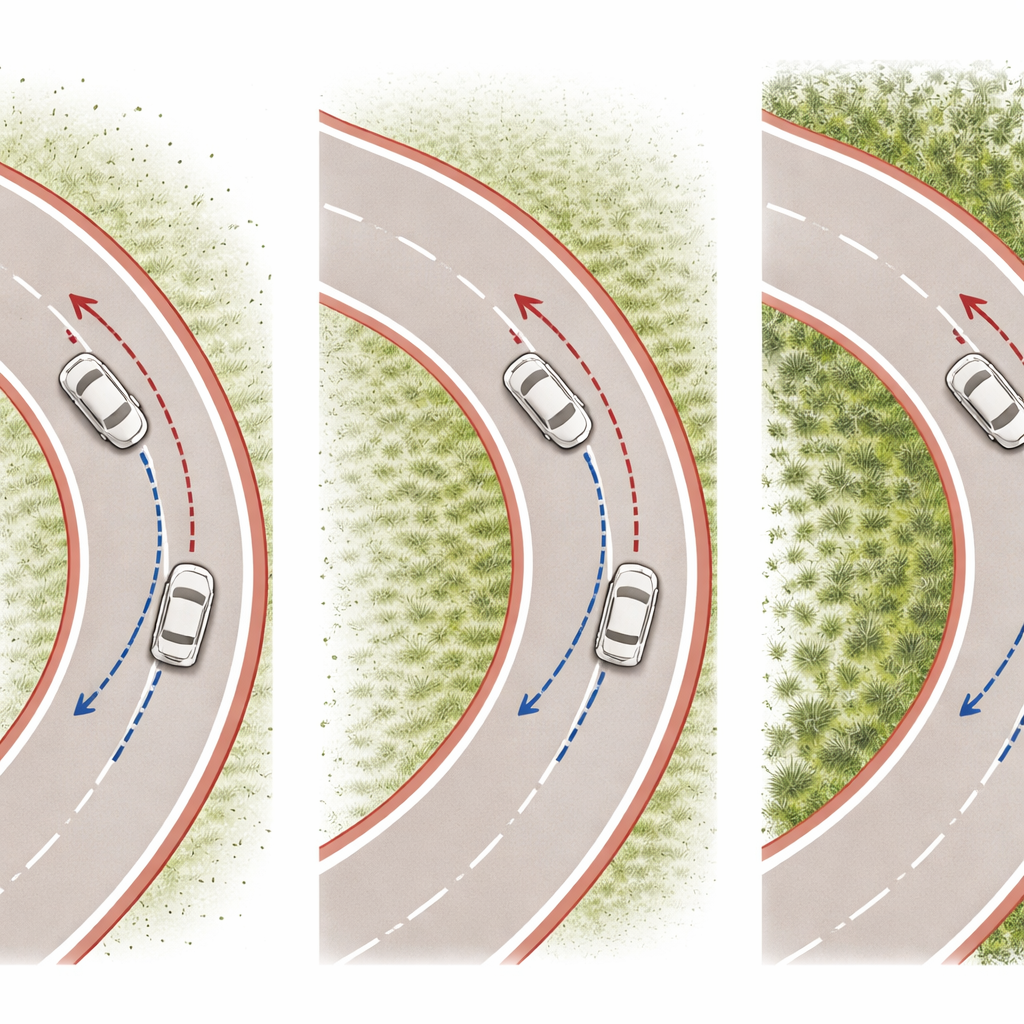
To tease these factors apart, the researchers recruited 21 adults with cortical blindness—11 missing vision on the left side, 10 on the right—and 9 age-matched people with normal sight. Wearing a virtual reality headset and using a steering wheel, participants drove along a single-lane winding road at a fixed speed, aiming to keep their head centered between bright red lane edges. The environment was stripped of traffic and pedestrians so that steering, not hazard avoidance, was the main task. Across trials, three features changed: the road curved left or right with different tightness, and the richness of visual motion was manipulated by adding or removing textures such as ground markings, trees, and bushes. Eye tracking inside the headset recorded where participants looked and how often they made quick gaze shifts.
What Changed with Motion—and What Stayed the Same
All groups, including those with cortical blindness, responded to changes in motion cues. When the ground and roadside were visually rich, drivers tended to “cut corners” slightly, bringing the car closer to the inside edge of a curve. When the visual scene was sparse and only distant mountains and lane edges were visible, they stayed farther from the inner edge and their lane position became more variable. These shifts mirror what has been seen in healthy drivers and confirm that the motion manipulation worked. However, people with vision loss on the left side showed a weaker change in their average lane position as motion cues were added, even though their maximum drift and overall variability still improved with richer motion, much like the other groups. This pattern hints that some left-sided participants may rely a bit less on motion and more on other sources of information, such as the clear lane boundaries or bodily sense of movement.
Eye Movements Without Extra Scanning
The researchers also asked whether drivers with a blind side compensate by aiming their gaze toward the missing region or by making more frequent scanning movements. Surprisingly, gaze patterns were broadly similar across groups. All participants tended to look toward the inside of a curve and showed a gentle back-and-forth eye motion typical of following a moving scene. Distributions of gaze direction were centered near the direction of travel rather than pulled strongly toward the blind side, and the number of rapid eye movements per turn differed little between groups. In this simplified, low-risk virtual world, most drivers with cortical blindness did not appear to rely on special scanning strategies to keep the road within their remaining vision.
What This Means for People with Cortical Blindness
For a layperson, the core message is both reassuring and cautionary. On the reassuring side, many aspects of steering and looking around while driving can remain surprisingly intact even when a large swath of the visual field is gone, at least in a controlled, obstacle-free setting. On the cautionary side, some individuals—especially those missing vision on the left side—seem to use motion cues from the environment differently, and the study’s virtual road lacked real-world pressures like traffic, pedestrians, and consequences for mistakes. Overall, the findings suggest that unilateral cortical blindness does not automatically doom a person’s basic steering ability, but that the side and layout of the vision loss can subtly alter how the brain blends motion with other signals to stay in lane. Understanding these differences may guide more tailored driving guidelines and rehabilitation for people living with this form of visual brain damage.
Citation: Giguere, A.P., Cavanaugh, M.R., Huxlin, K.R. et al. The effect of unilateral cortical blindness on lane position and gaze behavior in a virtual reality steering task. Sci Rep 16, 11421 (2026). https://doi.org/10.1038/s41598-026-35805-x
Keywords: cortical blindness, optic flow, virtual reality driving, steering control, eye movements