Clear Sky Science · en
Practical predefined-time adaptive fuzzy control for quantized nonlinear systems via observer-differentiator scheme
Why fast and reliable control matters
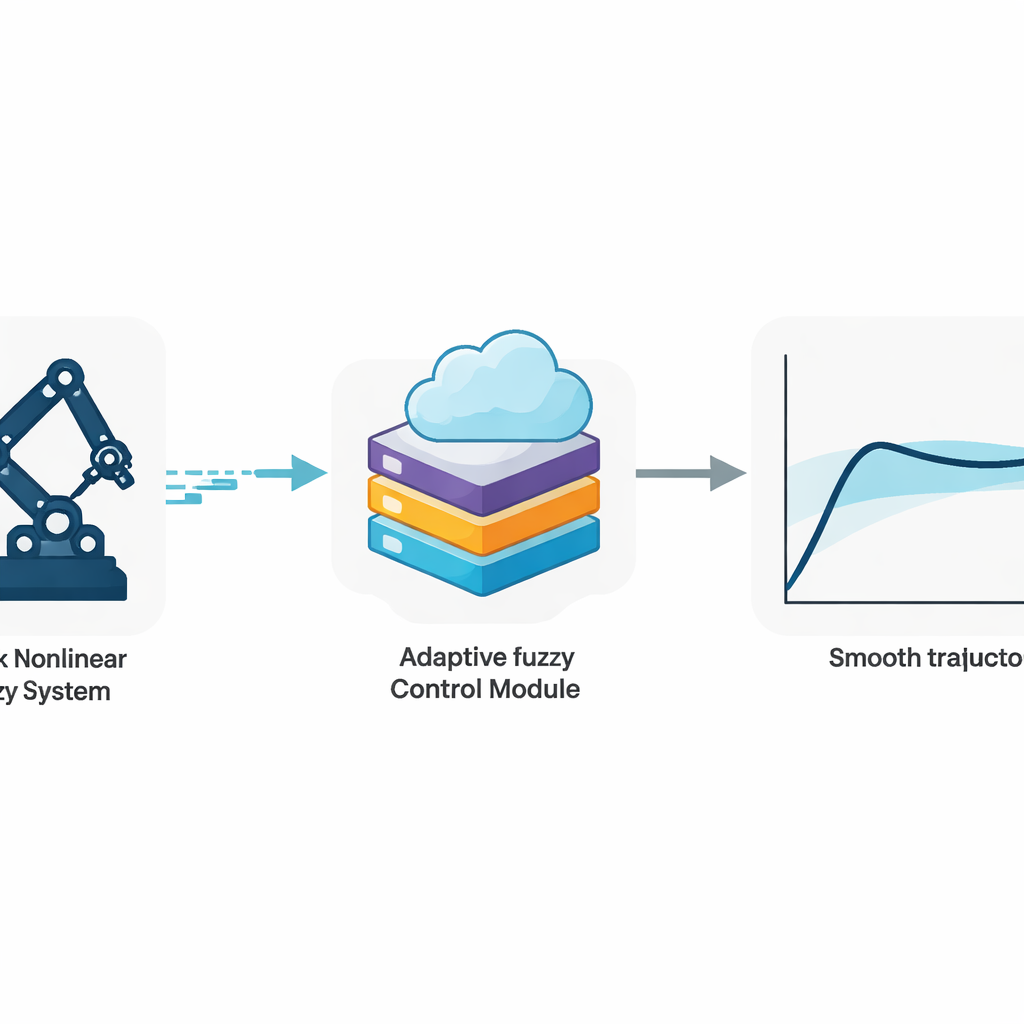
Modern machines—from industrial robots to remote-controlled vehicles—often have to follow a desired motion very quickly and accurately, even when information is distorted or delayed by digital communication. This paper explores how to design control algorithms that can guarantee a system will settle near its target within a time chosen in advance, despite the fact that both the commands sent to the machine and the measurements coming back are coarsely digitized into steps rather than smooth signals.
Digital steps instead of smooth signals
In many real-world settings, control signals travel through networks with limited bandwidth. Instead of continuous values, they are “quantized” into discrete steps, much like rounding every number to the nearest cent. The same can happen to sensor readings coming back from the machine. These stepped signals simplify communication but introduce errors and abrupt changes, which can cause chattering, wasted energy, and even instability if the controller is not carefully designed. The systems the authors consider are also highly nonlinear and of a more general, hard-to-handle type where internal variables are linked in complicated ways that standard design tools struggle with.
Promising idea: reaching a goal in predefined time
Traditional control schemes often ensure that errors shrink to zero eventually, but without saying how long this will take. More advanced “finite-time” and “fixed-time” approaches can guarantee that the settling time is bounded, yet the bound itself cannot be freely chosen. Here, the authors build on the concept of predefined-time control, which lets engineers specify in advance a desired upper limit on how long the system may take to get close to the target. This is crucial in time-sensitive applications such as spacecraft maneuvers or high-speed manufacturing, where missing a timing window can carry high costs.
New tools: observer and differentiator working together
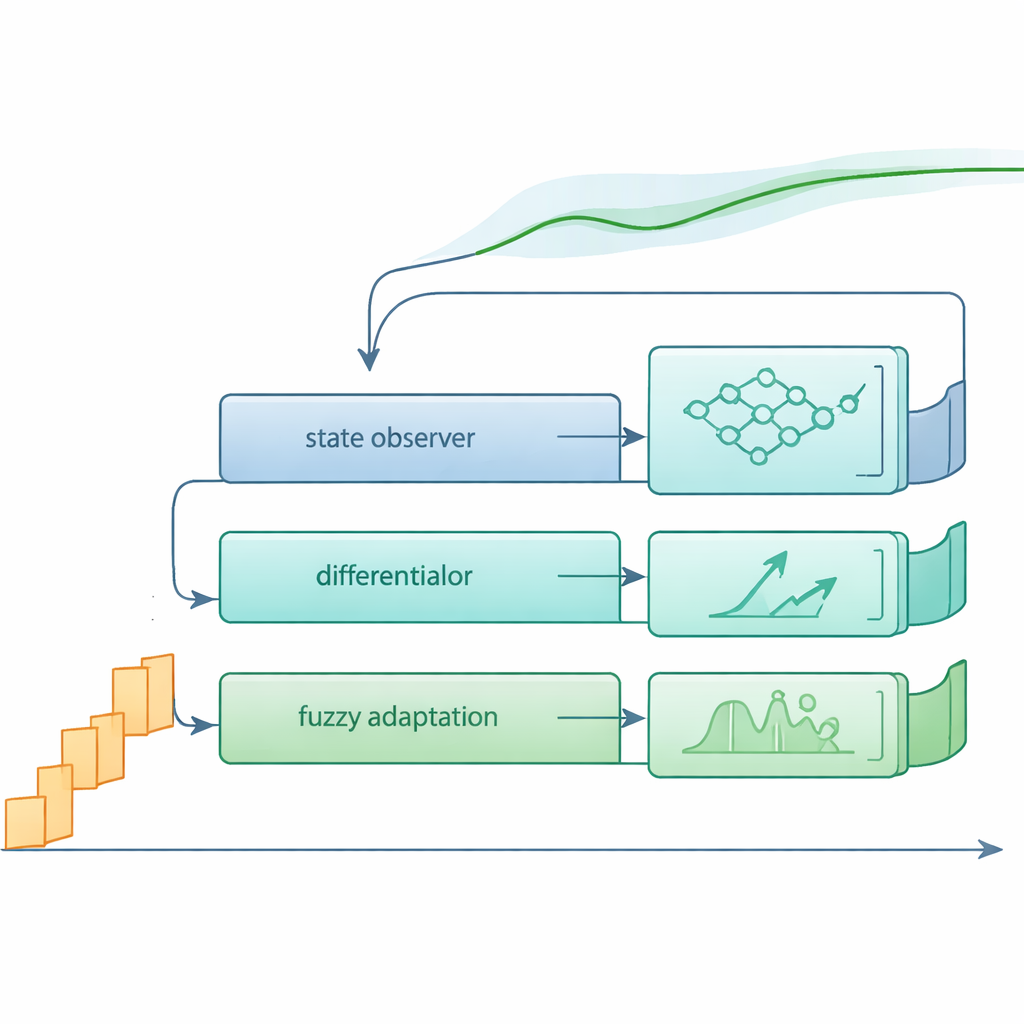
To achieve this predefined-time behavior under harsh quantization, the paper introduces two key ingredients. First, a new state observer based on an inverse hyperbolic sine function estimates the machine’s unmeasured internal variables using only the quantized output. Unlike many previous fuzzy observers, this design does not require a precise mathematical model of the plant, which makes it more suitable for uncertain or poorly known systems. Second, the authors propose a unified differentiator that can handle the non-smooth, non-differentiable nature of quantized signals. Instead of stacking multiple filters and smoothing functions—which can make algorithms bulky and hard to analyze—the single differentiator both tames the sharp corners of the digitized measurements and avoids a cascade of complex calculations.
Adaptive fuzzy control under digital constraints
On top of these signal-processing tools, the authors build an adaptive fuzzy controller. Fuzzy logic is used to approximate unknown nonlinear effects, while adaptive laws adjust the controller’s internal parameters on the fly as the system behaves. The design is carefully structured so that all signals in the closed loop remain bounded, and the tracking error—how far the actual output strays from the desired reference—shrinks to a small, tunable neighborhood of zero within the chosen time window. Importantly, the same framework copes with quantization in both the input (control voltage or torque) and the output (sensor readings), which is closer to what happens in real networked control systems.
Evidence from simulated machines
The authors test their approach on a simulated direct-drive robotic arm and on another nonlinear system with strong mathematical coupling between its variables. In these examples, the controller drives the system output to follow the desired trajectory within the preset time and keeps internal quantities such as position, velocity, and motor current within acceptable bounds. Comparisons with a recent alternative method show that the new scheme can achieve similar or better tracking while requiring smaller control signal swings, which translates into lower energy use and less wear on actuators. The simulations also illustrate a natural trade-off: demanding a shorter settling time improves speed but increases control effort, giving designers a knob to balance performance against cost.
What this means for future smart machines
In plain terms, this work shows how to make complex, partly unknown machines obey time-critical commands reliably, even when their control and measurement signals are heavily digitized. By combining a model-independent observer, a streamlined differentiator, and an adaptive fuzzy controller, the method can guarantee that the system gets close to its target within a user-chosen time and stays there with modest fluctuations. This opens a path toward more predictable and energy-efficient control in networked and resource-limited environments, from industrial drives to robotics and beyond.
Citation: Wang, Y., Chen, J. & Ma, W. Practical predefined-time adaptive fuzzy control for quantized nonlinear systems via observer-differentiator scheme. Sci Rep 16, 11519 (2026). https://doi.org/10.1038/s41598-026-35313-y
Keywords: predefined-time control, adaptive fuzzy control, quantized signals, nonlinear systems, state observer