Clear Sky Science · en
A model-based image fusion framework using discrete band-limited shearlets
Why better photos matter
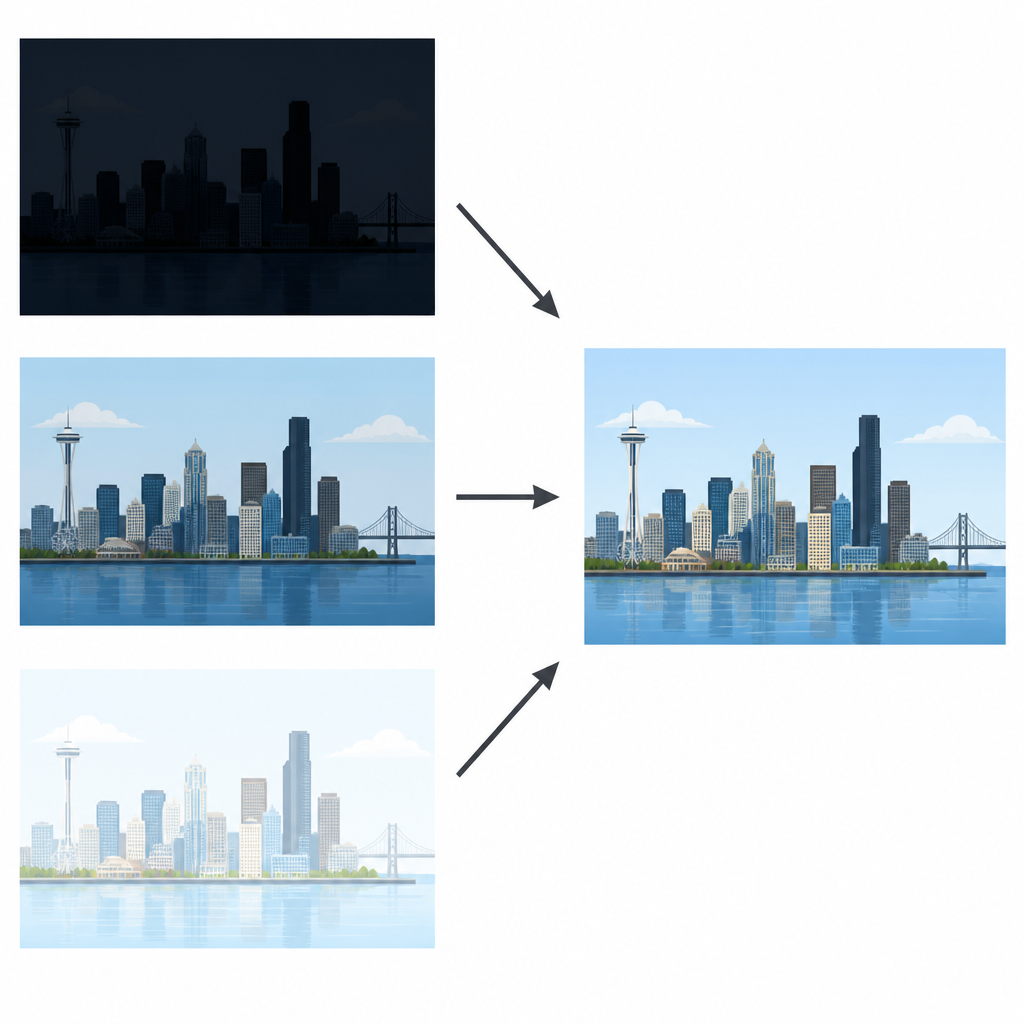
Anyone who has tried to photograph a sunset or a night skyline knows the frustration: if the sky looks right, the buildings are too dark; if the buildings are clear, the sky turns into a white blur. This paper tackles that everyday problem. It presents a new way to combine several photos of the same scene, taken at different brightness levels, into a single image that keeps both shadow and highlight details, without relying on opaque deep learning tricks.
Turning several shots into one clear view
Modern camera sensors cannot match the human eye, which comfortably sees detail in both bright clouds and dim streets at the same time. Photographers often work around this by taking a sequence of shots of the same scene: one underexposed to protect bright areas, one normal, and one overexposed to reveal dark regions. The goal of multi-exposure image fusion is to combine these shots into a single picture that feels natural and detailed everywhere. Earlier methods either mixed the pixels directly or used simple tricks to avoid ghosting, but they often produced dull results or smeared fine texture.
A clear alternative to black box learning
Recently, deep learning systems have taken over this task, learning how to blend images from large training sets. These systems can produce striking pictures, but they are costly to train, depend heavily on the data used, and are hard to interpret. In contrast, the authors develop a fully transparent, training free approach that rests on well understood mathematics. Instead of learning how to fuse images from examples, their method follows precise rules that can be inspected, reproduced, and adjusted, which is attractive in scientific, medical, or safety critical settings where trust and traceability are essential.
Using smart directions to track detail
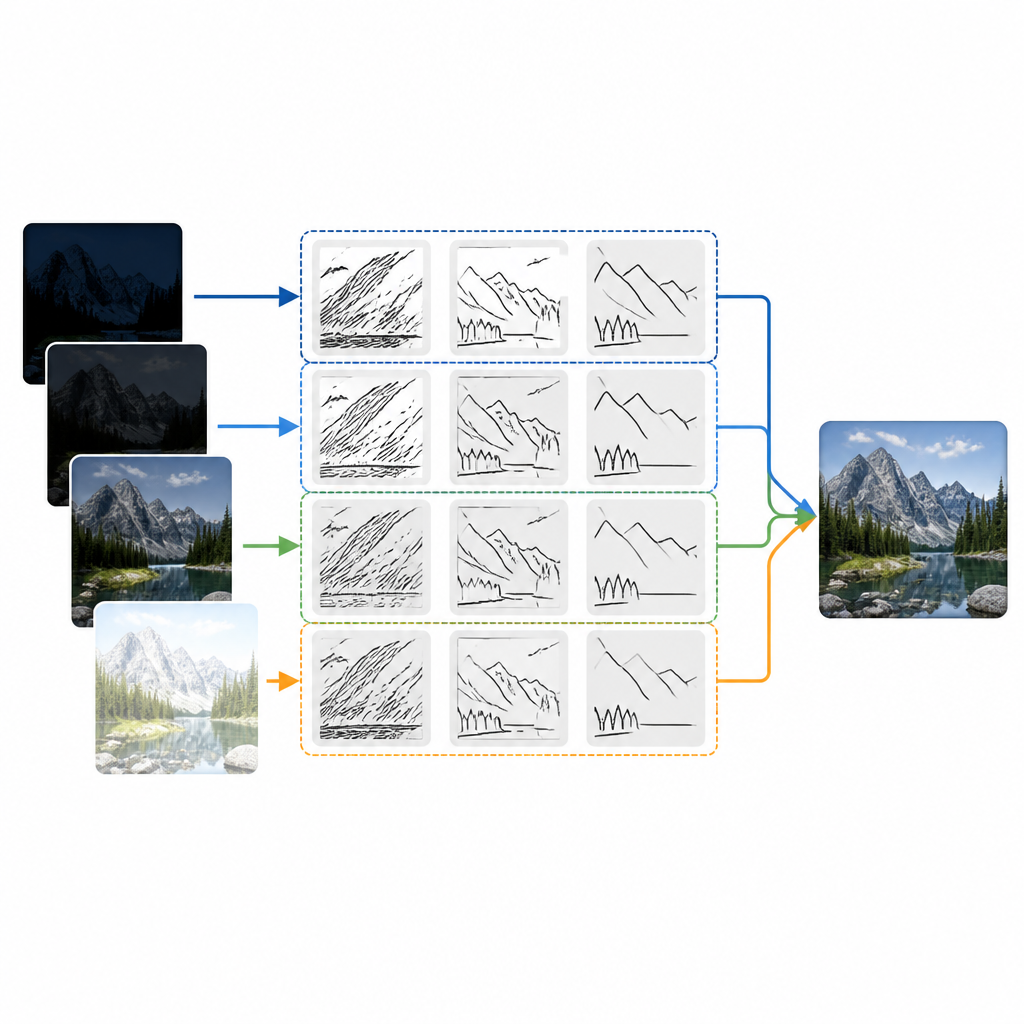
The heart of the new approach is a tool called the discrete band limited shearlet transform. In simple terms, this tool breaks each input image into layers that capture structures at different sizes and directions, such as edges, lines, and curves. Unlike older techniques that mostly treat detail the same in all directions, this transform is especially good at following slanted and curved features like rooflines, silhouettes, and ripples on water. Each source image is first converted into low frequency layers that hold overall brightness and shape, and high frequency layers that carry fine edges and textures. The method then fuses these layers using carefully chosen rules before rebuilding the final image.
Choosing what to keep from each exposure
To decide which details from each exposure should appear in the final picture, the authors test two simple strategies. For slow changing background content, they average the low frequency layers so that the overall brightness and scene structure look natural. For fine detail, they try two competing ideas. One rule favors regions where the variation in a small neighborhood is consistently strong, which tends to keep stable textures while resisting noise. The other rule simply picks, at each location, the most striking local change relative to its surroundings, which can sharpen edges but may be more sensitive to noise. Experiments on standard test scenes, such as views of a canal and a masked street performer, show that both rules behave similarly once combined with the powerful directional layers of the shearlet transform.
Seeing the gains in numbers and in scenes
The team checks their method against several widely used tools that decompose images in different ways, including classic wavelets and more advanced contour and shear based schemes. Using common quality scores that measure sharpness, information content, and structural similarity, their approach consistently produces images with crisper edges and richer detail than these older methods. The fused photos show readable texture in boats, buildings, and skies that were either lost in glare or buried in shadow in the original exposures. While the new method is slower than some alternatives, because it works in the frequency domain with many directional filters, it remains practical for offline processing where visual quality and interpretability matter more than speed.
What this means for better and clearer images
In simple terms, this work shows that a carefully designed mathematical tool can rival and even surpass both traditional and learned approaches for blending multi exposure photos, without the need for training data. By focusing on how edges and textures appear at different sizes and directions, the method can pull out the best seen parts of each input shot and weave them into a single, balanced image. For photographers, engineers, and scientists who need trustworthy, reproducible image enhancement, it offers a clear, well explained path to high dynamic range pictures that look closer to what the human eye naturally sees.
Citation: Ji, W., Chen, X. A model-based image fusion framework using discrete band-limited shearlets. Sci Rep 16, 15204 (2026). https://doi.org/10.1038/s41598-025-34942-z
Keywords: multi exposure image fusion, high dynamic range imaging, shearlet transform, image detail enhancement, computational photography