Clear Sky Science · en
Optimized decomposition and deep learning with bias correction for reliable runoff point-interval prediction
Why smarter river forecasts matter
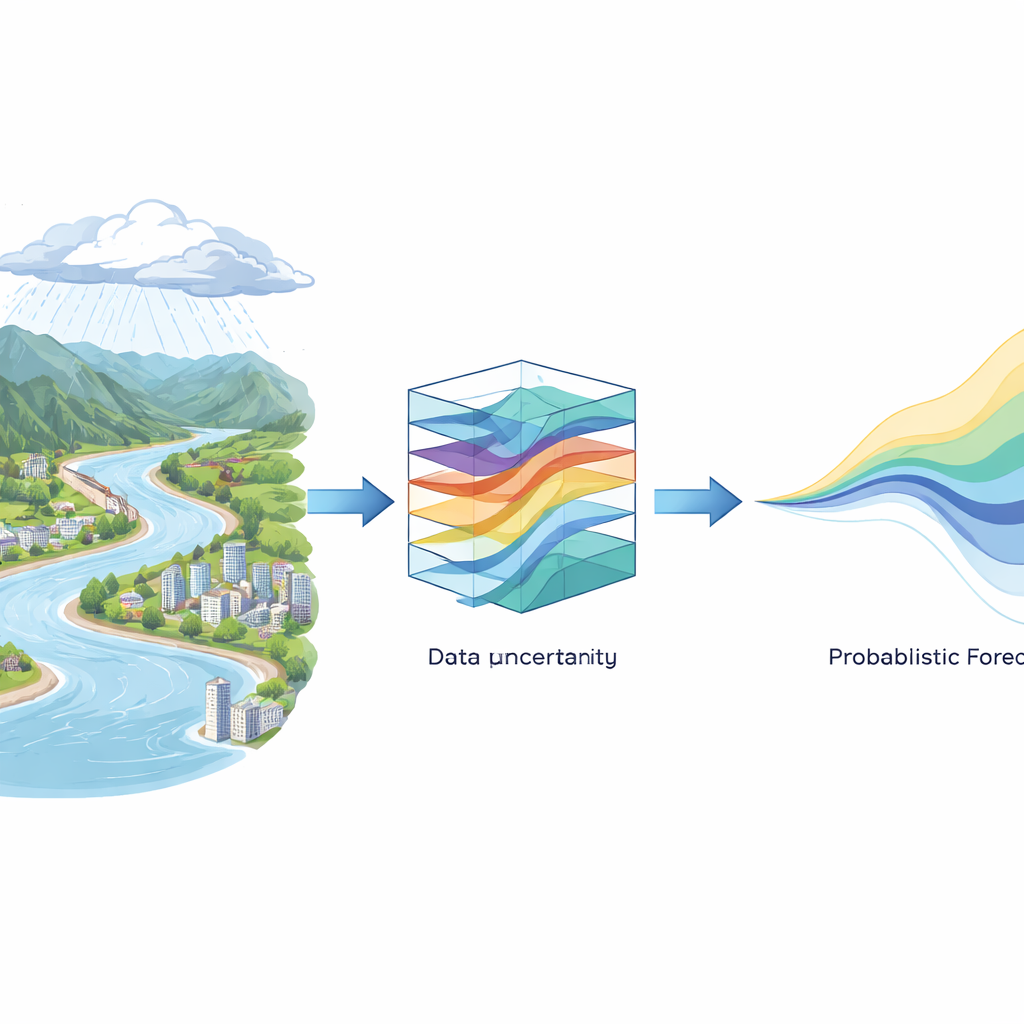
Communities along great rivers like the Yangtze live with a constant tension between too much water and too little. Sudden floods can endanger lives and infrastructure, while long dry spells threaten drinking supplies, farming, and hydropower. This study presents a new way to forecast how much water will be flowing in the Yangtze River months ahead, not just as a single best guess but also with a clear sense of how uncertain that guess is—information that can help planners prepare for both everyday conditions and rare extremes.
Taming a restless river signal
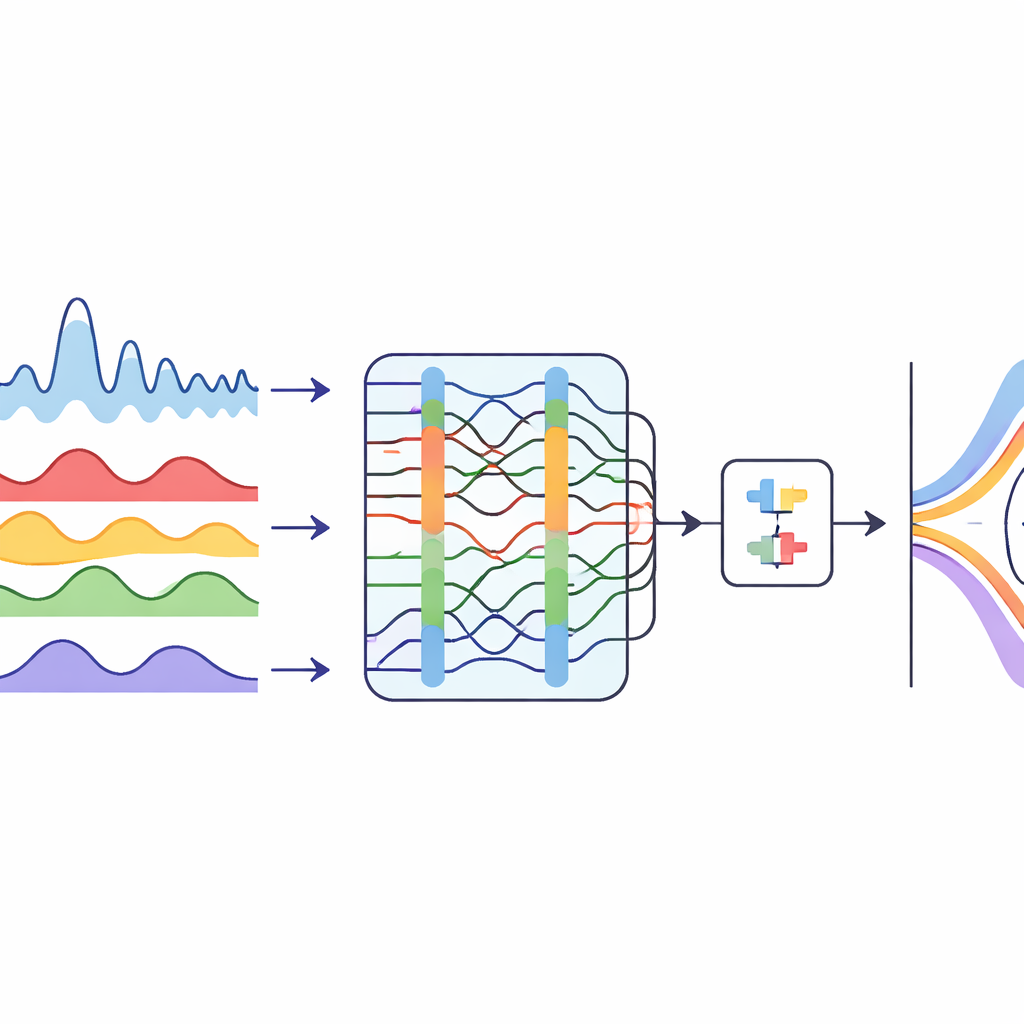
River flow rises and falls in complex patterns shaped by monsoon rains, dams, land use, and climate change. These ups and downs make the data “noisy” and irregular, which can confuse even advanced computer models. The authors first tackle this by breaking the monthly runoff record from two Yangtze stations into several smoother components. They use a technique that separates a tangled signal into cleaner building blocks, and then let an optimization algorithm inspired by humpback whales’ hunting behavior automatically choose how many components to use and how tightly each should be shaped. The result is a set of more stable flow patterns that are easier for a learning system to understand.
Teaching machines to read the river
Once the flow record is decomposed, the study turns to a hybrid deep learning model to predict future runoff. One part of the model, a temporal convolutional network, is good at spotting long-term patterns and seasonal rhythms in a sequence. Another part, a bidirectional recurrent network, looks both backward and forward along the time line to better grasp how past months influence the next one. The whale-based optimizer also tunes key design settings of this combined model, such as how many filters it uses and how quickly it learns. This careful setup allows the system to make much more accurate one-month-ahead forecasts than a range of rival methods, including more traditional neural networks and transformer-based sequence models.
Fixing hidden biases in predictions
Even when average errors are small, a model can still show subtle, repeated mistakes—for example, regularly underestimating big floods. To correct for these hidden biases, the authors add a second learning step. First, the model produces an initial forecast from the decomposed signals. Then they compute the difference between this forecast and the actual observed flows and train the same type of network to predict these leftover errors. By adding the predicted errors back onto the initial forecast, they obtain a bias-corrected result. At both Yangtze stations, this strategy slashes the standard error of predictions by roughly two-thirds compared with the same model without bias correction, and it tracks flood-season peaks much more closely.
From a single line to a range of possibilities
For real-world decisions, knowing only one “best” forecast is not enough; managers need to understand the range of flows that remain plausible. The study therefore goes beyond point forecasts to estimate prediction intervals—bands that should contain the true runoff a chosen percentage of the time. Instead of assuming a simple bell-shaped error pattern, the authors estimate the error distribution directly from the data using a flexible method that smooths the observed residuals. This nonparametric approach better captures skewed and heavy-tailed behavior, which is important for extremes. Using these fitted error distributions, they construct runoff intervals at different confidence levels and show that their method consistently covers the observed flows more reliably, yet with relatively narrow bands, than standard statistical distributions.
What this means for people and planning
In plain terms, the study delivers a forecasting tool that is both sharper and more honest about its uncertainty. By cleaning up the flow record, using an optimized deep learning engine, correcting systematic errors, and then building data-driven uncertainty bands, the framework gives water managers along the Yangtze a clearer picture of what to expect and how sure we can be. While the method is computationally involved and still needs testing in other river basins, it points toward a new generation of river forecasts that can better guide dam operations, flood warnings, and long-term water planning in a changing climate.
Citation: Ma, H., Marsani, M.F., Mansor, M.A. et al. Optimized decomposition and deep learning with bias correction for reliable runoff point-interval prediction. Sci Rep 16, 9616 (2026). https://doi.org/10.1038/s41598-025-33713-0
Keywords: flood forecasting, river runoff, deep learning, uncertainty estimation, Yangtze River