Clear Sky Science · en
The Very Long-term Iberian Fish Database Archaeological Fish Occurrences within the Iberian Peninsula
Tracing ancient fish to tell human stories
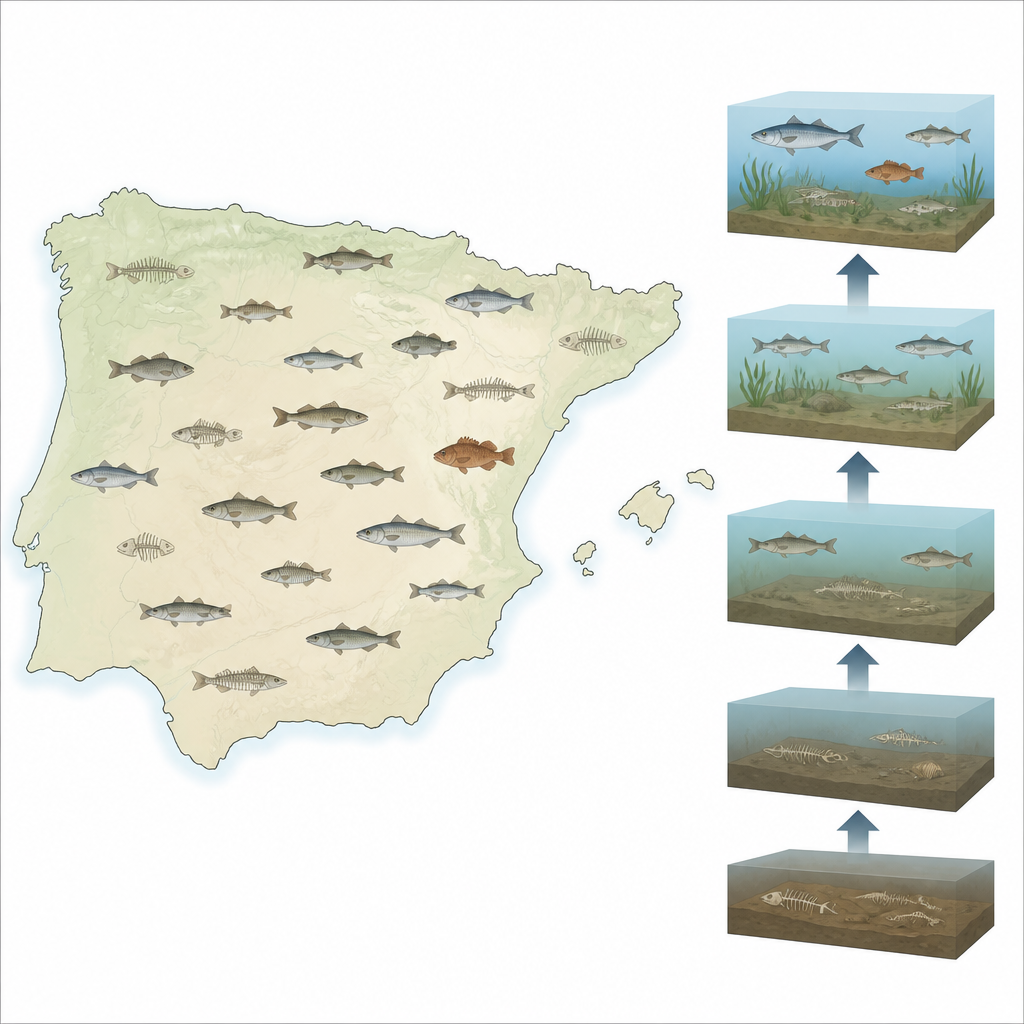
Imagine being able to follow the history of people living by the seas and rivers of Spain and Portugal simply by looking at old fish bones. This study does just that, presenting a huge database of fish remains from archaeological digs across the Iberian Peninsula that lets researchers track how fish and people have shared the same waters for nearly 90,000 years.
A long look at fish and people
The Very Long-term Iberian Fish Database brings together information on 94,204 fish remains from 441 samples found at 225 archaeological sites. These sites range from early Stone Age shelters to towns active in the 19th century. By gathering scattered reports from scientific papers, books, technical reports, and unpublished studies, the authors created a single, open resource that shows where and when different fish were used or present. This allows researchers to follow shifts in fish life across thousands of years and to explore how human communities relied on rivers, coasts, and seas.
How scattered clues became one record
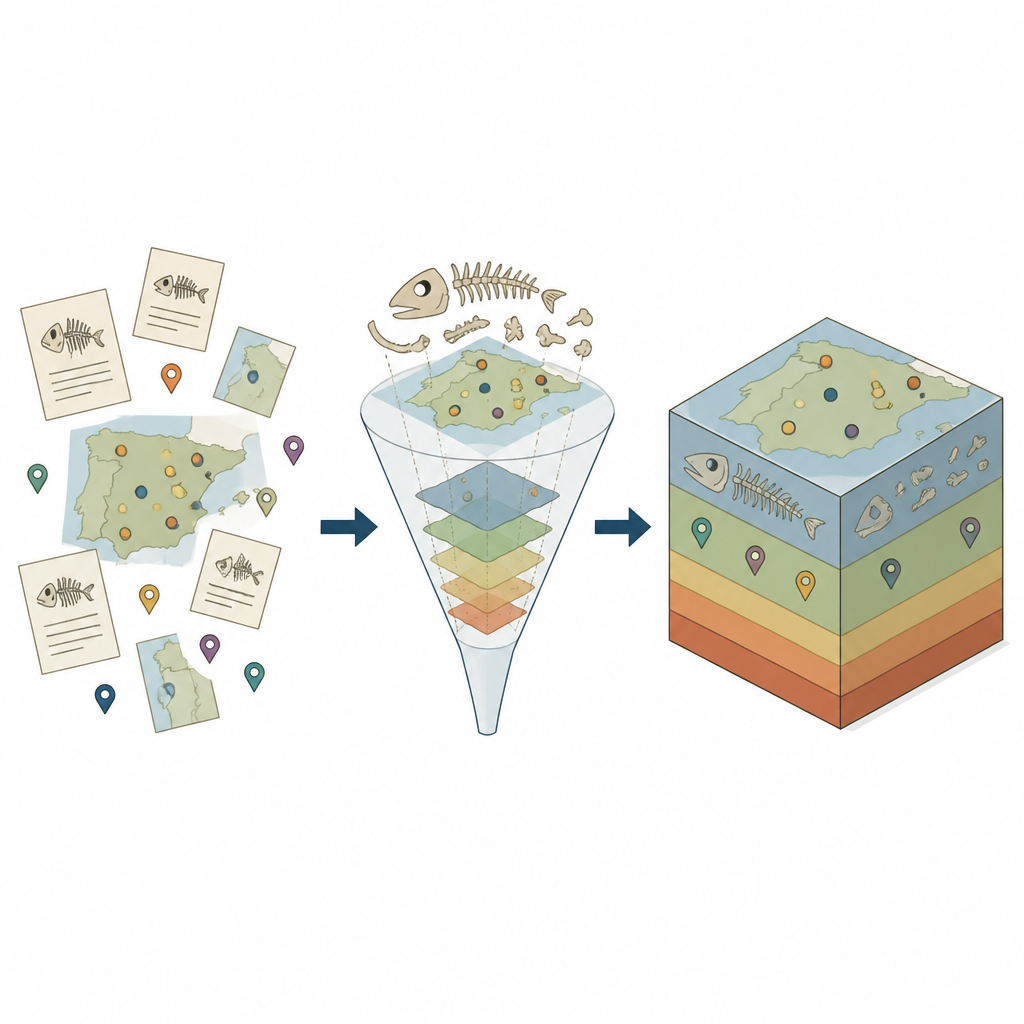
To build the database, the team followed a three step path. First, they tracked down any study that mentioned fish remains from Iberian archaeological sites, searching online repositories, libraries, and academic platforms. Second, they carefully copied out the details of each sample, including the site name and location, date range, how the fish bones were recovered, and which kinds of fish were identified. Third, they checked the records for errors, removed duplicates, and mapped the sites to confirm their coordinates. When precise dating was not available, broader cultural periods such as Neolithic or Iron Age were used with standard time ranges so that samples could still be compared.
Making sense of names and places
One major challenge was that fish names have changed over time as biology has advanced. The authors therefore kept the original taxonomic labels given by earlier researchers but also built a matching list that links those older names to current scientific usage. This is especially important for groups like carp and minnows, where older names once covered several distinct species that are now separated. The team flagged cases where fish might have been misidentified, introduced by people, or found far from their usual range. For each site, they also worked to pin down geographic coordinates using national heritage portals, regional cultural databases, and cross checking with published studies and online maps when official sources lacked precise location data.
From raw data to a tool for many fields
The finished dataset is shared as an open CSV file that can be read by mapping and statistical software, along with a geopackage that lets users view and analyze the spatial patterns of sites directly. A detailed data dictionary explains every field, and a companion file summarizes all recorded fish groups, how many remains belong to each, and the updated naming. Because the database includes counts of identified and unidentified bones, minimum numbers of individuals where available, and notes on body size estimates, it can support many kinds of analysis. Researchers can examine long term changes in fish distributions, study human diets and trade networks, explore ritual uses of fish such as fossil shark teeth, or search for suitable material for DNA or other biomolecular work.
Why this matters for today’s waters
Modern ecological studies usually look at records from only the past few decades, but the patterns we see today are shaped by much longer histories of climate shifts and human activity. By pushing the timeline for Iberian fish back to the Middle Palaeolithic, this database offers a deeper backdrop against which to judge present day changes in rivers and seas. It is not a perfect or complete picture, since archaeological finds are uneven in space and time and shaped by many biases, but it provides a powerful shared starting point. In simple terms, the study gives scientists a long running ledger of where fish once lived and how people used them, helping us better understand and care for aquatic life in the future.
Citation: Gabriel, S., Barrett, J.H., Sillero, N. et al. The Very Long-term Iberian Fish Database Archaeological Fish Occurrences within the Iberian Peninsula. Sci Data 13, 749 (2026). https://doi.org/10.1038/s41597-026-07079-5
Keywords: zooarchaeology, Iberian Peninsula, fish remains, historical ecology, species distributions