Clear Sky Science · en
An Improved Chromosome-Level Genome Assembly and Comprehensive Annotation of the Model Ascidian Ciona savignyi
Why a Tiny Sea Creature Matters
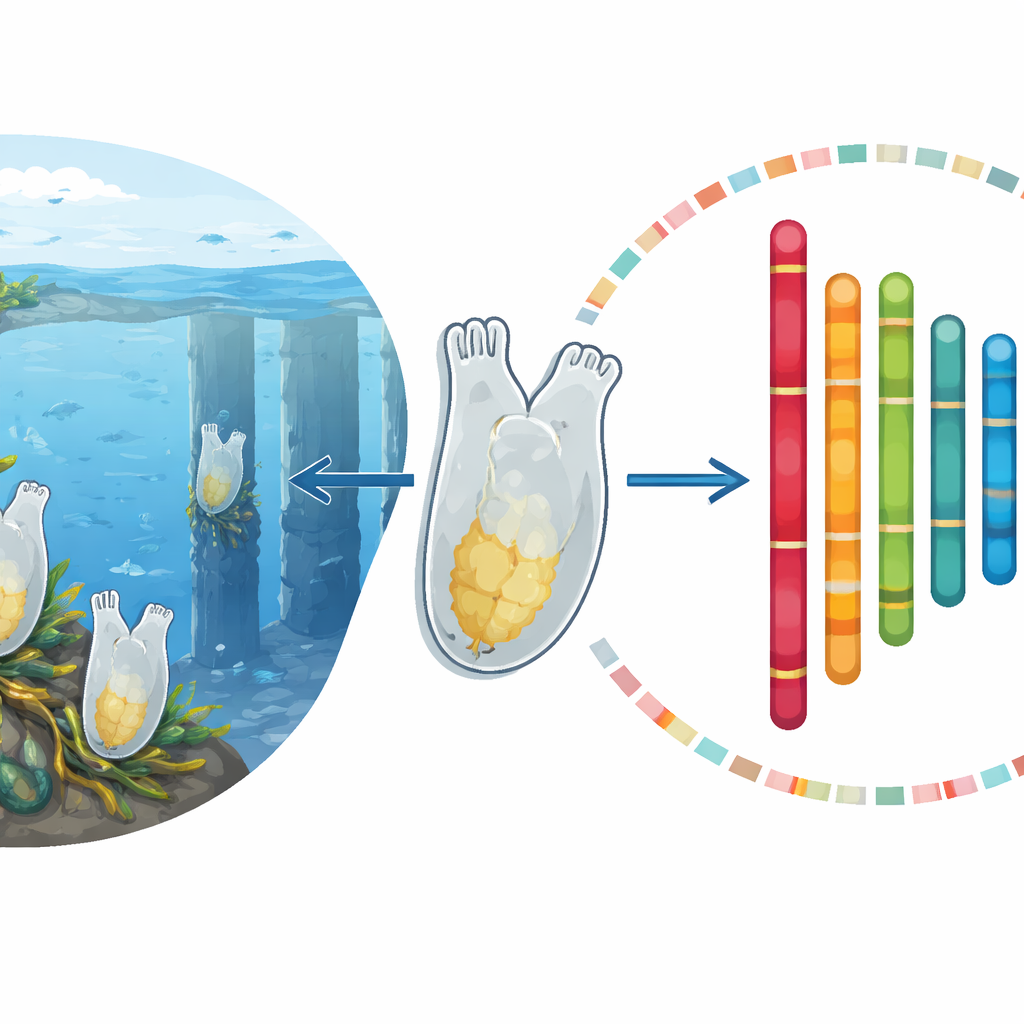
At first glance, the sea squirt Ciona savignyi looks like a simple, bag-shaped animal clinging to docks and ship hulls. Yet this modest creature sits close to the evolutionary root of all backboned animals, including humans. Because it is easy to grow, quick to develop, and remarkably good at invading new environments, Ciona savignyi has become a powerful model for understanding how complex bodies evolve and how life adapts to rapid environmental change. This study delivers a much sharper genetic blueprint for this species, opening the door to more precise work in fields ranging from developmental biology to invasion ecology.
A Simple Animal with a Big Story
Ciona savignyi belongs to the tunicates, the closest invertebrate relatives of vertebrates. Their tadpole-like larvae have a stiff rod and a nerve cord that resemble the early backbone and spinal cord in vertebrate embryos. Because these animals have transparent, fast-developing embryos and compact genomes, they have long served as clean, streamlined systems for probing how complex body plans arise. Many tunicates, including Ciona species, also spread quickly around the globe, tolerating wide swings in temperature and salinity. That makes them natural test cases for studying how organisms cope with the environmental upheavals that now accompany climate change and global trade.
The Need for a Better Genetic Map
Researchers have studied Ciona savignyi for years, but its earlier genome map was fragmented and incomplete. One major reason is that individuals of this species carry an unusually large amount of genetic variation, which makes stitching together DNA fragments technically difficult. The previous reference genome, widely used since 2008, was broken into hundreds of pieces. This limited scientists’ ability to link traits such as stress tolerance, rapid acclimation, or differences among populations to specific stretches of DNA. A clearer, chromosome-scale genome was needed to turn Ciona savignyi into a truly modern genomic model.
Piecing Together the Genome Puzzle
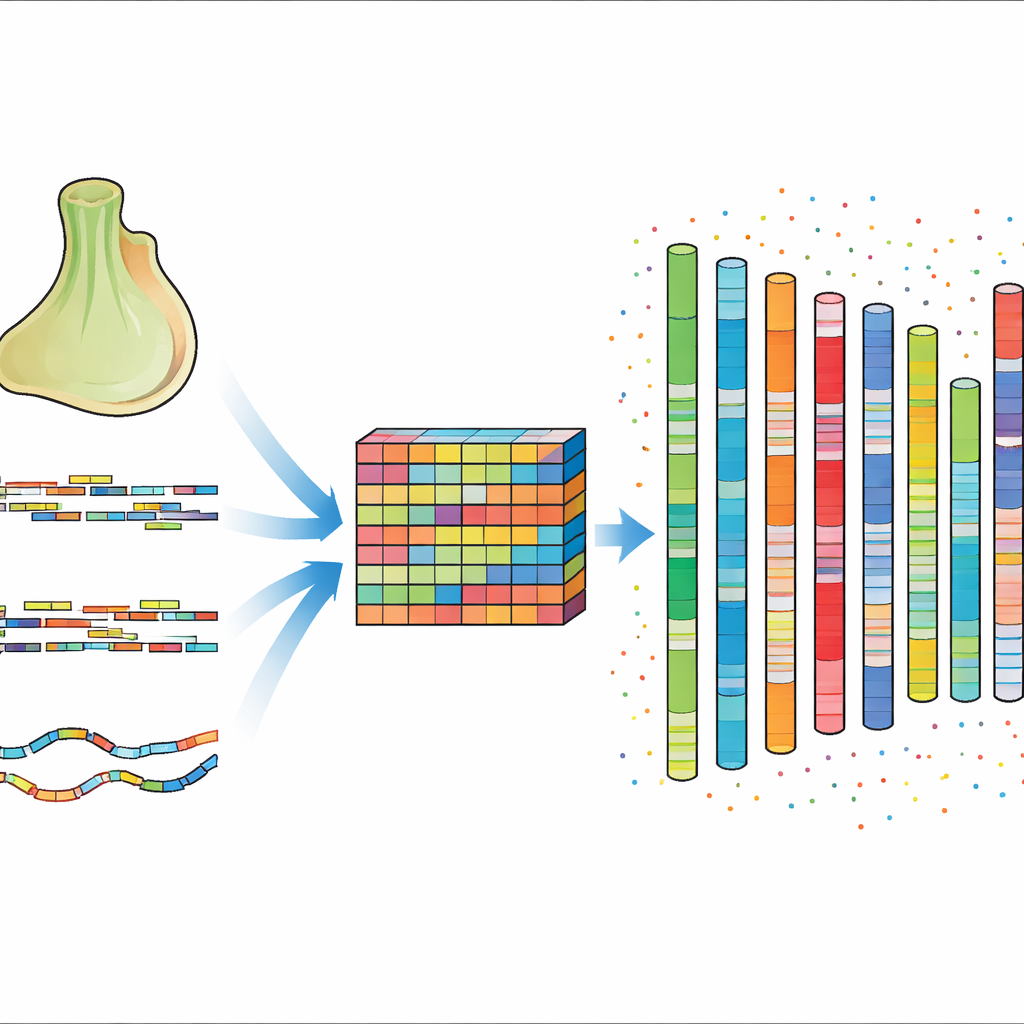
To solve this, the authors combined several cutting-edge sequencing approaches. They used highly accurate short DNA reads to count and characterize the overall content of the genome, long reads to span difficult, repetitive regions, and a technique called Hi-C that reveals which parts of the DNA sit near one another inside the cell nucleus. They also sequenced long stretches of RNA from multiple animals to capture which genes are active and how they are structured. By carefully cleaning, assembling, and polishing these data, then using the Hi-C information to order and orient the pieces, they built a contiguous genome that spans about 200 million DNA letters and is neatly arranged into 13 chromosomes.
What the New Genome Reveals
The improved assembly is not only more continuous, it is also richer in biological detail. Nearly 96 percent of the sequence could be placed on chromosomes, and the typical continuous stretch of assembled DNA is now many times longer than in the previous version. Surprisingly, almost 45 percent of the genome consists of repeated elements, such as mobile DNA segments that can copy and move themselves. The authors identified 15,327 protein-coding genes, with more than 96 percent linked to known or predicted functions through large public databases. They also cataloged thousands of non-coding RNA genes involved in tasks like protein synthesis and gene regulation, providing a deeper view of how this compact genome is organized and controlled.
Why This Resource Changes the Game
For non-specialists, the key takeaway is that scientists now have a far clearer and more reliable map of Ciona savignyi’s DNA. This enables precise comparisons with other chordates to trace how vertebrate features evolved, and it allows researchers to pinpoint genetic changes that underlie the species’ impressive ability to survive new and stressful environments. In practical terms, the new genome assembly turns this humble sea squirt into an even more powerful model for exploring evolution, development, and environmental adaptation—offering insights that ultimately help us understand our own origins and our planet’s rapidly changing seas.
Citation: Huang, X., Zhan, A. An Improved Chromosome-Level Genome Assembly and Comprehensive Annotation of the Model Ascidian Ciona savignyi. Sci Data 13, 617 (2026). https://doi.org/10.1038/s41597-026-06990-1
Keywords: Ciona savignyi, genome assembly, tunicate, environmental adaptation, invasive species