Clear Sky Science · en
Competitive interactions shape mammalian brain network dynamics and computation
Why this matters for understanding the mind
Brains are often pictured as harmonious webs of activity, with regions working together to think, feel and act. But real brains are also full of push and pull: some areas boost each other, while others tug in opposite directions. This study asks how that hidden tug-of-war shapes the way mammal brains — including humans, macaques and mice — actually work, and shows that competition between brain regions is not a bug but a vital feature that makes brain activity more realistic, more individual and more capable of complex computation.
How the brain’s wiring guides cooperation and rivalry
The authors start from a simple puzzle: the brain’s structural wiring diagram, or connectome, mostly tells us where fibers run, not whether those connections act like friendly helpers or opposing rivals. Most large-scale brain models quietly assume that if one connected region becomes more active, it tends to drive its partners up as well. Yet biology is full of competitive interactions — from inhibitory neurons in local circuits to balancing feedback in ecosystems and social networks. The team therefore builds a whole-brain model that can assign each long-range connection a positive (cooperative) or negative (competitive) influence and asks which mix best reproduces the actual activity patterns measured with functional MRI in humans, macaques and mice.
Building virtual brains from real anatomy
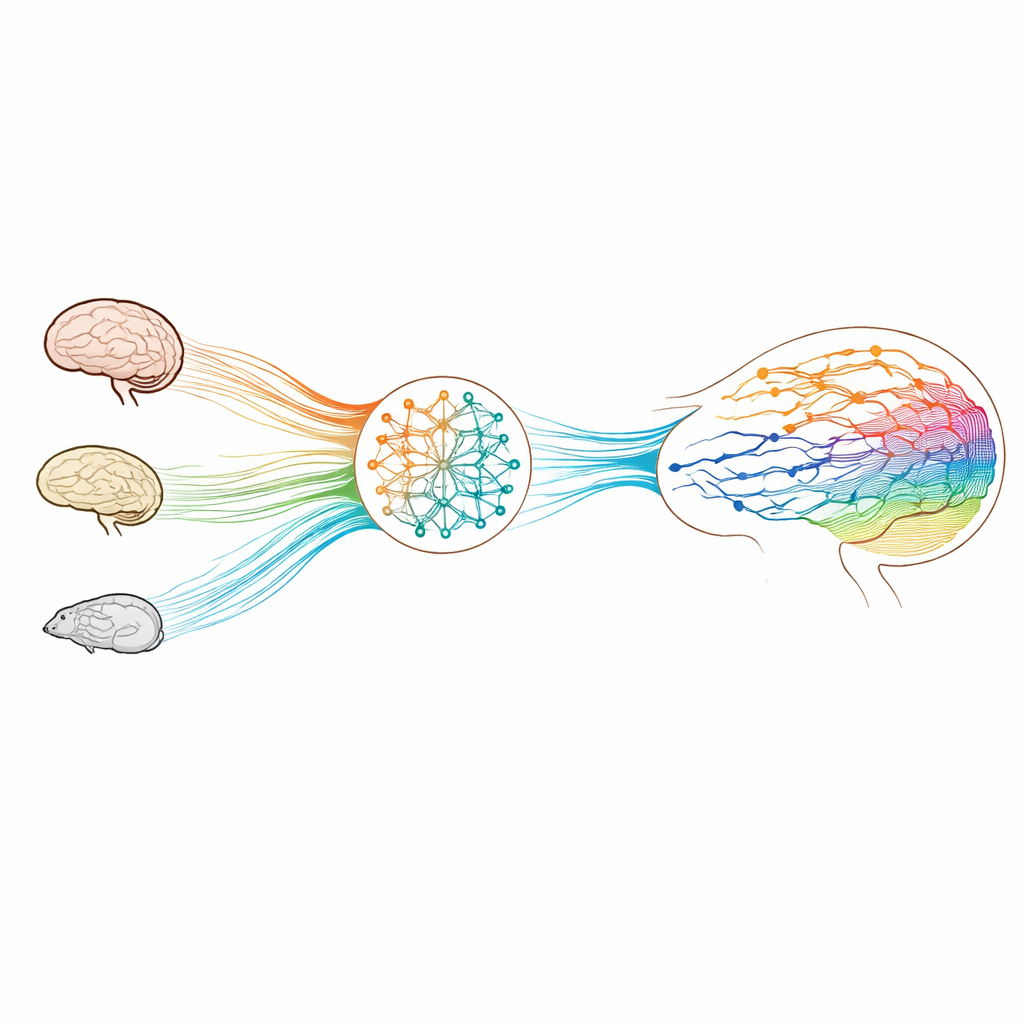
To do this, the researchers use a standard mathematical workhorse in network neuroscience: a set of nonlinear oscillators poised near a tipping point, one per brain region. These oscillators naturally produce fluctuating, rhythm-like signals similar to the slow waves seen in fMRI, neither completely noisy nor perfectly regular. They couple the oscillators according to each species’ structural connections — from human diffusion MRI, macaque data that blend tract tracing and imaging, and pure tract tracing in mice — and then iteratively adjust the strength and sign of those existing links so that the simulated activity matches the observed patterns of co-activation over time. The result is a “generative connectivity” matrix: a functionalized version of the wiring diagram that captures how structure must be weighted to give rise to the living brain’s dynamics.
Competition emerges as a necessary ingredient
When the model is allowed to use negative as well as positive influences, it does so enthusiastically. Across species, roughly a quarter to two-fifths of effective connections become competitive. These negative links are not sprinkled at random: they tend to be weaker, longer-range and less tightly clustered than cooperative ones, forming a diffuse web that crisscrosses more modular positive communities. Removing them quickly degrades how well the model matches real data. With competition included, the similarity between simulated and empirical functional connectivity jumps dramatically, reaching correlations as high as 0.95 in mice and more than doubling in humans compared with a positive-only model. The improved model also produces realistic levels of anticorrelation between regions, matching the widespread “see-saw” patterns long observed in brain scans.
Competition aligns with deep biological differences
The team then asks whether the placement of competitive links reflects deeper biological organization. They compare where negative model connections fall with maps of many cortical features, including cell types, gene expression, receptor distribution, microstructure and myelination. Across humans, macaques and mice, competitive links preferentially join regions that sit on opposite ends of these biological gradients — for example, areas rich in one kind of inhibitory interneuron versus areas rich in another, or highly myelinated sensory zones versus transmodal association cortex. In effect, the large-scale tug-of-war is strongest between cortical territories that are built and tuned very differently, suggesting that macroscale competition is anchored in conserved molecular and cellular contrasts.
Richer dynamics and more individual brains
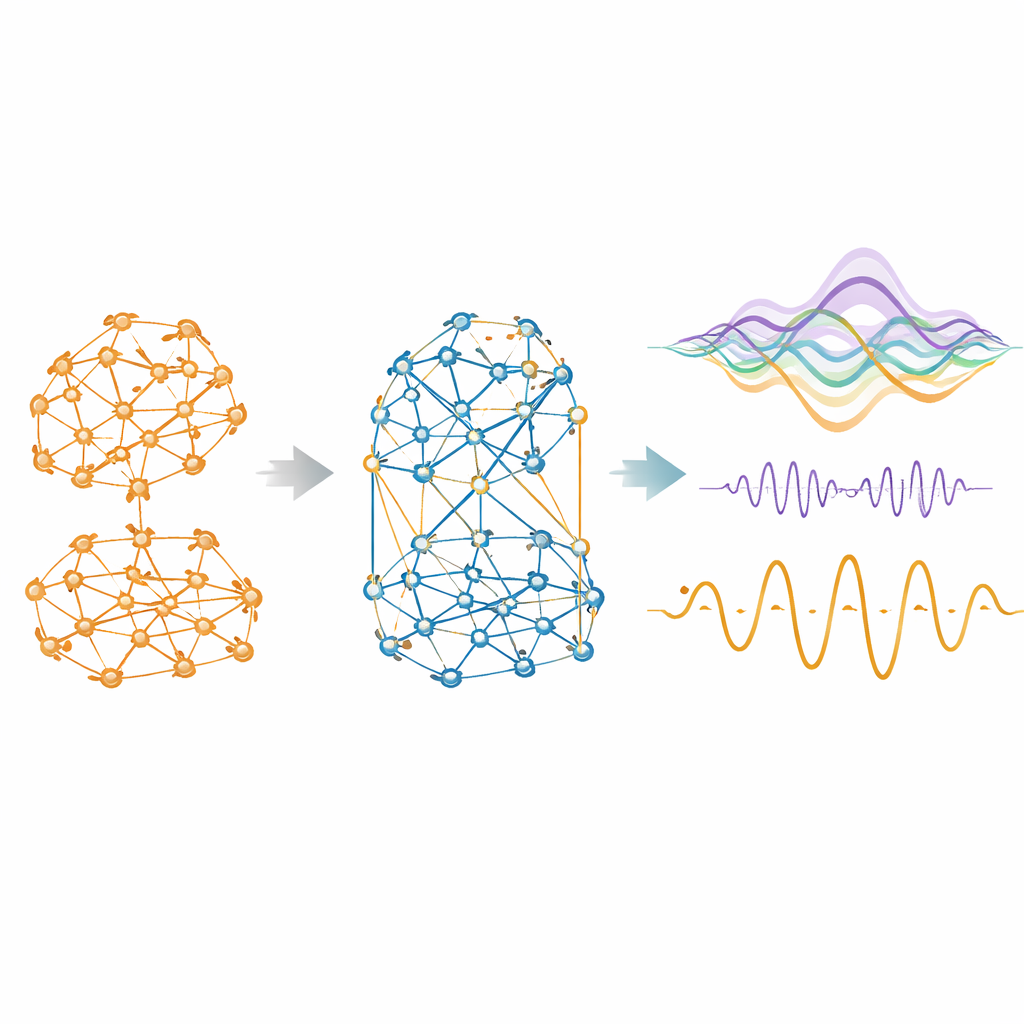
Including competition does more than improve static snapshots of connectivity. When the fitted models are run forward to generate synthetic brain activity, the cooperative–competitive version shows more realistic temporal behavior. It avoids unrealistically high global synchrony, instead wandering through a balanced regime that alternates integration and segregation, a property known as metastability. It also displays stronger hierarchy, where some regions are better positioned to ignite widespread cascades of activity or to send more information than they receive. Measures of synergistic information — the idea that pairs of regions together carry more predictive power than either alone — rise toward empirical levels. Crucially, these improvements were not explicitly targeted during fitting; they emerge naturally once competitive interactions are allowed.
From realistic activity to computation and cognition
Because no two brains are exactly alike, a convincing model must be both faithful and personal. The cooperative–competitive models proved more “fingerprintable”: they fit each individual’s connectivity better than others’ and suffer a larger drop in accuracy when mismatched to the wrong subject, in humans as well as in macaques and mice. For humans, the authors also tested how well instantaneous model activity patterns matched large databases of brain maps linked to specific mental functions, such as attention or memory. Models with competition produced spontaneous patterns that more closely resembled these canonical cognitive circuits, implying more “mind-like” dynamics at rest. Finally, when the model-derived networks were used as the wiring in artificial “reservoir computing” systems performing a memory task, those with competitive links showed higher computational capacity, better retaining past inputs.
What this means for understanding brains and building models
In plain terms, the study shows that the mammalian brain works best on a knife-edge between cooperation and competition. Strong, local positive ties bind nearby regions into specialized modules, while weaker, long-range negative ties pit different systems against each other, structuring information flow across the cortex. This architecture not only reproduces the fine-grained quirks of individual brains, but also naturally yields dynamics that are diverse, hierarchical and computationally powerful. For future brain modeling — whether to understand consciousness, simulate disease or design neuromorphic computers — the message is clear: leaving out large-scale competition means leaving out a core principle of how real brains compute.
Citation: Luppi, A.I., Sanz Perl, Y., Vohryzek, J. et al. Competitive interactions shape mammalian brain network dynamics and computation. Nat Neurosci 29, 915–933 (2026). https://doi.org/10.1038/s41593-026-02205-3
Keywords: brain networks, neural competition, connectome modeling, functional connectivity, neuromorphic computing