Clear Sky Science · en
Dominant clones leverage developmental epigenomic states to drive ependymoma
Why children’s brain tumors start so early
Some of the most challenging childhood brain tumors seem to appear out of nowhere and resist today’s treatments. This study asks a deceptively simple question: why do certain genetic accidents cause aggressive tumors only in young children, and only in very specific parts of the brain? By tracing how the developing brain’s “epigenetic” landscape—its pattern of open and closed DNA—interacts with a powerful cancer-causing gene fusion, the authors uncover how early growth programs are hijacked to seed a lifelong disease.
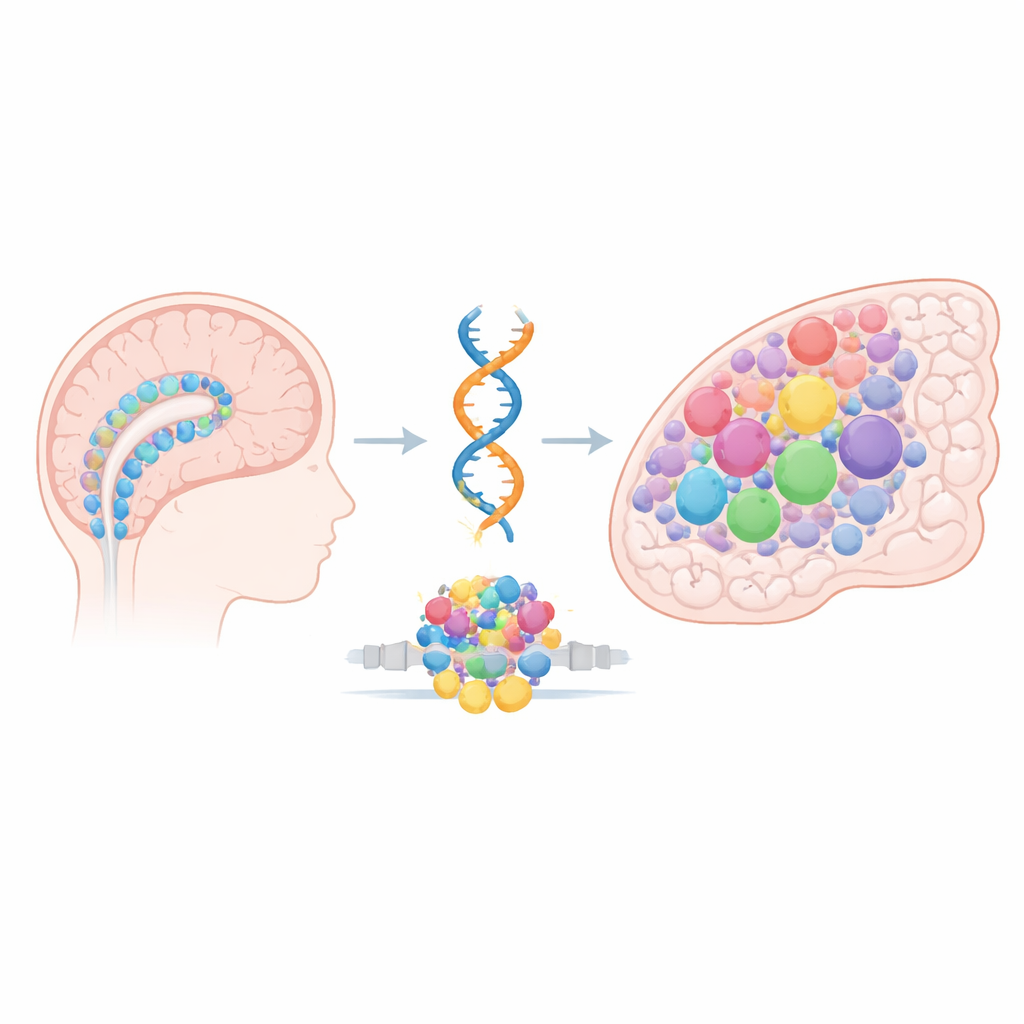
Early brain builders and a dangerous fusion
The team focuses on ependymoma, a pediatric brain tumor that often arises in the cerebral cortex and is notoriously hard to treat. Many of these tumors carry the same genetic glitch: a fusion between two genes called ZFTA and RELA, producing a hybrid protein that can switch on gene programs inappropriately. Yet this fusion, known as ZFTA–RELA, shows up almost exclusively in children and in a narrow brain region. The authors suspected that the answer lies not just in the mutation itself, but in which cells are present—and what their DNA “accessibility map” looks like—when the fusion appears. In the embryonic brain, radial glial cells and other cycling progenitors serve as master builders, giving rise to neurons and support cells. These cells carry temporary epigenetic states that keep many growth and developmental genes poised for action. The study asks whether these short-lived states create a window of special vulnerability to the fusion.
Mapping vulnerable states in the developing brain
To probe that window, the researchers used single-nucleus “multiome” sequencing to read both gene activity and chromatin accessibility in tens of thousands of mouse forebrain cells from mid-gestation to shortly after birth. They found that specific DNA sites recognized by a family of transcription factors called PLAG/L were widely open in radial glial cells and cycling progenitors, but became much less accessible as cells matured into neurons and oligodendrocytes. Using a biochemical screen, they showed that the ZFTA–RELA fusion protein strongly prefers exactly these PLAG/L-type DNA motifs. Strikingly, when they artificially introduced the fusion into purified radial glial cells, global chromatin accessibility barely changed, yet thousands of downstream genes were switched on. This suggests that the fusion does not carve new paths through the genome; instead, it “plugs into” developmental modules that are already open in progenitor cells and repurposes them for oncogenic growth.
From normal development to disordered tumor growth
The authors then modeled ependymoma in mice by introducing the fusion into embryonic cortical progenitors in utero and profiling the resulting tumors with the same multiome approach. These tumors were surprisingly diverse: some cells resembled radial glia or actively cycling progenitors, while others looked more like immature neurons or astrocytes. Unlike a complete developmental block, this pattern reflected an incomplete march along normal differentiation routes. Yet only a small subset of progenitor-like and radial glial–like cells showed strong cell-cycle activity; most differentiated-looking cells carried the fusion’s gene-expression signature but divided rarely. In parallel experiments, forcing the same fusion into more mature oligodendrocyte precursors failed to efficiently trigger tumors, reinforcing the idea that only certain developmental stages with the right open chromatin are truly at risk.
Shared mechanisms across human tumors
When the team examined single cells from human patient tumors—including ZFTA–RELA ependymomas, posterior fossa ependymomas, and related tumors driven by PLAG/L gene fusions—they saw a similar picture. ZFTA–RELA and PLAG/L fusion tumors clustered together by their chromatin landscapes, showing a striking enrichment of PLAG/L-type DNA motifs at accessible regions, even though the exact genes switched on could differ. Within ZFTA–RELA tumors, malignant cells again spanned a range of states, from progenitor-like to neuronal-like, astrocyte-like, and ependymal-like, with PLAG/L motif activity remaining high even in cells that should normally have “closed” these developmental modules. This persistence of an embryonic epigenetic program into later cell types appears to be a central unifying theme.
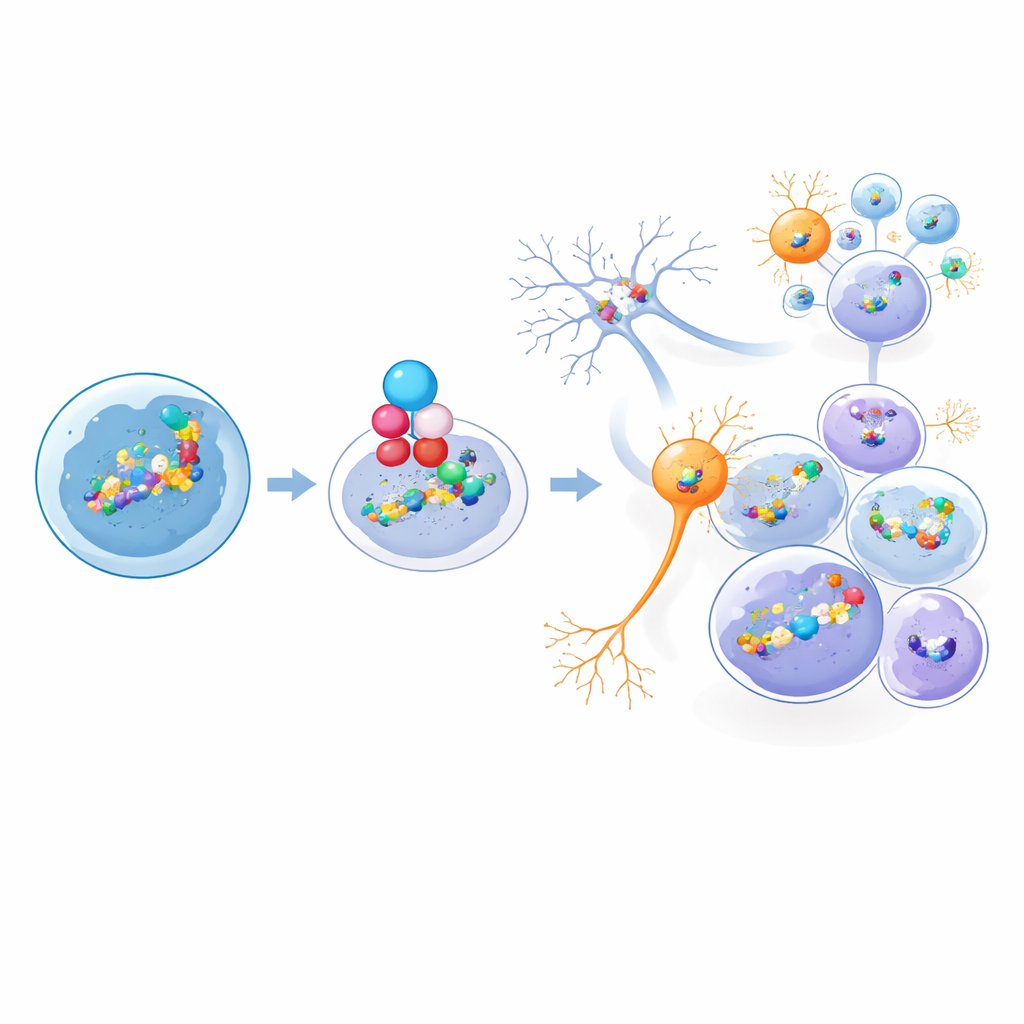
How a few clones shape the whole tumor
To understand how this diversity arises over time, the researchers used a barcoding system that tags individual cells in the embryonic mouse brain before tumors form. Tracking these barcodes into full-blown tumors revealed that, although many transformed cells appear early, a single or very small number of “dominant” clones typically overtake the lesion. Importantly, those dominant clones give rise to the entire range of tumor cell types, from proliferative progenitor-like cells to more quiescent neuronal- and astrocyte-like cells. Computational “pseudotime” analyses in both mouse and human samples support a hierarchy in which a minority of cycling progenitor-like cells sit at the top and feed into these diverse, largely non-dividing branches.
What this means for children with ependymoma
Taken together, the work shows that a childhood brain tumor can arise not simply because of a potent mutation, but because that mutation lands in a cell whose developmental epigenetic state is primed to be hijacked. The ZFTA–RELA fusion latches onto PLAG/L-controlled DNA modules that are normally active only briefly in early progenitors, keeping growth-promoting genes switched on as cells attempt to mature. A few early clones that exploit this vulnerability then expand and generate a complex but largely non-cycling tumor ecosystem, which may help explain why standard, division-targeting therapies often fail. By pinpointing the specific developmental states and chromatin modules at risk, this study suggests new strategies that either close these epigenetic windows or push malignant progenitors to fully differentiate and exit the cell cycle.
Citation: Kardian, A.S., Sun, H., Ippagunta, S. et al. Dominant clones leverage developmental epigenomic states to drive ependymoma. Nature 652, 1027–1037 (2026). https://doi.org/10.1038/s41586-026-10270-8
Keywords: pediatric brain tumors, ependymoma, epigenetic states, gene fusion, radial glial cells