Clear Sky Science · en
The hydrodynamic torque dipole from rotary bacterial flagella powers symmetric discs
Tiny Swimmers That Can Turn Tiny Gears
At first glance, a cloud of swimming bacteria looks like aimless chaos. This study reveals that, under the right conditions, those microbes can do something surprisingly orderly: they can make perfectly round, symmetric discs spin in a chosen direction without ever pushing directly on their edges. The work shows how the twisting motion of bacterial tails can be harvested as a new kind of microscopic power source, with possible implications for smart materials, tiny machines and how bacteria move through tight spaces in nature.
How Bacteria Move and Stir Their Surroundings
Motile bacteria such as Escherichia coli propel themselves with rotary motors that spin long, flexible tails called flagella. At the scale of a few micrometres, water behaves like thick syrup: nothing coasts, and to keep moving, a cell must constantly push on the fluid. For years, physicists have described swimming microbes mainly by how they pull or push fluid along their direction of motion, a picture that explains effects such as enhanced diffusion of nearby particles and even "superfluid"-like behaviour of dense microbial soups. But this standard view largely ignores another feature of the motion: because the flagellar bundle spins one way and the cell body spins the other to balance the overall torque, each bacterium also acts like a tiny pair of counter-rotating stirrers.
From Random Collisions to Controlled Spinning
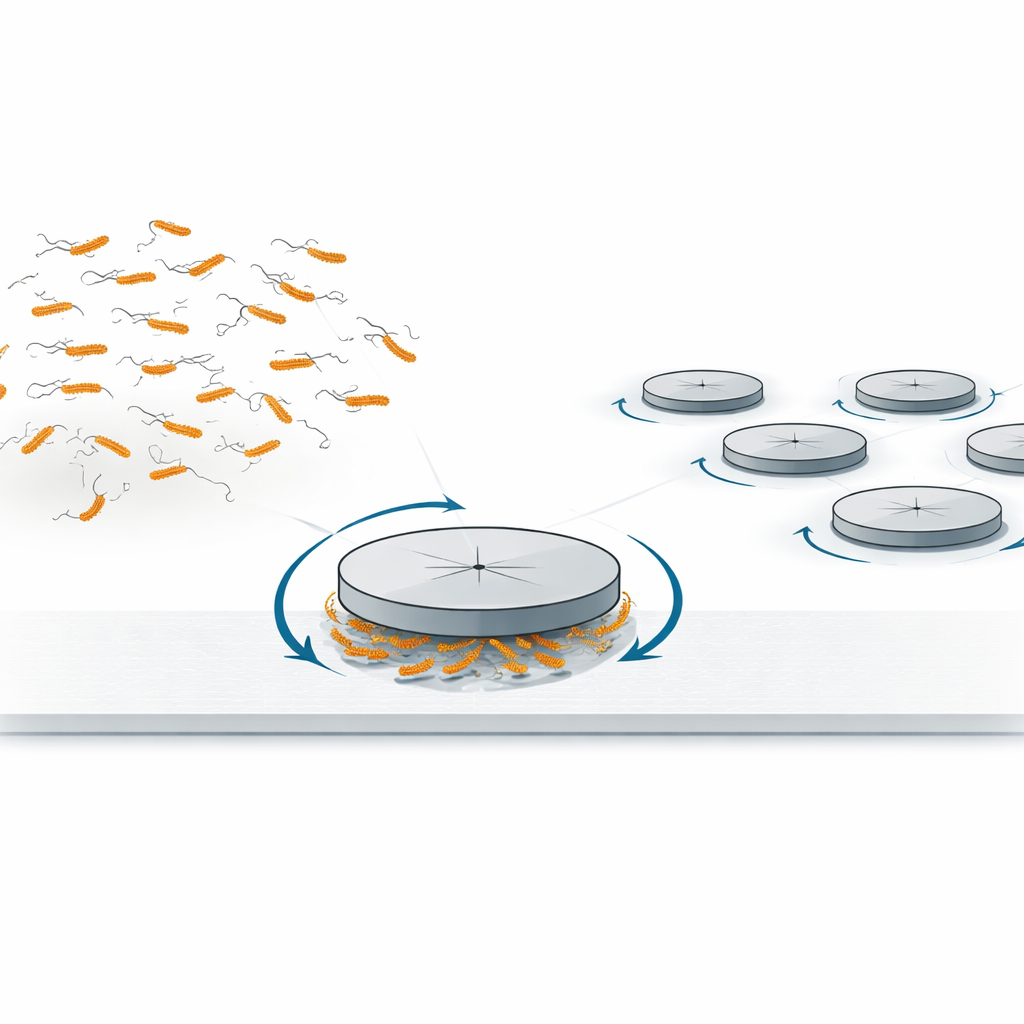
The authors first revisited a more familiar effect: when smooth discs, or "pucks", were placed on the bottom wall of a narrow glass chamber filled with a dense suspension of swimming bacteria, collisions of bacteria with the disc edges made the pucks rotate slowly clockwise. This behaviour had been seen before with irregularly shaped aggregates, and can be explained by the fact that near a solid surface E. coli naturally swim along curved, clockwise paths. Those curved trajectories lead to slightly more kicks in one rotational direction than the other, producing a gentle net torque on the perimeter of the disc. The team measured how the rotation rate depended on disc size and showed it scaled as expected for this edge-collision mechanism, confirming that simple impacts with swimming bacteria can set symmetric objects spinning.
Confining Single Bacteria Under a Disc
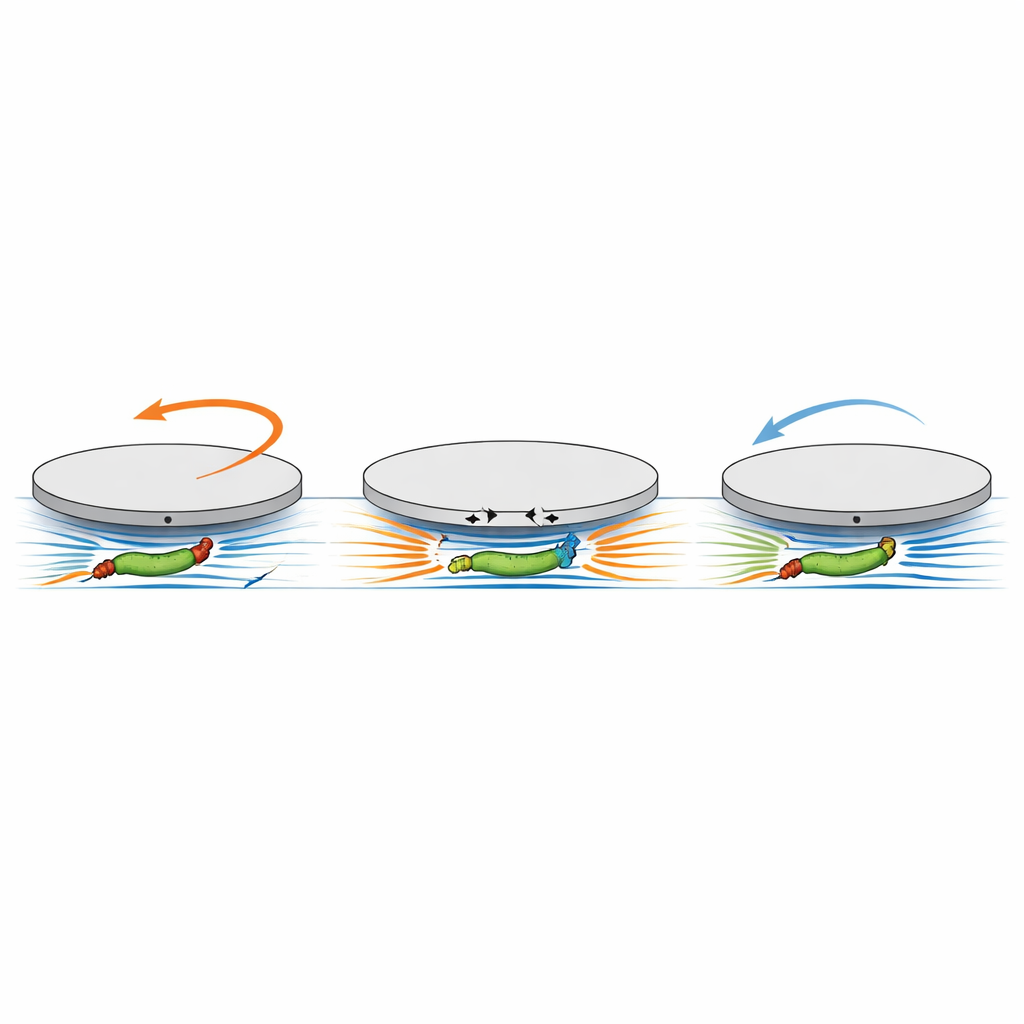
To probe a more subtle source of motion, the researchers used high-resolution 3D printing to sculpt discs with narrow underground passageways only a few micrometres high and wide. In one design, four short radial chambers ended just shy of the disc centre; in another, a straight channel ran right across the disc, open at both ends. These features were oriented facing down, so bacteria swimming along the bottom surface could occasionally enter and become tightly confined beneath a puck. Because the channels were so narrow, bacteria could not easily turn around or slide past the walls in a way that would simply push on a dead-end. Yet, once a single cell entered a radial chamber, the disc’s rotation rate jumped by an order of magnitude, always in the same (clockwise) direction, and increased further as more chambers were filled. Even when the channels were open at both ends—so there was no wall to push against—the passage of a single bacterium across the disc produced a characteristic "down–up" change in the disc’s angle: it first turned one way and then the other as the cell exited. Crucially, this pattern did not depend on whether the bacterium swam left-to-right or right-to-left, ruling out simple pushing as the cause.
A Hidden Torque That Grabs the Disc
To explain these puzzling observations, the team built a hydrodynamic model that focused on the twisting, rather than the straight-line, action of the bacterial motor. In the model, the spinning cell body and counter-spinning flagellar bundle are treated as two tiny sources of rotational motion in the fluid, separated by a distance comparable to the cell length. When this pair sits inside a narrow channel just beneath the disc, the rotating flows they generate drag on the top wall of the channel—the underside of the disc—in opposite directions at slightly different positions. Because these two traction patterns are offset along the channel, they do not cancel perfectly. Instead, they combine to exert a net torque that tends to spin the entire disc. The calculations show that this torque is independent of the cell’s swimming direction and scales with the effective spacing between body and flagella, which in turn grows with cell length. The model reproduces both the initial clockwise turning when body and flagella are under the disc together, and the later reversal when only one of them remains in the channel as the cell leaves.
Toward Chiral Fluids and Microbial Machines
By comparing measurements with their model, the authors conclude that the rotary motors of E. coli act as "torque dipoles" that can transmit twisting motion through a fluid to nearby objects without direct contact or shape asymmetry. Confinement—here, the narrow channels under the discs—is what converts that local twisting into a persistent, directional spin. When many such pucks are placed in a bacterial bath, they can form a collection of identical rotors all turning the same way, a step toward "chiral" fluids whose bulk behaviour depends on an overall sense of twist. Beyond offering a new way to design microscopic machines powered by living cells, this mechanism may matter wherever bacteria with rotary flagella move through crowded or porous environments, such as soils, biofilms or engineered filters, subtly coupling their own navigation to the motion of their surroundings.
Citation: Grober, D., Dhar, T., Saintillan, D. et al. The hydrodynamic torque dipole from rotary bacterial flagella powers symmetric discs. Nat. Phys. 22, 620–627 (2026). https://doi.org/10.1038/s41567-026-03189-4
Keywords: bacterial motility, microfluidics, active matter, microswimmers, micro-robots