Clear Sky Science · en
Entrained debris records regrowth of the Greenland Ice Sheet after the last interglacial
Hidden clues in Greenland’s ice
Deep inside the Greenland Ice Sheet, scientists have found buried evidence that tells a story about how the ice sheet shrank and then grew back after a past warm period. By reading these clues, researchers can better understand how Greenland responded to natural warming in the past, and what that might mean for sea level and ice loss in a warming world today.
Strange structures under the surface
Most of Greenland’s ice is neatly layered, with thin, smooth sheets of snow and ice stacked over hundreds of thousands of years. In northern Greenland, however, radar images reveal huge, disturbed features deep in the ice. These features bend and twist the otherwise tidy layers and rise more than a kilometer above the bedrock. For years, scientists debated whether they were simply folds in normal ice or zones where meltwater had refrozen at the base. The new study set out to determine what these mysterious structures are actually made of.
Listening to echoes in three dimensions
To probe these buried features, the team used advanced ice-penetrating radar flown on aircraft. The system sends out radio waves and records how they bounce back from different depths. By processing the returning signals from many angles, the researchers built three-dimensional “swath” images that capture not just where layers are, but how strongly they scatter the radar energy. They found two distinct types of echoes in the deep ice. One is relatively weak and fuzzy, likely linked to subtle changes in ice crystals. The other is very bright and diffuse, coming from narrow horizons that scatter energy over a wide range of angles, even more strongly than the reflection from the bottom of the ice sheet.
Debris trains and a moving, messy base
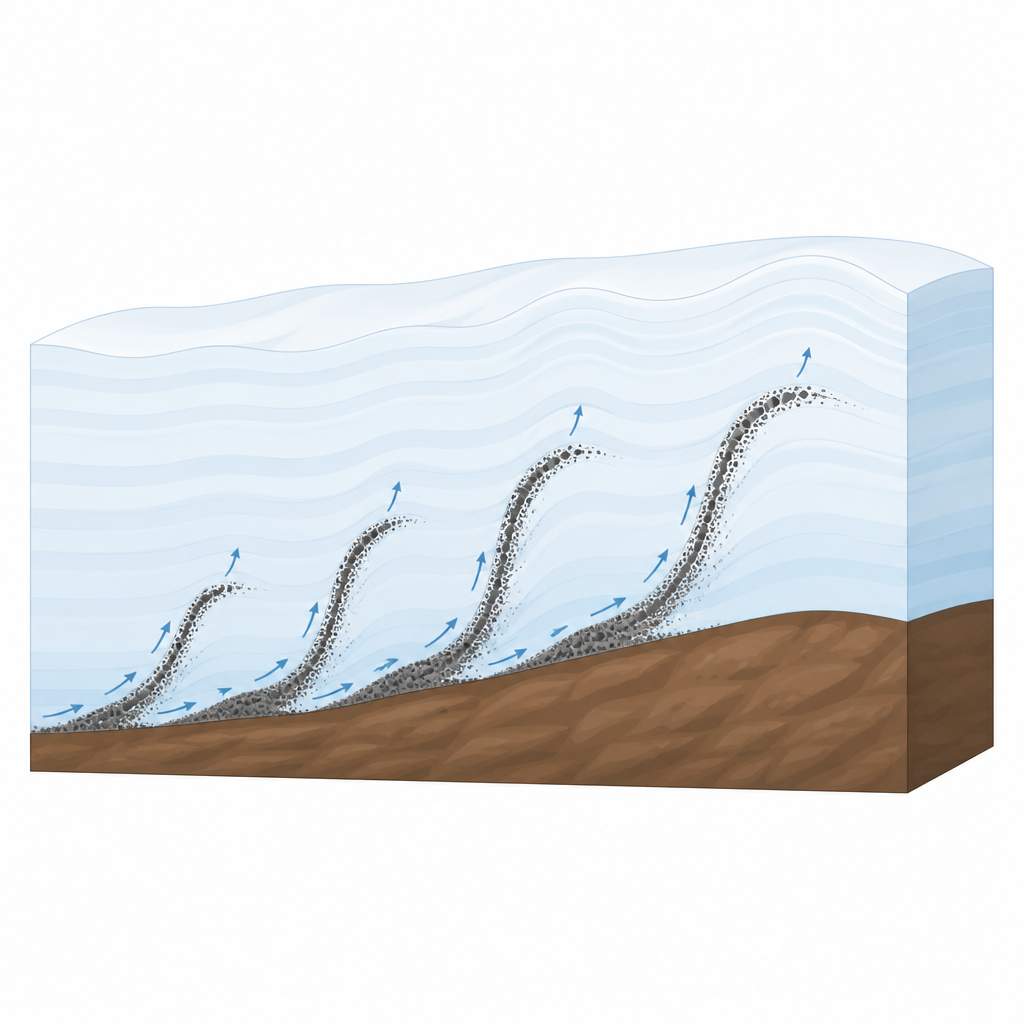
The strongest echoes match what would be expected if bands of rock and sediment were frozen into the ice, rather than pure ice alone. The authors argue that these bright horizons are “debris trains” made of material scraped from the bed and carried upward into the ice interior. Where these debris trains occur, the nearby layers steepen and change slope, showing that the mixtures of ice and rock locally weaken the ice and focus deformation there. Surprisingly, such debris-rich structures are widespread across northern Greenland, but are largely absent in similar settings in Antarctica and in southern Greenland, hinting that they formed under special conditions that no longer exist.
A record of past retreat and regrowth
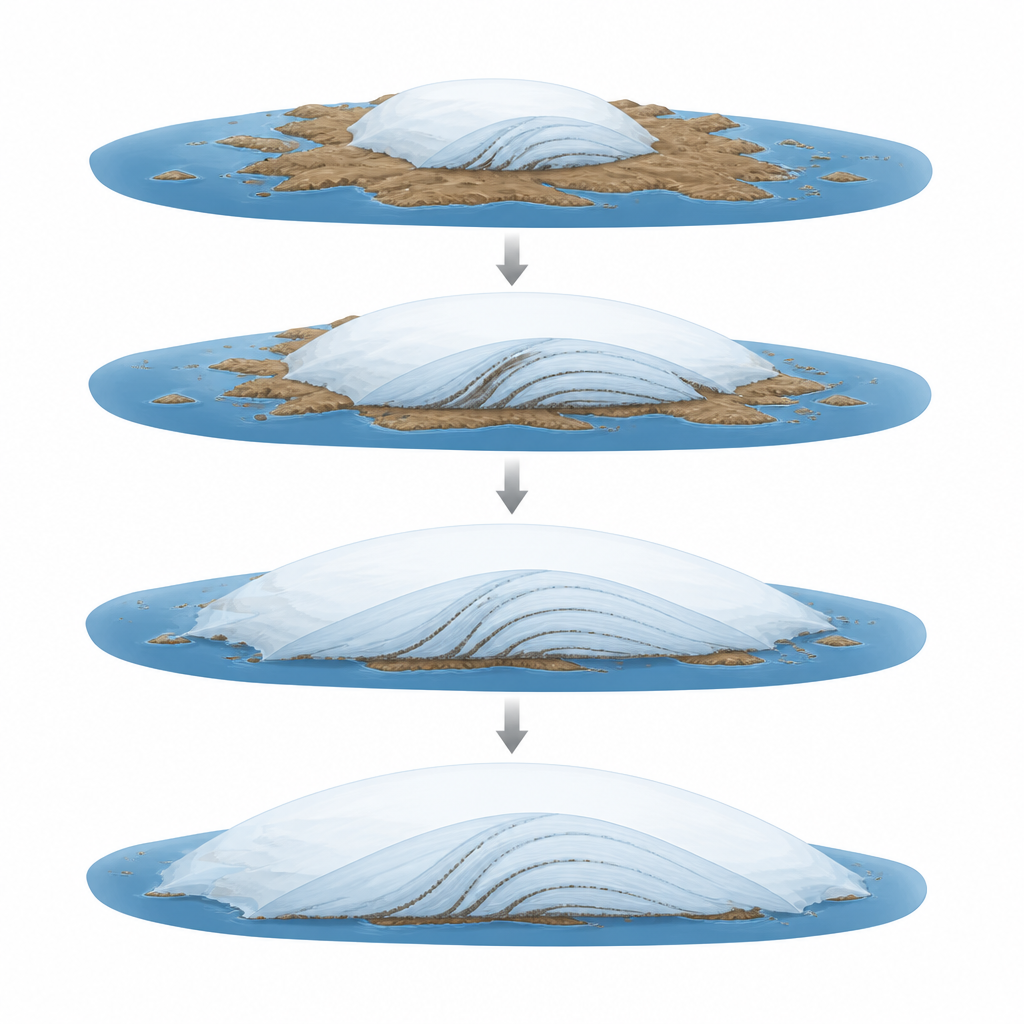
To explain this pattern, the researchers link the debris trains to a key moment in Greenland’s history, about 120,000 years ago during the last interglacial period. At that time, warmer air led to strong surface melt and thinning of the ice sheet, shrinking it toward a smaller, warmer core. As the climate cooled again and snowfall increased, thin, cold ice grew outward from this core over land that had been deglaciated. This set up sharp transitions between warm, sliding ice in the interior and cold, sluggish ice at the margins. Along these boundaries, ice and rock at the base could be pushed upward along internal planes, or possibly frozen on from meltwater, forming the debris trains now seen high in the ice column. The presence and distribution of these structures suggest that northern Greenland’s ice sheet was much reduced during that warm period and then advanced again in a surge-like way.
Why these buried bands matter today
These debris-filled zones are more than historical curiosities. Because they weaken the surrounding ice and change how it deforms, they affect how stress is shared between ice sliding over bedrock and ice flowing internally. Most ice-sheet models assume that ice properties depend mainly on temperature and are uniform at depth. The study shows that this is too simple for northern Greenland, where hidden debris and reorganized ice fabrics make some zones flow more easily than others. Ignoring this complexity can lead models to assign the wrong amount of friction at the base and to misjudge how sensitive the ice will be to future changes. The work also points to promising places to drill for very old ice that may preserve repeated snapshots of Greenland’s climate as the ice sheet retreated and regrew.
A simple picture of the findings
In everyday terms, the study reveals that Greenland’s ice is not a clean, even cake of frozen water, but a layered dessert streaked with buried bands of rock and dirt left behind by past changes. Those bands likely formed when a smaller, warmer ice sheet grew outward into colder regions, pushing and lifting debris from the bottom into the middle of the ice. These hidden features record how Greenland recovered after a natural warm spell and quietly shape how the ice moves today, offering important context for predicting how the ice sheet and sea level may respond to ongoing climate change.
Citation: Holschuh, N., Christianson, K., Dienstfrey, W. et al. Entrained debris records regrowth of the Greenland Ice Sheet after the last interglacial. Nat. Geosci. 19, 573–580 (2026). https://doi.org/10.1038/s41561-026-01950-1
Keywords: Greenland Ice Sheet, englacial debris, last interglacial, ice sheet dynamics, radar sounding