Clear Sky Science · en
Population discontinuity in the Paris Basin linked to evidence of the Neolithic decline
When Ancient Tombs Fell Silent
Across northwestern Europe, thousands of stone tombs from the Stone Age suddenly stopped being built and used around 3000 BC. Archaeologists have long wondered whether this "Neolithic decline" reflected a simple change in customs or something more dramatic, like disease, environmental damage or large-scale migration. This study zooms in on one remarkable tomb near Paris to show that its long pause in use hides a story of population collapse, newcomers from the south and even traces of early plague.
A Stone Monument with Two Histories
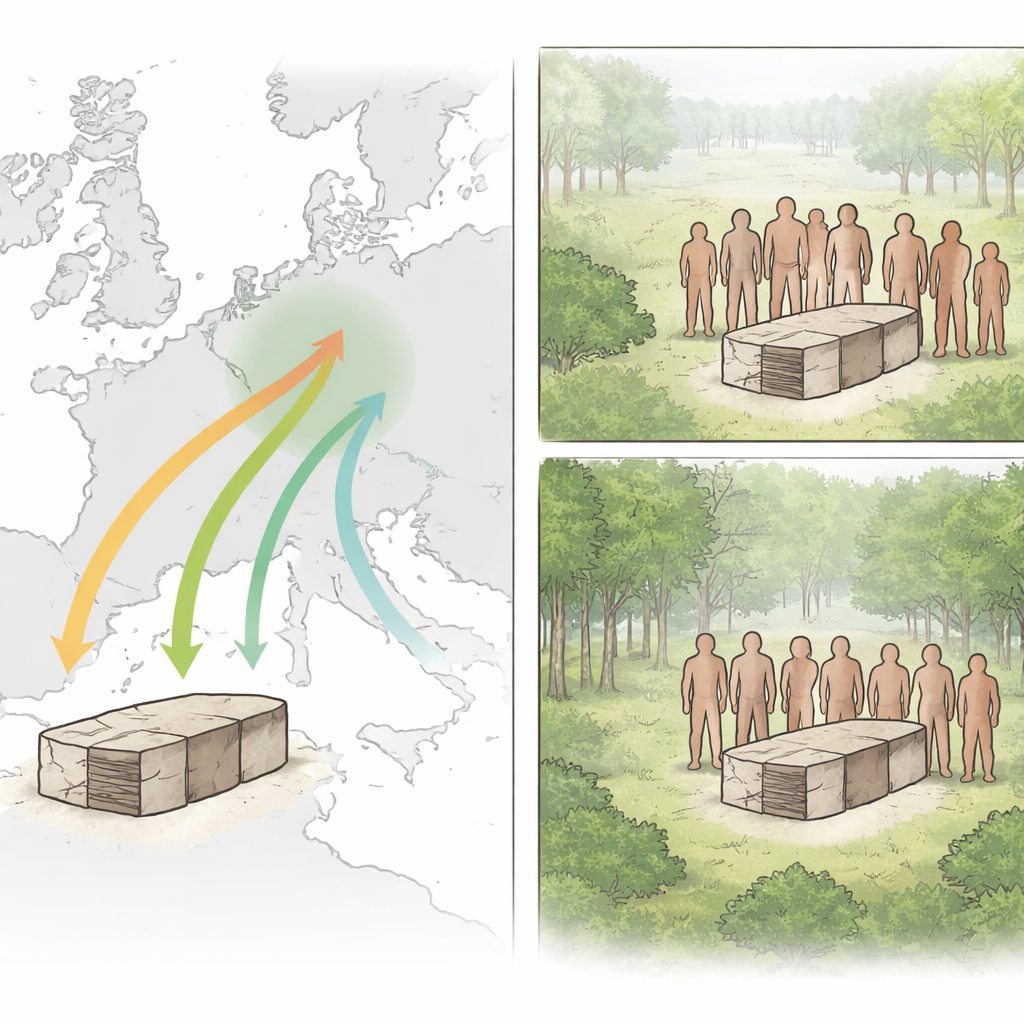
The Bury grave, about 50 kilometers north of Paris, is a long, semi-underground stone chamber that held the remains of more than 300 people. Careful excavation showed that it was used in two main phases separated by a gap of several centuries. In the first phase, near the end of the fourth millennium BC, bodies were laid out stretched along the axis of the tomb. In the second phase, in the third millennium BC, people were buried in more cramped, flexed positions with no preferred orientation. The break between these phases coincides with the broader Neolithic decline, when megalith building and burial in such collective tombs faded across much of northern and western Europe.
Reading Family Ties in Ancient DNA
To uncover what happened at Bury, the researchers extracted DNA from the teeth of 182 individuals and reconstructed 132 ancient genomes. This allowed them to determine biological sex, family relationships and broader ancestry. In both phases, males greatly outnumber females in the tomb, suggesting that women and men were treated differently in death and that many women were buried elsewhere. In Phase 1, most of the people interred belonged to a few large extended families stretching over several generations, with many full siblings and cousins buried together. In Phase 2, by contrast, the team found smaller, narrower family lines and many more people who were not close biological relatives, hinting at a change from broad community burials to a more selective, perhaps more socially defined use of the monument.
Two Populations, Not One Long Story
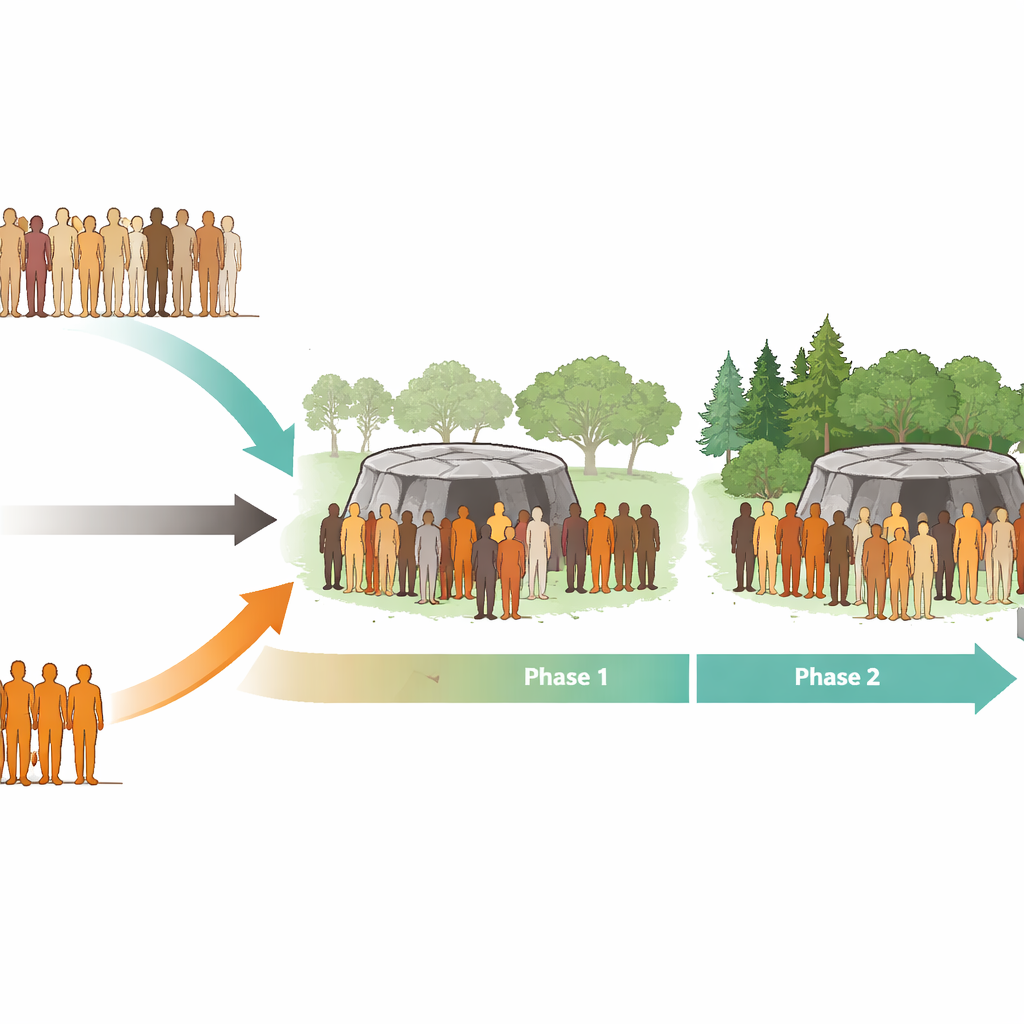
When the Bury genomes were compared to thousands of other ancient Europeans, all individuals fell within the broad spectrum of Neolithic farming populations, but the two phases looked strikingly different. People in Phase 1 showed a mix of ancestries typical of earlier farmers in the Paris Basin and central Europe, with some carrying extra ancestry linked to local hunter-gatherers. People in Phase 2 formed a much tighter group and shared most of their ancestry with Neolithic communities from Iberia and southern France. Statistical analyses of shared DNA segments between individuals showed that the Phase 1 and Phase 2 groups were more closely related to different external populations than to each other, and computer simulations ruled out a simple "same people over time" scenario. Instead, the data point to a substantial population turnover: the original local community largely disappeared and was replaced or heavily reshaped by incoming groups from the southwest after about 2900 BC.
Illness, Forests and the Human Footprint
The genetic data also preserve traces of microbes that once infected these people. Among them, the team identified DNA from an early form of Yersinia pestis, the bacterium that later caused famous plague pandemics, along with other disease agents such as the cause of louse-borne relapsing fever. Plague appears in three individuals from Phase 1 and only one from Phase 2, but its overall frequency is low and the cases are scattered through the family trees, suggesting it was present rather than clearly driving a mass die-off at the site. To look beyond the tomb, the authors examined pollen records from the Paris Basin and nearby regions. Around the same time as the break between the two burial phases, the vegetation record shows forests growing back where open fields and pastures had been, a pattern usually linked to a sharp fall in human activity and abandonment of farmland.
How One Tomb Illuminates a Wider Collapse
By combining strands of evidence—from the layout of a single grave and the kin ties of its occupants to genetic ancestry, ancient pathogens and regional vegetation—the study shows that the Bury monument did not simply evolve gradually with one continuous community. Instead, there was a real break: an earlier, densely settled farming population suffered a contraction, fields were reclaimed by trees and, after a pause, a different group with roots in Iberia and southern France moved into the region and eventually reused the tomb under new rules. Later still, people carrying steppe ancestry arrived and mixed with this second population. For a lay reader, the key message is that sudden quiet in the archaeological record often signals deep human upheaval. In the case of the Paris Basin, that silence marks a complex episode of environmental strain, disease and migration that reshaped who lived there long before written history began.
Citation: Seersholm, F.V., Ramsøe, A., Cao, J. et al. Population discontinuity in the Paris Basin linked to evidence of the Neolithic decline. Nat Ecol Evol 10, 677–688 (2026). https://doi.org/10.1038/s41559-026-03027-z
Keywords: Neolithic decline, ancient DNA, population turnover, megalithic tombs, prehistoric epidemics