Clear Sky Science · en
Subsidence more than doubles sea-level rise today along densely populated coasts
Why sinking coasts matter for everyday life
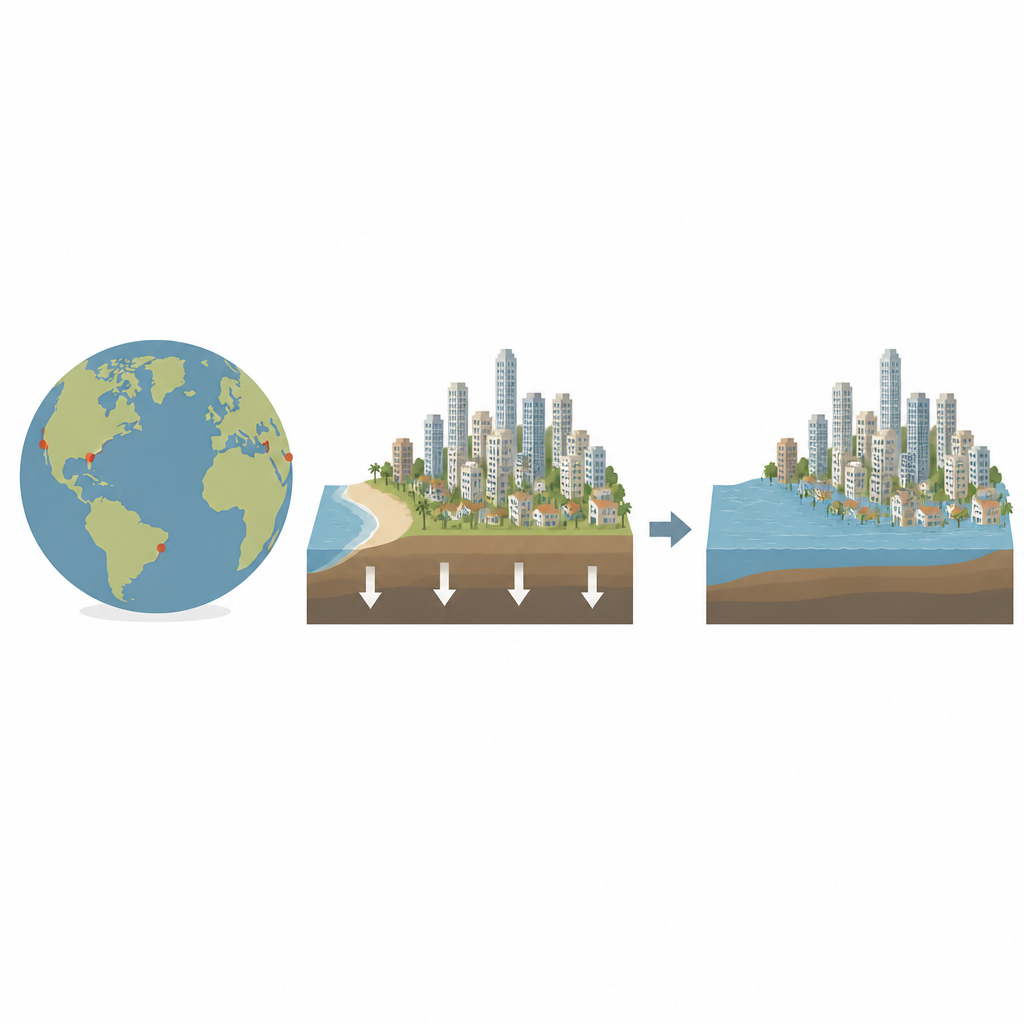
Many people living near the sea worry about rising oceans caused by climate change. This study shows that for hundreds of millions of coastal residents, the ground beneath their feet is quietly sinking at the same time. When land goes down while water goes up, the local rise in sea level that people actually feel can be roughly twice what global climate models suggest. Understanding this hidden sinking is crucial for planning defenses, insurance, and where it is safe to build homes and cities.
Where people live, the land often sinks
The researchers looked at coastlines worldwide and focused on places where people live less than 10 meters above sea level. They found that 71 percent of this coastal population lives in areas where the land is dropping rather than lifting. Big cities and river deltas in East, South, and Southeast Asia, as well as in parts of Africa and North America, stand out as hot spots. In cities like Jakarta, Tianjin, Bangkok, Lagos, and Alexandria, some neighborhoods are sinking by several millimeters each year, far faster than the global average rise of the ocean. This combination greatly increases the risk of flooding, even without storms.
New tools reveal a sharper picture
Earlier global studies knew that sinking land worsened sea level rise, but they relied heavily on scattered local reports and expert judgment. Those estimates often treated whole cities or large deltas as if they moved at a single, uniform rate. In this work, the authors combined several modern measuring techniques to see land motion in much finer detail. They used satellite radar that detects tiny vertical shifts of buildings and ground, satellite measurements of the sea surface, tide gauges at the shore, and networks of GPS receivers that track slow changes in Earth’s crust. Together, these data now cover about 65 percent of the coastal population and can resolve variations over just a few city blocks.
How much faster the sea is rising where people live
By merging land motion with satellite records of ocean height, the team calculated how quickly the sea is rising relative to the land for coastal residents between 1995 and 2020. On average, the global ocean rose by a bit more than 3 millimeters per year during this period. But when they weighed the numbers by where people actually live, the typical coastal resident experienced about 6 millimeters per year of rise relative to the land. In other words, subsidence now adds nearly as much to the sea level problem as climate-driven ocean change itself. In countries such as Thailand, Bangladesh, Nigeria, Egypt, China, and Indonesia, people in low-lying zones are seeing local sea levels climb by 7 to 10 millimeters per year on average.
Why the land is sinking and why it is hard to predict
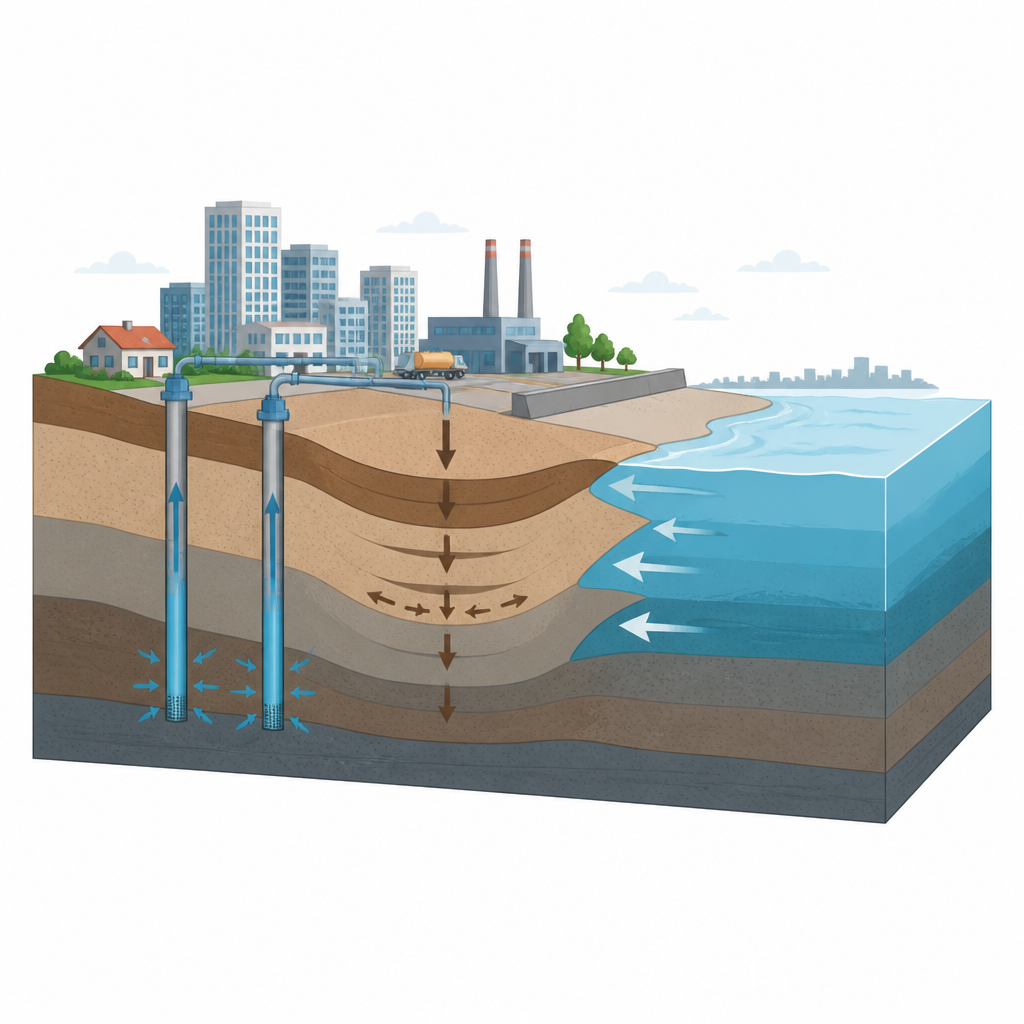
Land can move up or down for many reasons. Natural causes include the slow rebound of Earth’s crust since the last ice age, motion along faults, and the weight of sediments and water. In many densely settled coasts, however, human activities dominate. Pumping groundwater, extracting oil and gas, draining wetlands, and loading cities with heavy buildings all squeeze the ground, making it compact and sink. These processes can change over time as pumping or building practices shift, making future sinking hard to forecast from short records. The study also notes that current measurements have gaps, especially in parts of Asia and Africa, and that different tools see different depths in the ground, so some shallow sinking may still be missed.
What this means for coastal decisions
The authors conclude that about half of the sea level rise experienced by coastal populations today is due to sinking land rather than rising water alone. For planners and communities, this means that simply using global sea level projections can seriously understate local risk. The study argues that improved, shared monitoring of land motion, especially in rapidly growing cities and major river deltas, is essential for realistic risk assessments. Because a large part of the sinking is caused by human choices, such as groundwater use, better management can slow or even partly reverse this hidden driver of rising seas, buying valuable time for coastal adaptation.
Citation: Oelsmann, J., Nicholls, R.J., Lincke, D. et al. Subsidence more than doubles sea-level rise today along densely populated coasts. Nat Commun 17, 4382 (2026). https://doi.org/10.1038/s41467-026-72293-z
Keywords: sea-level rise, land subsidence, coastal cities, river deltas, groundwater extraction