Clear Sky Science · en
Single cell transcriptional evolution of myeloid leukemia of Down syndrome
Why this research matters for families
Children with Down syndrome face a much higher risk of developing a rare blood cancer called myeloid leukemia of Down syndrome (ML-DS). Before this leukemia appears, many babies go through a short-lived pre-cancerous phase that often clears on its own. Understanding why some children progress to full leukemia while others do not is crucial for earlier diagnosis, gentler treatments, and possibly preventing cancer altogether. This study uses powerful single-cell genetic tools to watch, in fine detail, how normal blood cells in Down syndrome gradually change into leukemia cells.
From extra chromosome to early warning phase
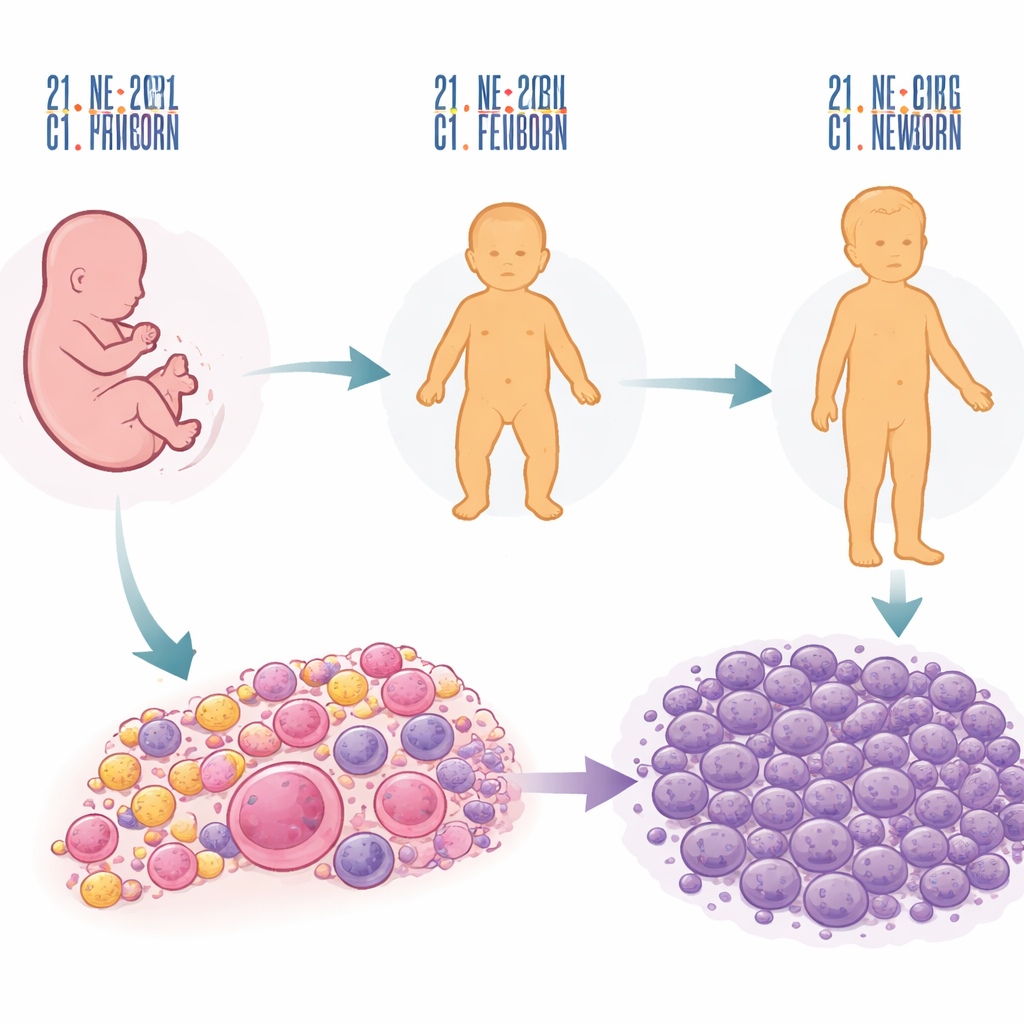
The story begins with the extra copy of chromosome 21 that causes Down syndrome. This extra chromosome subtly reshapes blood formation in the fetus, especially in the liver, where early blood cells are made. By comparing fetal liver samples with normal and abnormal chromosome patterns, the researchers found that trisomy 21 shifts the balance of developing blood cells: cells that will become platelets and red blood cells expand, while early B cells are reduced. Other unusual chromosome patterns also disturbed blood development, but in different ways, suggesting that the effect of chromosome 21 is quite specific. On its own, however, the extra chromosome changes only a small fraction of the genes that later define leukemia.
A key mutation that tips the balance
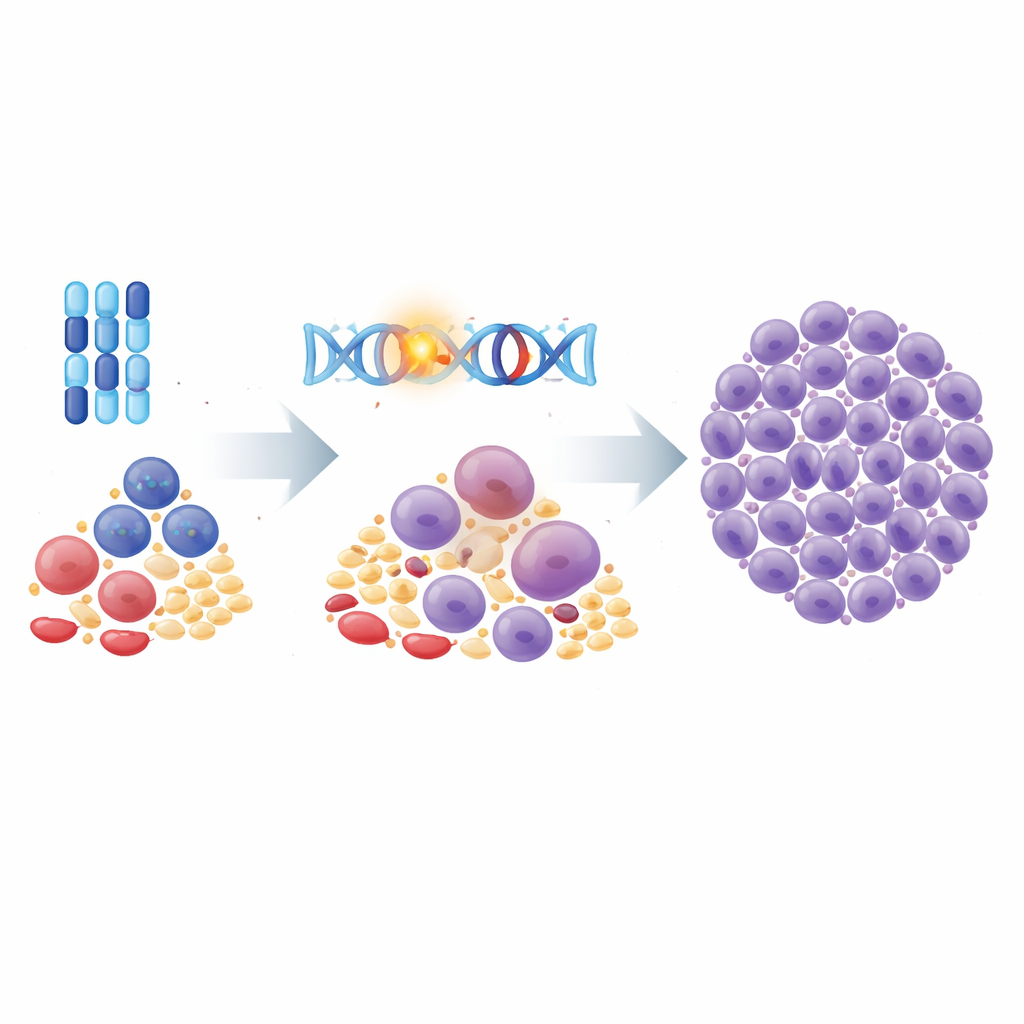
The next crucial step involves a gene called GATA1, which normally helps guide immature blood cells to become healthy red cells and platelets. Many babies with Down syndrome acquire a mutation in GATA1 that produces a shortened version of the protein. This change leads to a condition called transient abnormal myelopoiesis (TAM), a temporary surge of immature blood cells. Using single-cell RNA sequencing, the team showed that the GATA1 mutation rewires the activity of hundreds of genes at once, pushing cells away from red cell development and toward a megakaryocyte- and myeloid‑like state. Remarkably, more than four out of five of the gene changes seen in full-blown ML-DS are already present at this early TAM stage, showing that GATA1 is the main driver of the leukemia-like program.
From temporary surge to true leukemia
Not all children with TAM develop leukemia, and many episodes resolve without treatment. To understand what completes the transition, the researchers compared cancer cells from children with ML-DS to cells from children with non-progressing TAM. They discovered a final set of gene changes shared across patients with ML-DS that sits on top of the GATA1 program. Many of these genes are known players in cancer growth and survival. Interestingly, this “ML-DS module” was also active in other childhood blood cancers, including those not linked to Down syndrome, suggesting it captures a general cancer signature rather than something unique to ML-DS. Children whose supposedly transient disease later returned or worsened already showed stronger activation of this module, hinting that it could help flag high‑risk cases early.
Tracking dangerous clones over time
The team had rare access to samples from two children with particularly aggressive ML-DS: one who relapsed twice and one whose leukemia resisted treatment from the start. By combining whole‑genome DNA sequencing with single-cell RNA data, they rebuilt family trees of cancer cells over time. In one child, relapse cells formed separate branches that evolved in parallel from a common ancestor, but all kept the same GATA1‑driven gene program and shared additional changes that likely helped them survive chemotherapy. In the other child, a hidden subclone with a missing piece of chromosome 17, affecting the famous TP53 “guardian” gene, was present at diagnosis and went on to dominate after treatment. Even in these advanced stages, the fingerprint of the GATA1 mutation remained strong in every leukemia cell.
What this means for future care
Taken together, the study shows that while the extra chromosome 21 sets the stage, the GATA1 mutation writes most of the script for this Down syndrome–related leukemia, and that script stays in place even as the disease evolves and resists treatment. The final leap from transient overgrowth to true cancer involves an additional, more general cancer program that appears across many types of leukemia. In practical terms, this work suggests two promising directions: first, focusing future therapies on the GATA1‑driven gene network, which seems to be a constant weakness of the cancer; and second, using the broader ML-DS gene signature to identify which babies with transient disease are at greatest risk of progressing to leukemia, so that care can be more precisely tailored.
Citation: Trinh, M.K., Schuschel, K., Issa, H. et al. Single cell transcriptional evolution of myeloid leukemia of Down syndrome. Nat Commun 17, 3474 (2026). https://doi.org/10.1038/s41467-026-71707-2
Keywords: Down syndrome leukemia, GATA1 mutation, single-cell RNA sequencing, transient abnormal myelopoiesis, pediatric blood cancer