Clear Sky Science · en
Phosphorylation of SF3B1 by CDK11 orchestrates spliceosome activation via SNIP1-dependent RES complex recruitment
How Cells Edit Their Genetic Messages
Every cell must carefully edit raw genetic messages before turning them into proteins. When this editing goes wrong, it can contribute to cancer and brain disorders. This study uncovers how a small group of proteins inside our cells works together as a timing switch to ensure that RNA messages are correctly processed, and how a single inherited change in one of these proteins can disturb this delicate control.
The Cellular Editing Machine
Our genes are first copied into long RNA strands that contain useful pieces mixed with extra segments that must be removed. A huge cellular machine called the spliceosome performs this cutting and joining. It builds up in stages, adding and releasing many protein parts as it moves from an early idle state to a fully active form. One core piece of this machine, a protein called SF3B1, is known to be chemically tagged and untagged during the editing cycle, but until now scientists did not fully understand what these tags do or exactly when they matter most.
Finding a Paused Editing Step
To probe this question, the researchers used a small molecule that blocks an enzyme named CDK11, which adds chemical tags to SF3B1. In human cells treated with this compound, they isolated spliceosome particles attached to DNA and measured their protein makeup. They discovered a previously unknown paused state in the editing cycle: a complex that has some helper protein groups already in place while others are still missing. They call this arrested form BOTS964. In this state, an early helper group has joined, but a later one that is normally needed for full activation has not yet arrived, revealing a specific checkpoint at which CDK11 activity is required. 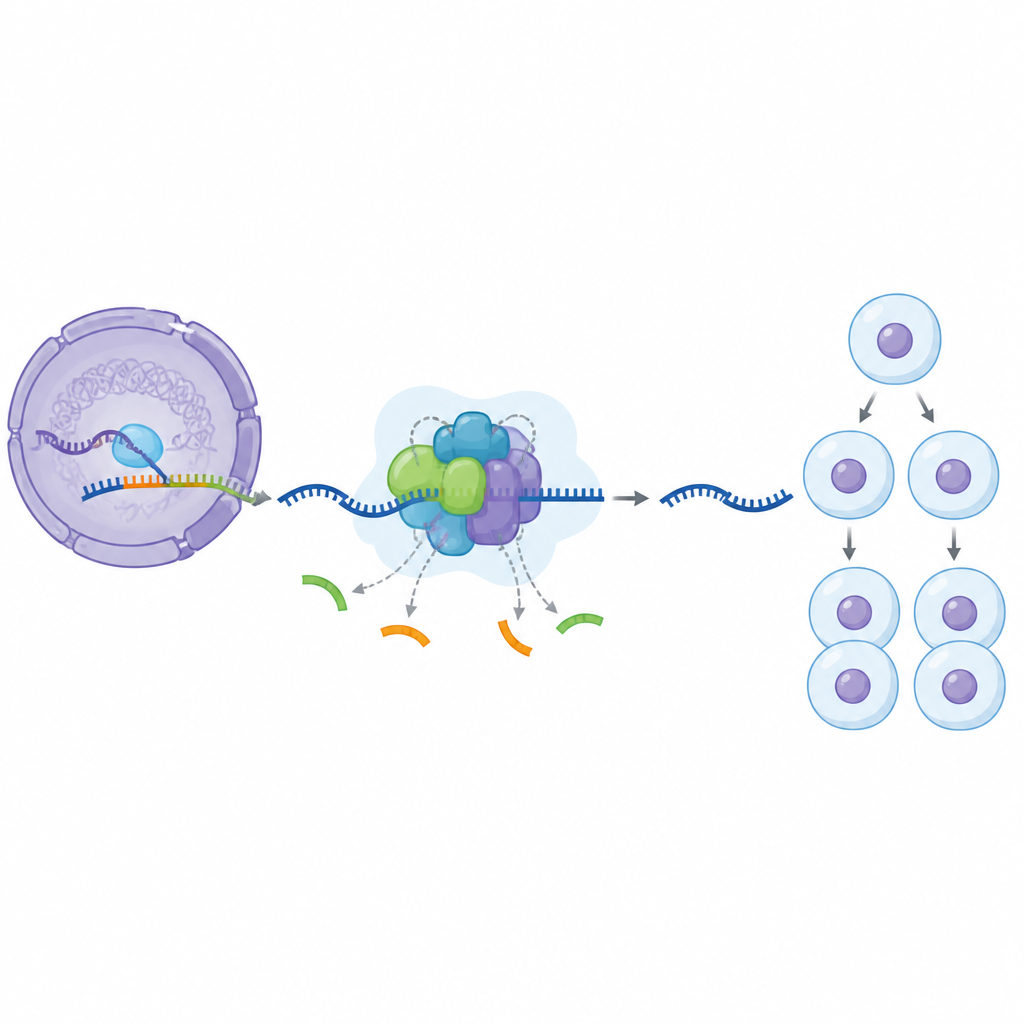
How a Tag on SF3B1 Shapes the Active Site
The team then asked where the tagged version of SF3B1 actually sits on RNA. Using a technique that crosslinks proteins directly to the RNA bases they touch, they mapped the contact points of phosphorylated SF3B1 within the small RNA pieces that form the heart of the spliceosome. They found that tagged SF3B1 is enriched at a particular loop within the U6 RNA, a region that helps shape the catalytic core where cutting and joining occur. When CDK11 was blocked, these contacts weakened, suggesting that adding phosphate tags to SF3B1 helps stabilize the folded RNA center needed for precise splicing.
A Reader Protein Recruits a Key Helper Complex
Next, the scientists searched for proteins that prefer to bind the tagged form of SF3B1. They identified SNIP1, part of a three-protein helper group called the RES complex, which is known to prevent faulty RNA messages from escaping the nucleus. SNIP1 carries a forkhead-associated domain, a pocket that recognizes specific phosphate marks. Biochemical tests and structural modeling showed that this pocket engages multiple phosphorylated sites within the flexible tail of SF3B1. This interaction helps recruit and anchor the full RES complex onto the spliceosome just as it becomes catalytically active, ensuring smooth progression through the activation step.
When the Reader Is Missing or Damaged
To see what happens when SNIP1 is suddenly removed, the team engineered cells in which SNIP1 can be rapidly degraded. Within hours of depletion, many genes showed widespread retention of introns, indicating a broad breakdown of RNA splicing. The pattern of defects closely matched what is seen when CDK11 is inhibited, highlighting that both proteins act together in the same stage of editing. Without SNIP1, most of the RES complex fails to join the spliceosome, and SF3B1 becomes over-tagged by CDK11, reinforcing the idea that proper recruitment of SNIP1 depends on a correctly phosphorylated SF3B1.
Links to a Human Brain Disorder
Finally, the researchers examined subtle changes in the SNIP1 pocket, including an E366G mutation previously found in people from one community with a neurodevelopmental disorder. Mutant SNIP1 proteins bound less well to tagged SF3B1, associated less strongly with the active spliceosome, and were less able to rescue splicing and cell growth when native SNIP1 was removed. Other artificial mutations that further weakened this interaction caused even stronger defects. Together, these results support a model in which CDK11 first tags SF3B1, tagged SF3B1 then recruits SNIP1 and the RES complex, and this chain of events stabilizes the RNA catalytic center and keeps splicing efficient. Disrupting any link in this chain, including disease-associated changes in SNIP1, can compromise RNA processing and normal cell function. 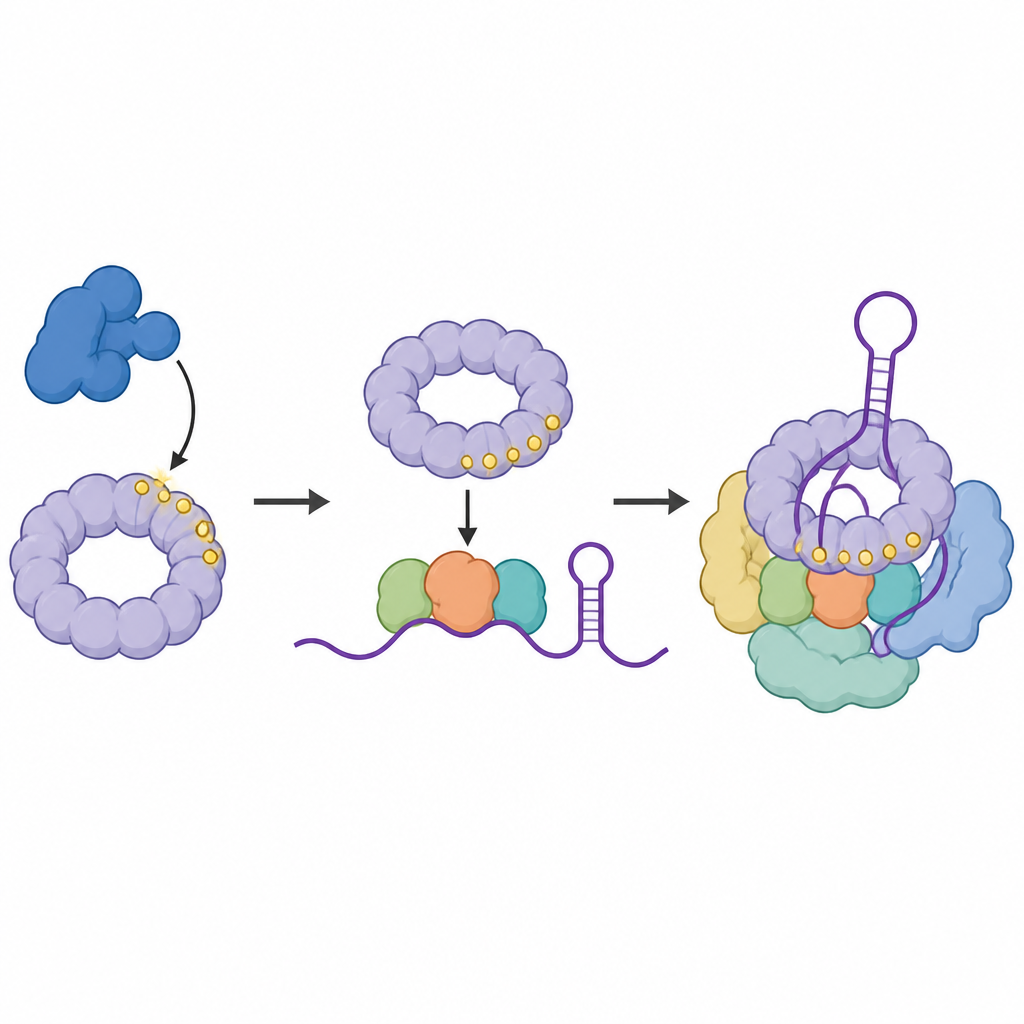
Citation: Gajdušková, P., Ruiz de Los Mozos, I., Hluchý, M. et al. Phosphorylation of SF3B1 by CDK11 orchestrates spliceosome activation via SNIP1-dependent RES complex recruitment. Nat Commun 17, 4577 (2026). https://doi.org/10.1038/s41467-026-71119-2
Keywords: RNA splicing, spliceosome, SF3B1, CDK11, SNIP1