Clear Sky Science · en
Meta-analysis reveals widespread negative associations between species richness and ecological uniqueness
Why hidden corners of nature matter
When we think about saving biodiversity, our minds usually jump to lush rainforests or colorful coral reefs packed with life. But this study shows that some of the most important places for global biodiversity may actually be the quiet, species-poor corners of the planet. By looking across thousands of sites and many groups of organisms, the authors reveal that areas with many species and areas that are ecologically unique often do not overlap, which has big consequences for how we design nature reserves and restoration projects.
Richness versus specialness
Biodiversity has at least two sides. One is species richness, the simple count of how many species live in a place. The other is ecological uniqueness, meaning how different the mix of species at one site is from other sites in the same region. A site can be species-poor yet host rare, locally restricted, or functionally unusual species that contribute strongly to regional diversity. Until now, scientists lacked a global picture of how these two dimensions align or conflict, making it hard to know whether focusing on species-rich “hotspots” alone is enough for conservation.
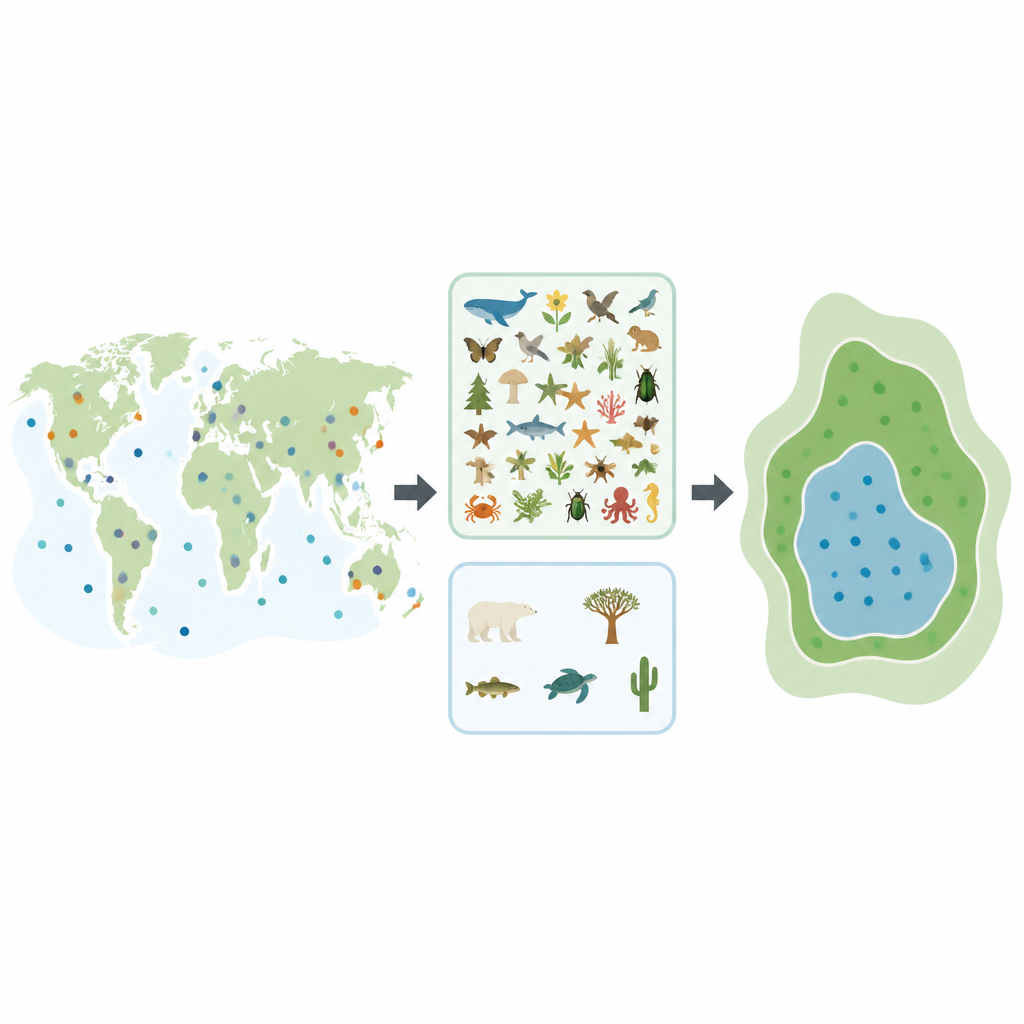
A global scan of life on land and in water
To answer this, the researchers carried out a large meta-analysis, pooling data from 451 studies and datasets around the world. These covered 20 broad groups, including terrestrial plants, freshwater insects, fish, birds, algae, reptiles and more, across environments ranging from tropical forests to polar regions. For each dataset they calculated local species richness and a standard measure of ecological uniqueness, based either on which species were present or on how abundant each species was. They then measured how tightly richness and uniqueness were linked at each site and combined these results using statistical tools that account for differences among studies and taxonomic groups.
When fewer species means a more special place
The analysis revealed a clear and surprisingly widespread pattern: in most cases, sites with more species were less ecologically unique. In other words, species-rich communities tended to resemble each other, while species-poor communities were more likely to host distinctive mixes of species. This negative relationship appeared across almost all major taxonomic groups and in both presence–absence and abundance data. Only a handful of groups showed weakly positive or non-significant patterns. These results confirm that richness “hotspots” and uniqueness “hotspots” are commonly located in different places, implying that conservation focused on richness alone will miss many unusual and irreplaceable communities.
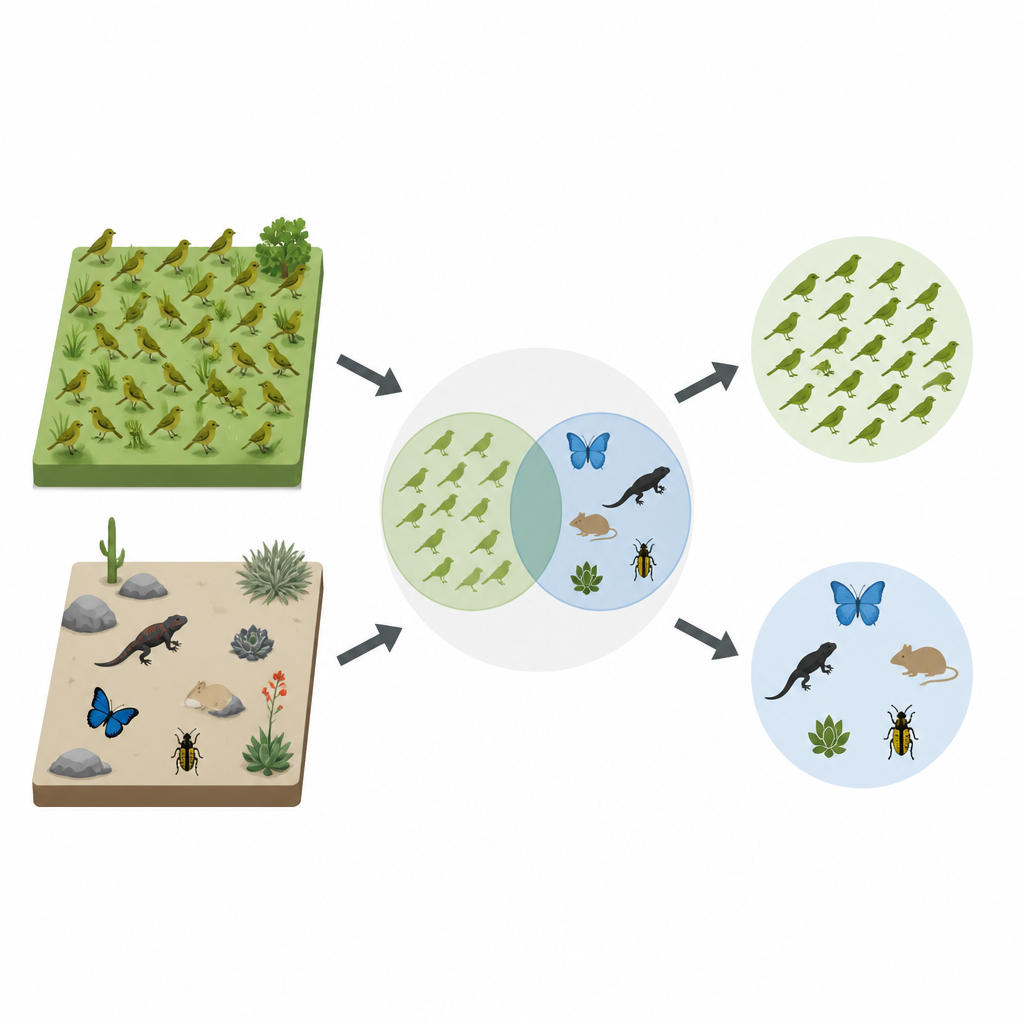
Why this mismatch happens
The authors then asked what ecological processes best explain why richness and uniqueness so often pull in opposite directions. They evaluated four ideas: the size and makeup of the regional species pool, limits on how easily species can spread, broad climate conditions, and the size of the sampling area. For data based only on presence and absence, features of the regional pool were most important. Regions with many species overall, especially many widespread species, tended to have stronger negative links between richness and uniqueness, because communities shared more of the same common species. In contrast, when a region’s pool contained a higher share of rare species and greater variation in local richness, species-rich sites were more likely to be unique as well, softening or reversing the negative pattern.
Movement, scale and climate
When the authors used abundance data, limits to dispersal emerged as a key driver. In groups like freshwater macroinvertebrates and terrestrial insects, strong barriers to movement led to sharp differences in which species and how many individuals occurred across sites. Species-poor, isolated habitats, such as high-elevation areas, often held specialized species that rarely showed up elsewhere, making them highly unique despite low richness. The size of each sampling unit also mattered: larger sampled areas tended to contain more species but had more similar species mixes, strengthening the negative link between richness and uniqueness. Climate had weaker and less consistent effects, suggesting that fine-scale habitat features and local processes often matter more than broad temperature and rainfall patterns for shaping ecological uniqueness.
Rethinking what to protect
For a layperson, the main message is that nature’s value is not only in the busiest, most species-rich places. Many drab-looking or species-poor sites quietly harbor rare, specialized, or otherwise distinctive communities that add greatly to regional biodiversity. This study shows that such places are frequently different from the classic richness hotspots. Effective conservation, the authors argue, should therefore protect both types of areas: the crowded centers of diversity and the sparse but special outposts. Only by considering ecological uniqueness alongside species counts can we safeguard the full variety of life on Earth.
Citation: Chen, Y., Soininen, J., Myers, J.A. et al. Meta-analysis reveals widespread negative associations between species richness and ecological uniqueness. Nat Commun 17, 4428 (2026). https://doi.org/10.1038/s41467-026-70886-2
Keywords: biodiversity, species richness, ecological uniqueness, conservation planning, rare species