Clear Sky Science · en
Common and distinct neurofunctional signatures of dynamic naturalistic emotion regulation strategies
How the brain keeps difficult feelings in check
Everyone faces upsetting moments, from frightening news clips to painful memories. Many people try to cope either by reframing what happened or by simply allowing the feeling to pass. This study asks a simple but important question: does the brain use the same machinery for these two approaches, or are there truly different mental “paths” to handling distress?
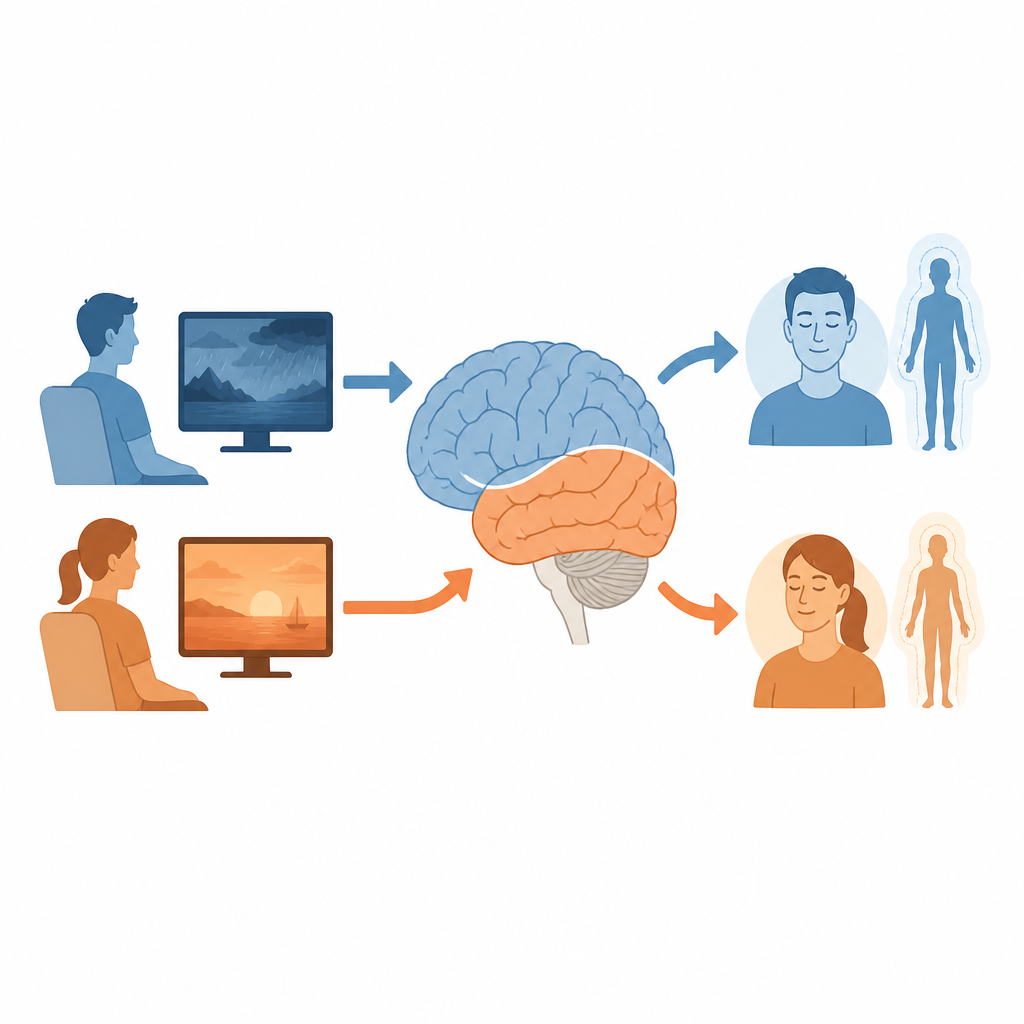
Two everyday ways to handle tough emotions
The researchers focused on two strategies that are central to modern psychotherapy. The first is reappraisal: mentally reinterpreting a painful situation, for example by imagining a safer outcome or a different perspective. The second is acceptance: turning toward the feeling with open, nonjudgmental awareness instead of trying to change it. Both are known to reduce distress and are widely taught in cognitive and mindfulness based treatments, yet they feel quite different in daily life. The team wanted to see how these differences show up in the living brain.
Watching emotional scenes inside the scanner
To mimic real life more closely than standard picture viewing tasks, volunteers lay in an MRI scanner and watched short silent video clips. Some clips were neutral, such as everyday activities; others were strongly negative, showing accidents, aggression, or threat. On some trials, people were asked just to react naturally; on others, they were cued to use acceptance or reappraisal while watching the same kind of negative material. After each clip, they rated how bad they felt. Both strategies clearly reduced negative feelings compared with simply reacting, with reappraisal giving a somewhat stronger relief on average.
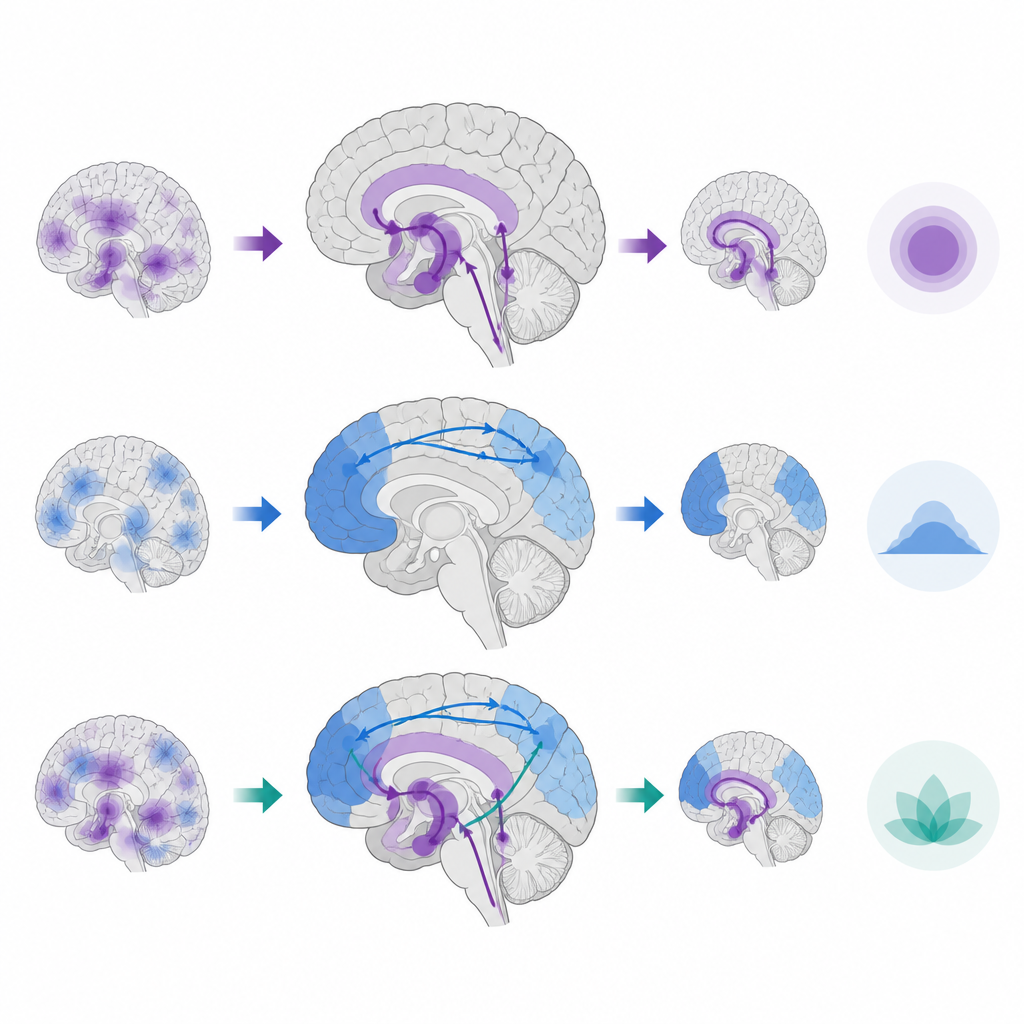
Reading emotional strategies from whole brain patterns
Instead of looking at one brain area at a time, the scientists used machine learning to search for whole brain patterns linked to three states: feeling negative emotion, regulating it with acceptance, and regulating it with reappraisal. From scans of 59 people, they trained “neural signatures” that could tell, based only on brain activity, which state a person was in. These signatures were then tested in new groups, including hundreds of people performing more traditional picture based tasks and a study where heat pain was regulated with reappraisal. Remarkably, the brain patterns successfully generalized across different scanners, cultures, and types of emotional challenges, especially for reappraisal.
Shared core system, distinct routes to calm
By mapping which networks contributed to each signature, the team found both overlap and separation. Acceptance and reappraisal both drew on a core set of midline regions often called the “default mode” network, linked to self reflection and evaluating one’s internal state. Beyond this shared hub, acceptance leaned more on areas that track bodily sensations and attention to the present moment, as well as deep emotion regions like the amygdala. Reappraisal, in contrast, relied more heavily on frontal and parietal “control” regions involved in working with thoughts and shifting meaning. The results suggest that our brains support multiple, partly distinct routes to easing difficult emotions: one more grounded in feeling and allowing, the other in actively reshaping how we think.
Brain clues to emotion problems in addiction
The authors also asked whether these neural signatures could reveal problems in people with addiction, where emotion regulation often breaks down. They applied the same brain patterns to scans from men with heavy cannabis use and healthy comparison participants who were reappraising negative pictures. In healthy volunteers, the reappraisal signature clearly distinguished “regulate” trials from “just feel” trials. In cannabis users, it did not, even though their brains still showed normal responses to simply seeing negative versus neutral images. This points to a specific weakness in the regulation process rather than in feeling emotions themselves, hinting that such signatures could one day help track therapy response or tailor interventions.
What this means for understanding our feelings
For a layperson, the key message is that there is no single control room in the brain for emotions. Instead, feeling bad, reappraising, and accepting each involve broad, coordinated patterns that stretch across many regions. Acceptance and reappraisal share a common core but then branch into different circuits that match their psychological flavor: sensing and allowing versus active interpretation. Because these patterns can be detected reliably across people and tasks, they may eventually serve as brain based markers to better understand who struggles with which kind of emotion regulation and why, and to guide treatments that strengthen the most helpful paths to emotional resilience.
Citation: Jiang, H., He, J., Zimmermann, K. et al. Common and distinct neurofunctional signatures of dynamic naturalistic emotion regulation strategies. Nat Commun 17, 4272 (2026). https://doi.org/10.1038/s41467-026-70708-5
Keywords: emotion regulation, brain networks, fMRI, reappraisal, acceptance