Clear Sky Science · en
Semantic similarity across languages reflects neurocognitive dimensions shaped by climate
Why Climate and Language Belong Together
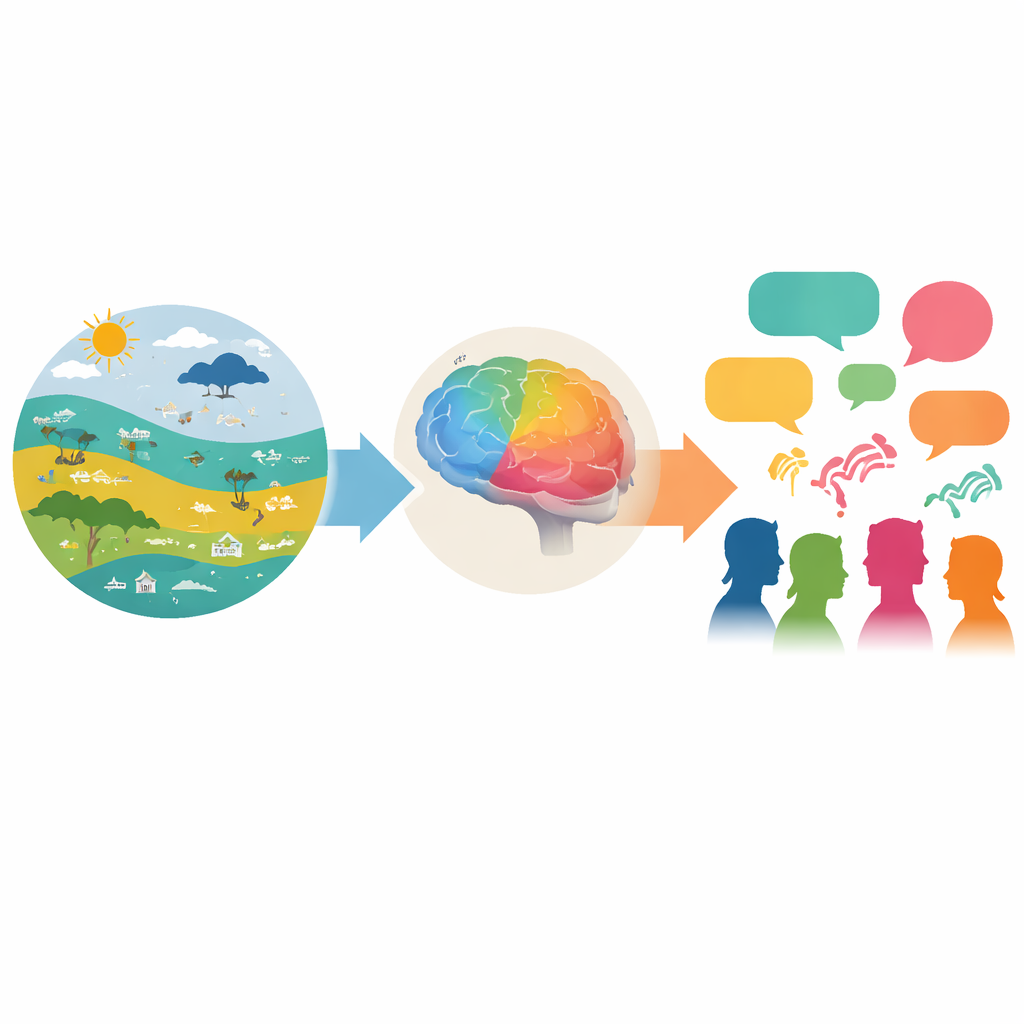
When we learn new words, it is easy to forget that every language on Earth must somehow fit the same human brain—and the same planet. This study asks a surprisingly down-to-earth question: how much do the places we live, especially their climates, quietly shape what our words mean and how our brains organize meaning? By blending big-data language models, human judgments, and brain scans, the researchers show that word meanings across dozens of languages share a common mental structure, yet that structure is subtly tuned by long-term environmental conditions such as temperature and rainfall.
Hidden Common Ground in Word Meanings
Languages sound very different on the surface, but underneath, the authors argue, they draw on a common set of basic meaning ingredients rooted in the brain. They focused on 13 such ingredients, covering both senses (like color, sound, smell, touch, taste, shape, and actions of the body) and core mental domains (like time, space, number, other minds, emotion, and social relations). Using large pretrained word-embedding models for 53 languages, they measured how strongly thousands of everyday concepts are connected to each of these ingredients. For example, across languages, the word for “rose” can be characterized by how much it evokes color, smell, emotion, and so on.
A Brain-Inspired Map That Fits Many Tongues
The team compared this brain-inspired map of meaning to several rivals: models built purely from how words co-occur in text, and models based on long lists of descriptive features such as “has fur” or “is round.” They asked a simple question: which map makes different languages look most alike in how they structure meaning? Across thousands of word comparisons and 53 languages from 10 families, the 13-dimensional, neurocognitive map did best. It produced the highest similarity between languages and outperformed random baselines, suggesting that these dimensions capture something universal about how humans, regardless of tongue, carve up meaning. The same structure also helped explain patterns in a massive database of “colexifications,” where a single word in a language covers multiple related ideas, across 2681 languages worldwide.
Climate as a Quiet Sculptor of Meaning
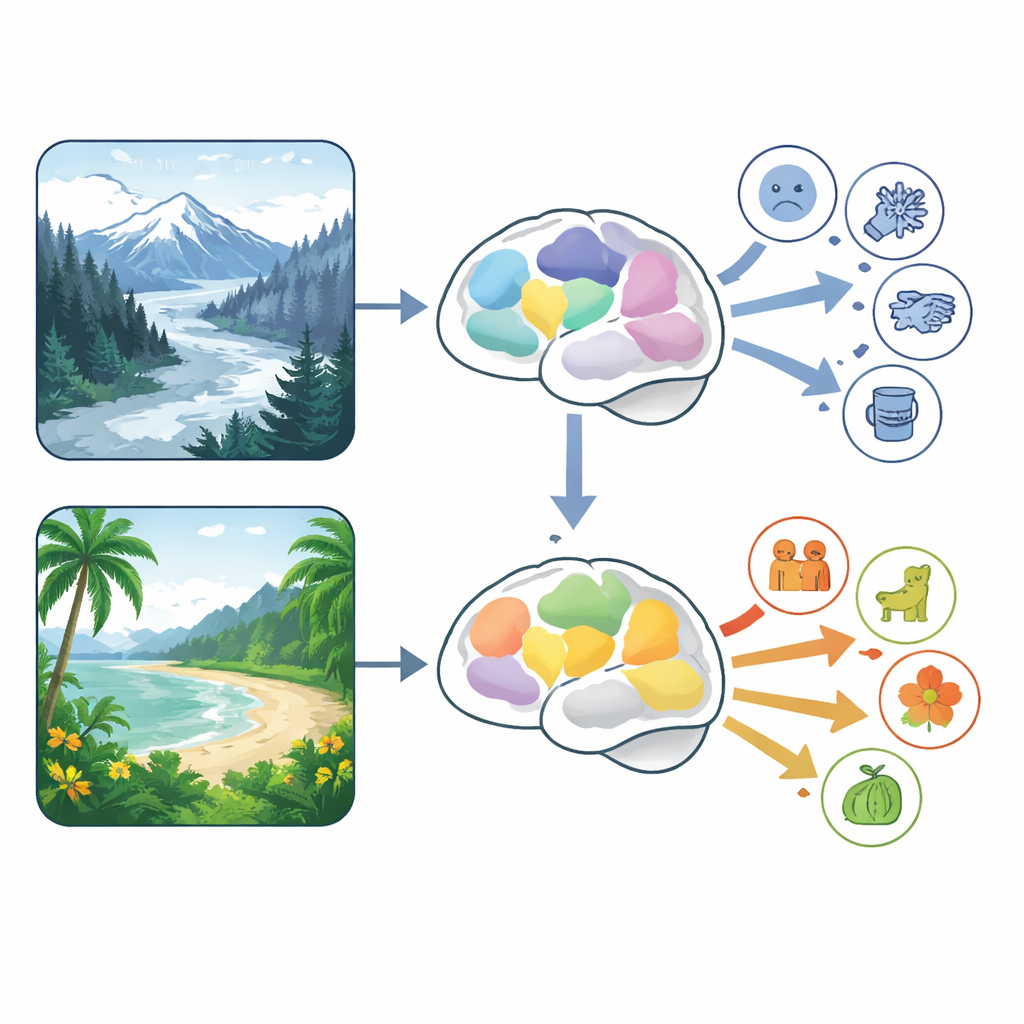
Having established this shared backbone, the researchers then turned to variation: why do languages still differ in how they position concepts along these 13 dimensions? They examined four broad types of influences—climate, geography, cultural practices, and linguistic history. Using statistical models, they found that climate consistently stood out. Languages spoken in regions with similar temperature and rainfall patterns tended to organize meanings more similarly along the neurocognitive dimensions, even when those languages were geographically distant or historically unrelated. Climate affected almost all dimensions, from basic senses to abstract domains like social relations and emotion, hinting that long-term sensory and social experiences in different environments seep into how we weight the ingredients of meaning.
From Judgments and Brains to Global Patterns
To test whether these patterns go beyond text statistics, the authors ran a rating study with 253 speakers of eight languages, who judged how strongly 207 everyday concepts related to each of the 13 dimensions. Again, most of the structure was shared across people and languages, but differences between language groups were best predicted by climate, not just culture or distance on the map. Finally, they analyzed brain scans from 86 people listening to stories in 45 different native languages. A key region in the right anterior temporal lobe—a hub for combining different aspects of meaning—showed neural activity patterns that mirrored both the 13-dimensional semantic structure and the climate differences between languages, suggesting a biological link between environmental conditions, mental meaning space, and brain activity.
What This Means for Understanding Human Meaning
Taken together, these findings paint a picture in which human languages share a deep, brain-shaped “coordinate system” for meaning, built from sensory channels and core cognitive domains that all people possess. At the same time, the climates we inhabit over generations—cold or tropical, oceanic or continental—nudge this system in different directions, shifting how strongly concepts draw on senses, emotions, and social knowledge. For a lay reader, the message is that words do not just mirror culture or history; they also quietly echo the weather and landscapes that surround us, revealing an intimate partnership between our brains, our languages, and the environments we call home.
Citation: Fu, Z., Chu, Y., Zhang, T. et al. Semantic similarity across languages reflects neurocognitive dimensions shaped by climate. Nat Commun 17, 4016 (2026). https://doi.org/10.1038/s41467-026-70608-8
Keywords: language and climate, semantic universals, cross-linguistic cognition, environment and brain, word meaning