Clear Sky Science · en
A guard cell carbonic anhydrase binds and regulates SLAC1 separate from its catalytic activity
Why tiny leaf pores matter
Every leaf is dotted with microscopic pores that act like adjustable valves, trading water for carbon dioxide. These valves, called stomata, must open to let in carbon dioxide for photosynthesis but close quickly to prevent plants from drying out. How stomata sense and react to changing carbon dioxide levels in real time has been a long‑standing puzzle. This study uncovers a key piece of that mechanism, showing how two proteins in the cells that surround each pore work together to fine‑tune water loss and growth.
Leaf valves that juggle air and water
Stomata consist of pairs of guard cells that swell open or shrink shut by moving salts and water in and out. When the surrounding air or the air spaces inside the leaf contain more carbon dioxide, stomata tend to close. This protects the plant from wasting water when extra carbon dioxide is already available. One important route for releasing negatively charged ions during closure is a membrane channel called SLAC1. Earlier work hinted that a family of enzymes known as carbonic anhydrases, which normally speed up the conversion between carbon dioxide and bicarbonate in water, somehow helped switch SLAC1 on. But it was unclear whether these enzymes were acting only as chemical converters or whether they were also acting as direct control knobs for the channel.
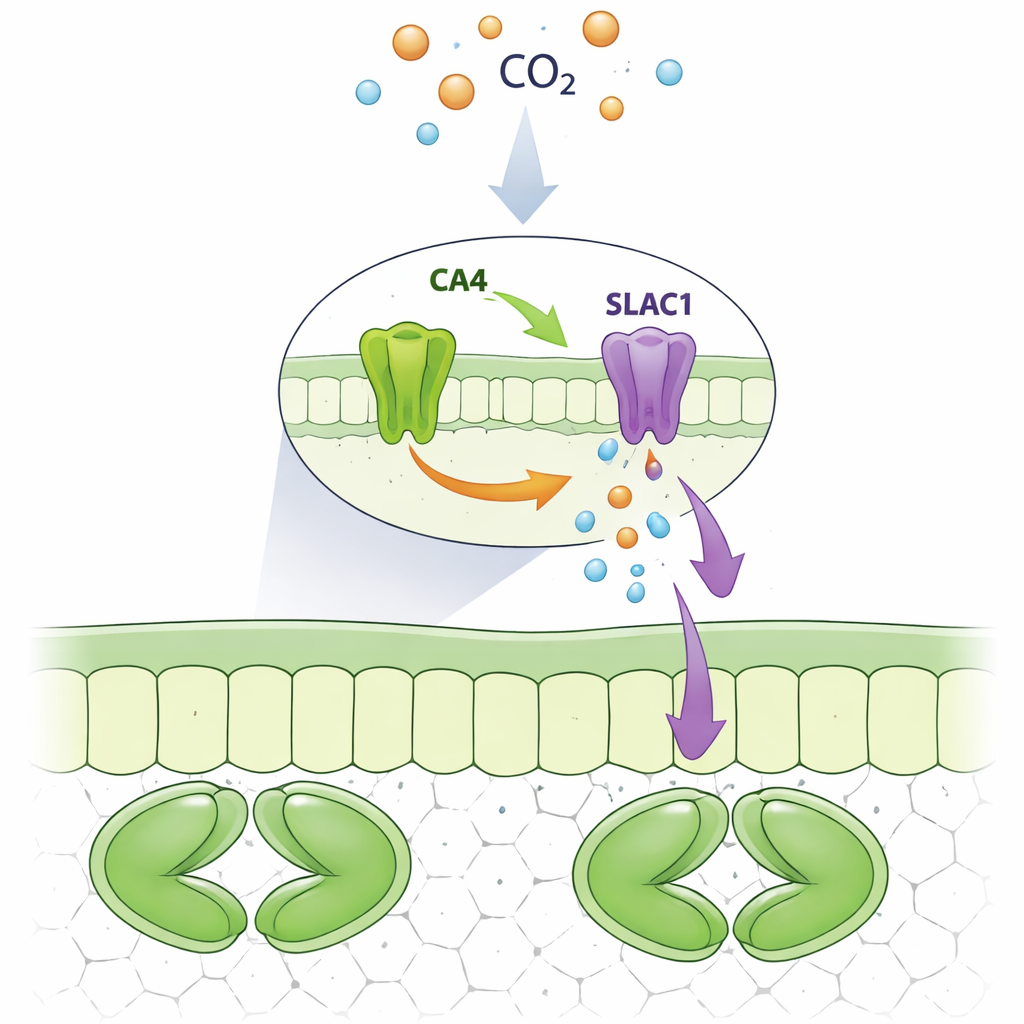
A protein partnership at the pore
The researchers focused on a particular carbonic anhydrase, CA4, that is abundant in guard cells. Using yeast cells and fluorescent imaging in plant cells, they showed that SLAC1 forms a physical complex with CA4, but not with closely related enzymes CA1 or CA3. Both versions of CA4 found in plants, one attached to membranes and one more freely floating in the cell fluid, could bind SLAC1. The team then systematically altered individual amino acids in CA4 to see which ones were needed for this handshake. They discovered a short surface patch of CA4, centered on a few specific residues far from its chemical reaction site, that is essential for binding SLAC1. Mutations in this motif broke the interaction while leaving the enzyme’s catalytic activity intact.
Separating chemistry from control
Having split CA4’s binding role from its catalytic role, the authors asked how each affected the SLAC1 channel. In frog eggs engineered to produce the plant proteins, adding normal CA4 boosted SLAC1’s ion current, while mutant forms of CA4 that could no longer bind the channel failed to do so. Strikingly, a CA4 mutant that had lost catalytic activity but still bound SLAC1 was still able to enhance the current. In guard cells of Arabidopsis leaves, normal CA4 restored a strong, carbon‑dioxide‑dependent increase in SLAC1 activity. By contrast, plants expressing binding‑defective CA4 showed little or no boost in channel activity even at elevated carbon dioxide, despite some of these mutants still performing normal chemistry. This shows that CA4’s direct physical contact with SLAC1, not just its ability to process carbon dioxide, is what tunes the channel’s response.
From single channels to whole‑plant performance
The team then followed the consequences of disrupting CA4–SLAC1 binding at the scale of entire leaves and plants. In plants where CA4 could not latch onto SLAC1, stomata closed and reopened much more slowly after carbon dioxide levels were increased or returned to normal. Computer models predicted this sluggish behavior and suggested it would make plants less efficient in their use of water. Experiments under controlled, fluctuating light confirmed these predictions: plants with binding‑impaired CA4 had smaller rosettes, lower dry weight, and significantly poorer water use efficiency than plants with normal or catalysis‑deficient but binding‑competent CA4. Importantly, their photosynthetic machinery itself worked just as well, indicating that the growth penalty stemmed mainly from mis‑timed stomatal movements rather than from defective carbon fixation chemistry.
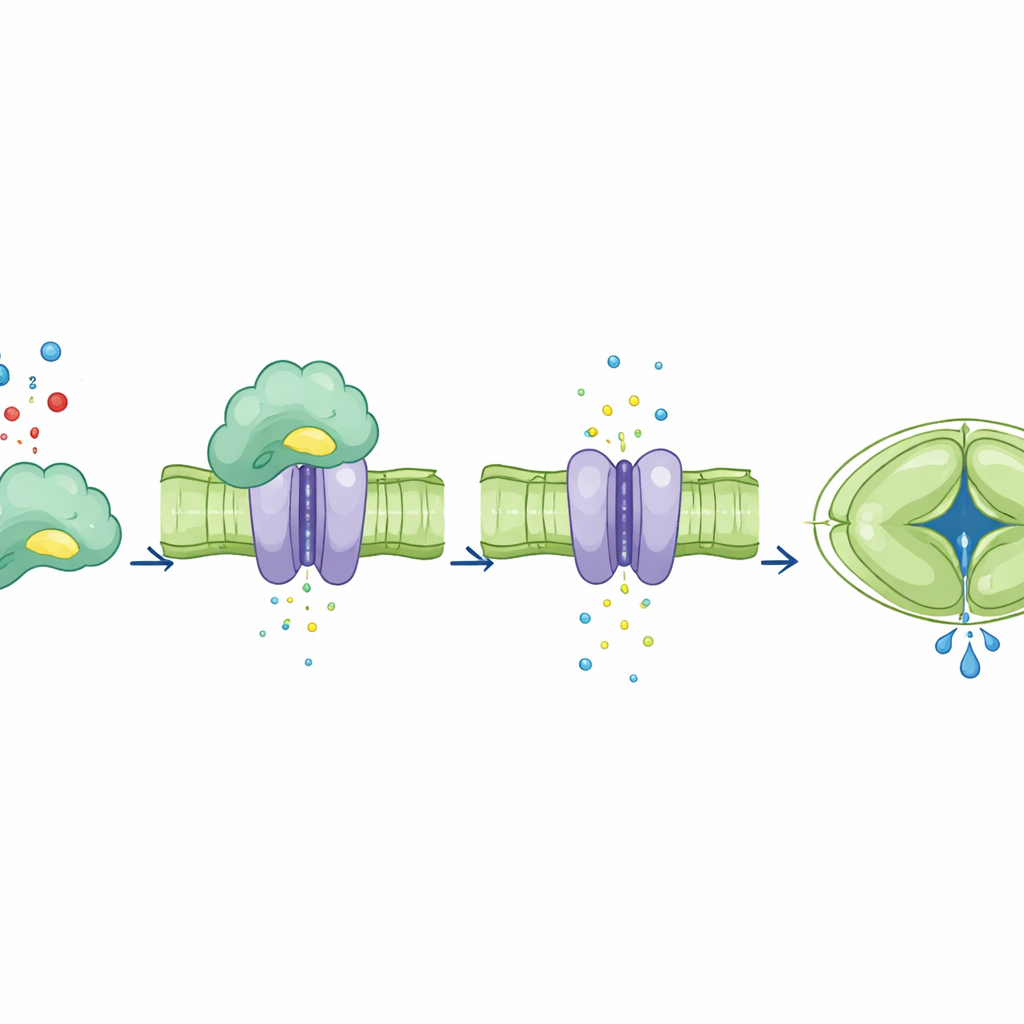
What this means for future crops
Together, the results reveal CA4 as a sensor‑partner that latches onto the SLAC1 channel in guard cells and directly adjusts its activity in response to near‑ambient carbon dioxide. This binding uses a structural motif distinct from the enzyme’s chemical reaction center, proving that its regulatory role can be uncoupled from its catalytic role. By sharpening how fast stomata open and close, this protein partnership helps plants strike a better balance between taking up carbon and saving water, especially under natural light conditions that change from minute to minute. In practical terms, the work points to new molecular targets for breeding or engineering crops whose leaf valves respond more nimbly, potentially boosting yields while using less water in a warming, drying world.
Citation: Xia, L., Alvim, J.C., Nguyen, TH. et al. A guard cell carbonic anhydrase binds and regulates SLAC1 separate from its catalytic activity. Nat Commun 17, 3911 (2026). https://doi.org/10.1038/s41467-026-70596-9
Keywords: stomata, carbon dioxide sensing, guard cells, water use efficiency, ion channels