Clear Sky Science · en
Substrate-interacting pore loops of two ATPase subunits determine the degradation efficiency of the 26S proteasome
How the cell’s recycling machine grabs damaged proteins
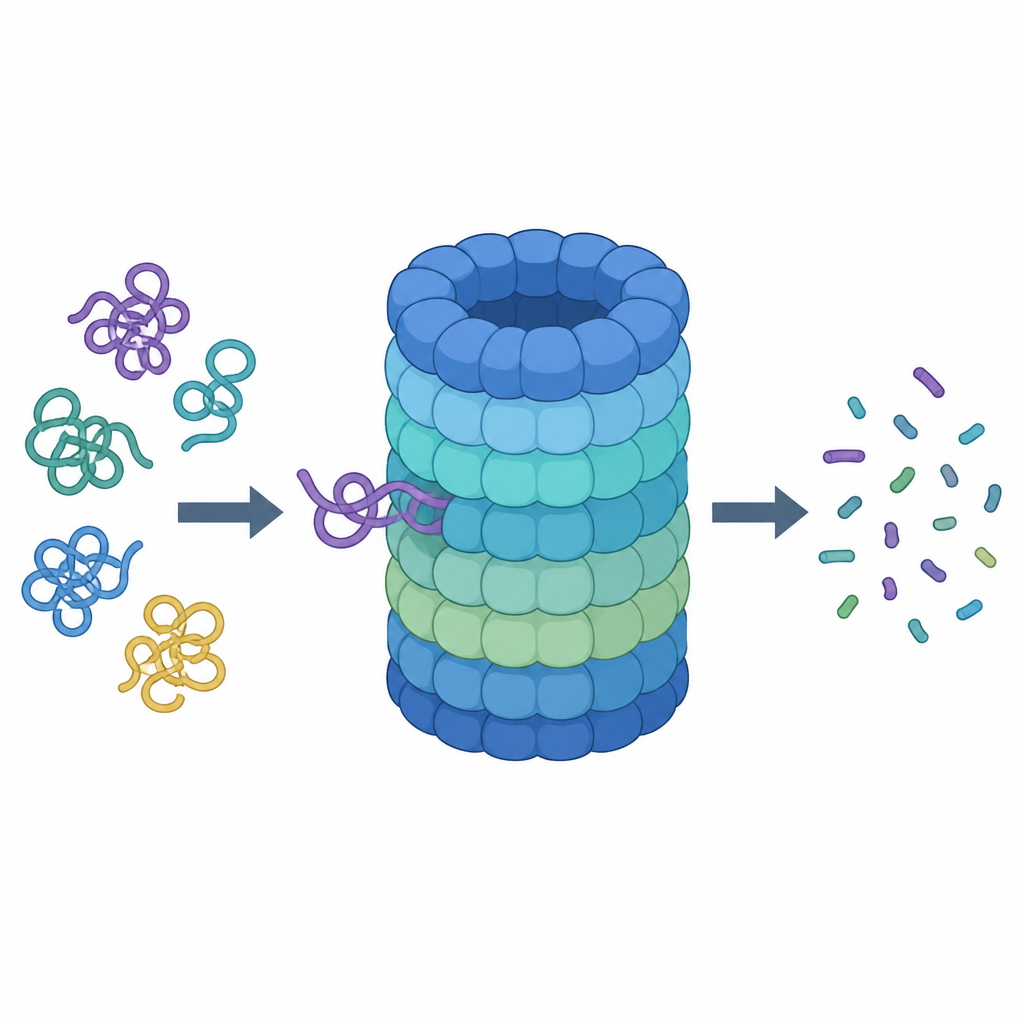
Every cell must constantly clean out damaged or no-longer-needed proteins. A giant molecular machine called the proteasome does this job by pulling proteins in, shredding them, and releasing the pieces. This study asks a surprisingly specific question with big consequences: how do just two tiny gripping parts inside the proteasome decide whether a protein will be efficiently destroyed or allowed to slip away?
A closer look at the cell’s protein shredder
The proteasome is a barrel-shaped machine made of many protein parts. Its central barrel is the cutting chamber, while a cap on top recognizes proteins marked for destruction, removes their molecular “tags,” and feeds them inside. To be accepted as trash, a protein must carry chains of a small tag molecule called ubiquitin and expose a floppy tail that can be grabbed and pulled. At the entrance to the cap sits a ring of six motor units that burn chemical fuel (ATP) and use finger-like loops inside a narrow pore to grip and tug on the protein tail.
Why a few gripping loops matter so much
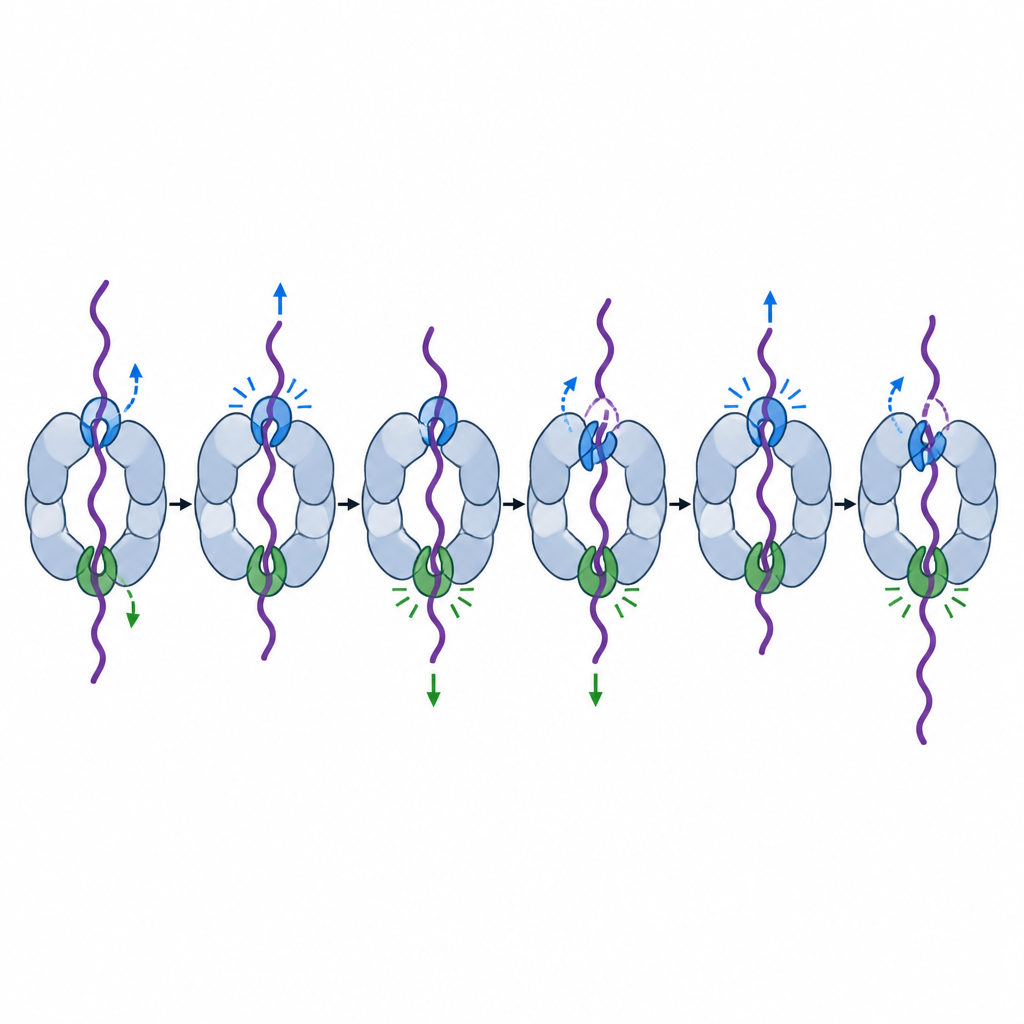
Each of the six motor units has a pair of pore loops that reach into the central tunnel like hooks and contact the passing protein chain. Earlier structural snapshots showed these hooks arranged in a spiral staircase around the tunnel, taking turns grabbing and pulling. But not all hooks appeared to be equal. To test this, the researchers weakened one key amino acid in the pore-1 loop of each motor unit in yeast proteasomes, then measured how well the machine burned fuel, changed shape, and chewed up model proteins.
Two special hooks that guide capture and unfolding
By combining bulk biochemical tests, single-molecule fluorescence tracking, and high-resolution cryo-electron microscopy, the team found that pore loops in two particular motor units, called Rpt6 and Rpt4, play especially important but different roles. When the Rpt6 loop was weakened, the proteasome burned ATP even without cargo and spent more time in a “processing” posture that partially blocks the entrance. This mutant often failed to firmly capture incoming protein tails, and even after starting to work on a stable protein, it kept slipping and taking extra time or ultimately letting the substrate escape. Cryo-EM images revealed why: in the resting state, the Rpt6 loop is tucked into a helical shape and held in place by unusual contacts with a neighboring subunit, apparently locking the machine in a quiet, engagement-ready configuration until a protein arrives.
Keeping a tight grip during tough jobs
The Rpt4 loop had a different specialty. Proteasomes with a weakened Rpt4 hook could still recognize and bind tagged proteins, but when they tried to unfold a particularly sturdy protein domain, they frequently slipped and released it instead of pulling it all the way through. Single-molecule traces showed repeated attempts to unfold the same protein, interrupted by brief returns to the relaxed state, as if the machine briefly lost its grip and had to start again. Structural comparisons with earlier spiral-staircase views suggest that Rpt4 often sits in a key “seam” position just before a power stroke, making it the first hook to clamp down during a strong pulling step.
An asymmetric engine tuned for reliability
Overall, the results paint the proteasome’s motor as an asymmetric engine rather than a perfectly even six-part rotor. Rpt6 helps sense when a protein is in place and triggers the shift from a waiting to a working posture, while also re-engaging the chain after occasional slips. Rpt4, in turn, provides much of the pulling power needed to unfold stubborn proteins without dropping them. By assigning these distinct tasks to different hooks around the ring, the proteasome can both avoid wasting energy and ensure that once a protein is chosen for destruction, it is usually broken down completely rather than partially released.
Citation: López-Alfonzo, E., Saurabh, A., Zarafshan, S. et al. Substrate-interacting pore loops of two ATPase subunits determine the degradation efficiency of the 26S proteasome. Nat Commun 17, 4473 (2026). https://doi.org/10.1038/s41467-026-70426-y
Keywords: proteasome, protein degradation, ATPase motor, ubiquitin system, single-molecule FRET