Clear Sky Science · en
Dopaminergic processes predict temporal distortions in event memory
Why Some Days Feel Longer in Memory
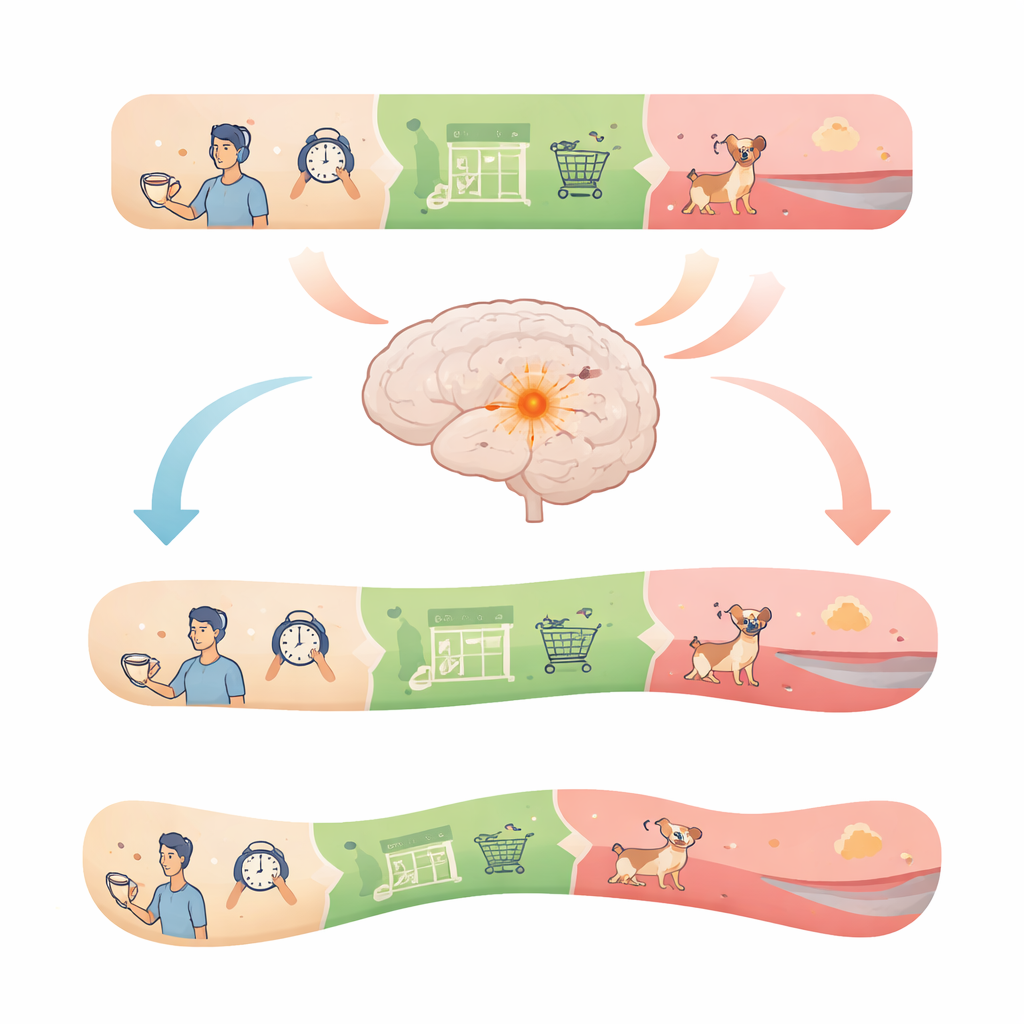
Think back to the first months of the pandemic or to a particularly eventful vacation. Some stretches seem to have vanished in a blur, while others feel packed with moments, as if time itself stretched or shrank. This study asks why our memories warp time in this way and points to a surprising culprit: the brain’s dopamine system, working together with tiny changes in eye blinking, to carve a continuous day into distinct episodes.
Turning Everyday Moments into Separate Chapters
Our daily lives unfold as a seamless stream, yet we remember them as chapters: before the meeting, after the phone call, during the trip. Psychologists call these breaks “event boundaries” – noticeable shifts in what we are doing or sensing, such as a change in location, sound, or goal. Earlier research showed that when two moments fall on opposite sides of such a boundary, they are remembered as farther apart in time than moments that occur in a steady, unchanging stretch, even if the actual clock time is the same. The new work asks what is happening in the brain at those boundaries and how that activity might stretch remembered time.
A Lab-made Day with Silent Scene Changes
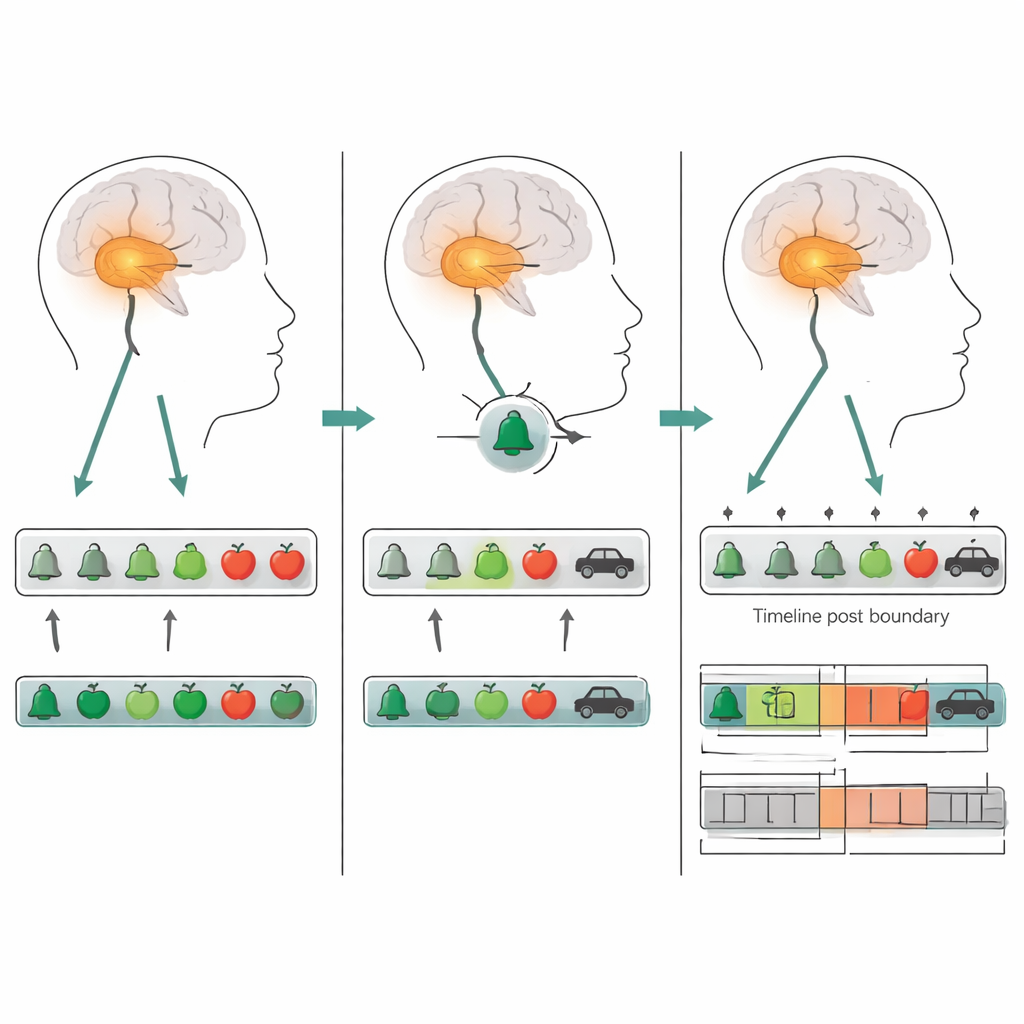
To probe this, volunteers lay in an MRI scanner and viewed sequences of ordinary object pictures while listening to tones played in one ear. For about eight pictures in a row, the tone’s pitch and ear stayed constant, creating a stable “event.” Then, abruptly, the tone switched ear and pitch, and participants also switched the hand they used to answer a simple size question about each object. These abrupt shifts formed clear event boundaries, even though the visual images stayed neutral and similar. After each sequence, people judged how far apart in time pairs of objects had appeared, using a four-step scale from very close to very far. Crucially, every pair was separated by the same number of intervening images, so any differences reflected memory’s distortion of time, not the actual duration.
The Brain’s Reward Hub Lights Up at Boundaries
Brain scans focused on the ventral tegmental area (VTA), a small region deep in the midbrain that releases dopamine and is known for its role in learning and motivation. The researchers found that the VTA became more active when the tone pattern switched – the event boundaries – than when the tone simply repeated. Moreover, the stronger a person’s VTA response at these switches, the more that person later judged boundary-spanning object pairs as having occurred farther apart in time. This link did not appear for pairs that stayed within the same stable context, suggesting that the dopamine system is especially engaged when the mind registers a meaningful change and may help stretch the mental distance between what came before and after.
Blinks as a Window into Hidden Brain Signals
Because brain chemicals cannot be measured directly in such experiments, the team also tracked participants’ eye blinks as an indirect clue to dopamine activity. Blinks are not just about keeping the eyes moist; they tend to cluster at natural breakpoints, like pauses in speech or punctuation in text, and past work links blink patterns to dopamine-related conditions. In this task, people blinked more in the brief moments right after a boundary tone than after repeated tones, and trials with higher VTA activity also showed more post-tone blinks, regardless of context. While these very short-lived blink bursts did not, by themselves, predict how far apart events were later remembered, longer stretches told a different story. When the researchers counted blinks across the full 30-plus seconds between two to-be-judged objects, more blinking during intervals that crossed a boundary was associated with greater remembered distance between those objects. This pattern did not hold for intervals with no boundary, hinting that sustained blinking during meaningful shifts in experience reflects a dopamine-driven process that helps the brain separate one episode from the next.
How the Brain Bends Time to Organize Experience
Taken together, the findings suggest that when something in our environment signals “a new chapter” – a change in sound, task, or situation – the brain’s dopamine system briefly ramps up, accompanied by characteristic blinking patterns. This combination seems to exaggerate the amount of time we later feel passed between what happened before and after that shift, effectively inserting extra breathing room between episodes in memory. Although this work cannot prove cause and effect, it supports the idea that our sense of time in memory is not a faithful replay of the clock but a useful illusion. By stretching time across important breaks, the brain may keep similar experiences from blending together, helping us to remember the story of our lives as a series of distinct, meaningful events rather than an undifferentiated stream.
Citation: Morrow, E., Huang, R. & Clewett, D. Dopaminergic processes predict temporal distortions in event memory. Nat Commun 17, 3971 (2026). https://doi.org/10.1038/s41467-026-69950-8
Keywords: memory, dopamine, time perception, event boundaries, eye blinks