Clear Sky Science · en
Structural basis of the promiscuity of the unusual Fe(II) and 2-oxoglutarate dependent human aspartate/asparagine-β-hydroxylase
Why tiny protein changes matter
Our cells rely on countless small chemical tweaks to proteins to keep life running smoothly. One such tweak is adding a single oxygen atom to certain building blocks within proteins. This study focuses on a human enzyme called AspH that performs this subtle modification and is linked to cancer. By uncovering how AspH works at the atomic level, the researchers show how it can act on several different protein targets and suggest new ways to design drugs that selectively switch it off.
A specialist enzyme with unusual parts
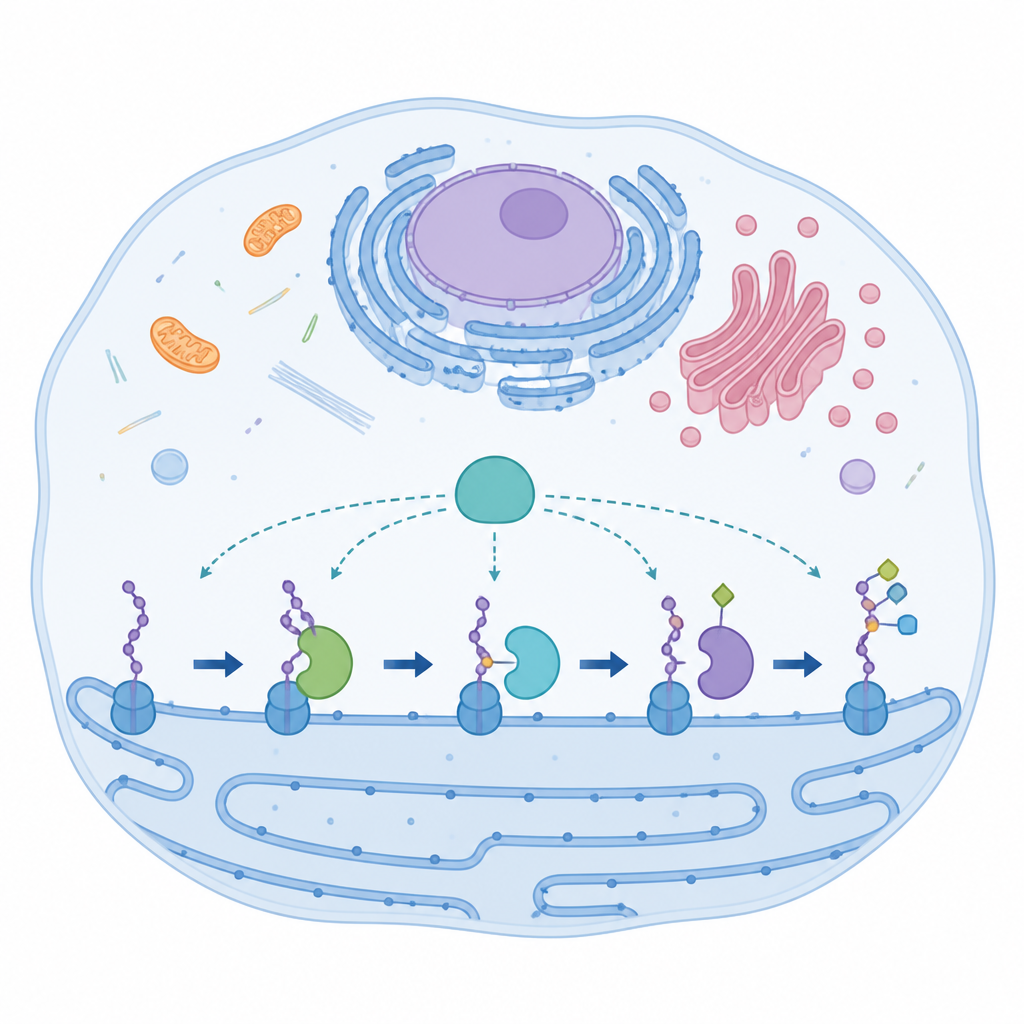
AspH operates inside a cell compartment called the endoplasmic reticulum, where it modifies short segments of proteins known as epidermal growth factor like domains. These domains help control processes such as blood clotting and cell signaling. Most related enzymes use a standard three pronged metal binding arrangement to hold an iron atom that drives chemistry. AspH breaks this rule: it uses only two histidine side chains from the protein plus a tightly held water molecule to grip iron. Despite this unusual setup, AspH can act on both aspartate and asparagine residues in its protein targets, hinting at a built in flexibility that researchers call promiscuity.
Watching chemistry inside crystals
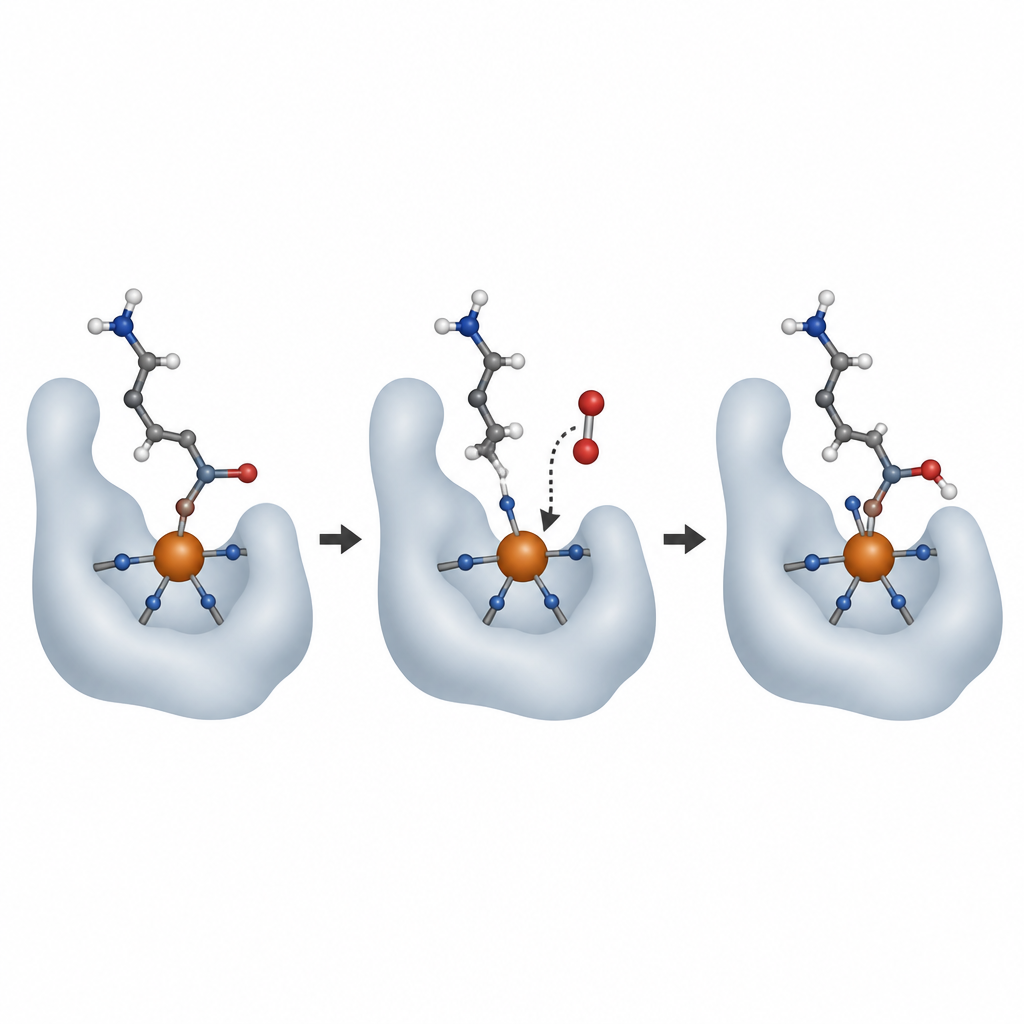
To see AspH in action, the team grew crystals of the active enzyme bound to its iron cofactor, helper molecule 2 oxoglutarate, and short protein substrates. Using high intensity X ray beams at powerful light sources, including X ray free electron lasers, they captured snapshots of the enzyme before and after it reacted with oxygen. At room temperature and even inside the rigid crystal lattice, AspH performed a single round of chemistry, adding an oxygen atom to the substrate and converting 2 oxoglutarate into succinate. The product’s new hydroxyl group swung around to bind the iron, taking the place of a water molecule that sat opposite one of the histidines in the starting state.
How oxygen finds its place
The scientists then asked where incoming oxygen binds and how the iron changes during the reaction. They used nitric oxide, a close mimic of oxygen that can be tracked by electron paramagnetic resonance spectroscopy, to stand in for O2. In both crystals and solution, nitric oxide attached to the iron at the same position previously occupied by that weakly bound water. Additional X ray emission measurements showed that, after a full turnover, the iron returned to its original Fe(II) state, consistent with the classic cycle in which iron briefly passes through higher energy forms to drive the reaction and then resets for another round. Carefully designed experiments with heavy oxygen gas (18O2) confirmed that the oxygen atom added to the protein comes directly from molecular oxygen, not from water, even though a water molecule is always bound to the metal.
Fine tuning and limits of enzyme flexibility
Subtle changes in the surrounding hydrogen bond network let AspH handle either aspartate or asparagine, but not equally well. A flexible glutamine side chain (Q627) shifts position to interact differently with each type of substrate and nearby waters, slightly changing how efficiently the reaction proceeds. The team also tested a pseudohalide, isothiocyanate, which can behave like halide ions that other related enzymes use to install chlorine or bromine atoms instead of oxygen. Isothiocyanate did bind to AspH’s iron, but at a site that does not support halogenation chemistry. This misplacement likely explains why AspH does not carry out halogenation, even though its iron site resembles that of known halogenating enzymes.
What this means for disease and therapy
AspH is frequently overproduced and mislocalized to the cell surface in several cancers, where its activity is linked to higher tumor invasiveness and worse outcomes. By clarifying how its unusual iron and water based metal site works, this study points to new strategies for drug design. Instead of only mimicking the helper molecule 2 oxoglutarate, future inhibitors could be crafted to displace the tightly held water or block the oxygen entry site, achieving greater selectivity for AspH over other essential human enzymes. Understanding this finely balanced chemistry also supports the idea that AspH may help cells sense oxygen levels, and it provides a structural framework for engineering related enzymes for new types of green chemical reactions.
Citation: de Munnik, M., Brasnett, A., Zhou, T. et al. Structural basis of the promiscuity of the unusual Fe(II) and 2-oxoglutarate dependent human aspartate/asparagine-β-hydroxylase. Nat Commun 17, 4267 (2026). https://doi.org/10.1038/s41467-026-69425-w
Keywords: AspH enzyme, protein hydroxylation, iron-dependent oxygenase, oxygen sensing, cancer biology