Clear Sky Science · en
Non-coding genome in nail-patella syndrome: Genetic diagnosis as a guide for personalized follow-up
Why this rare condition matters
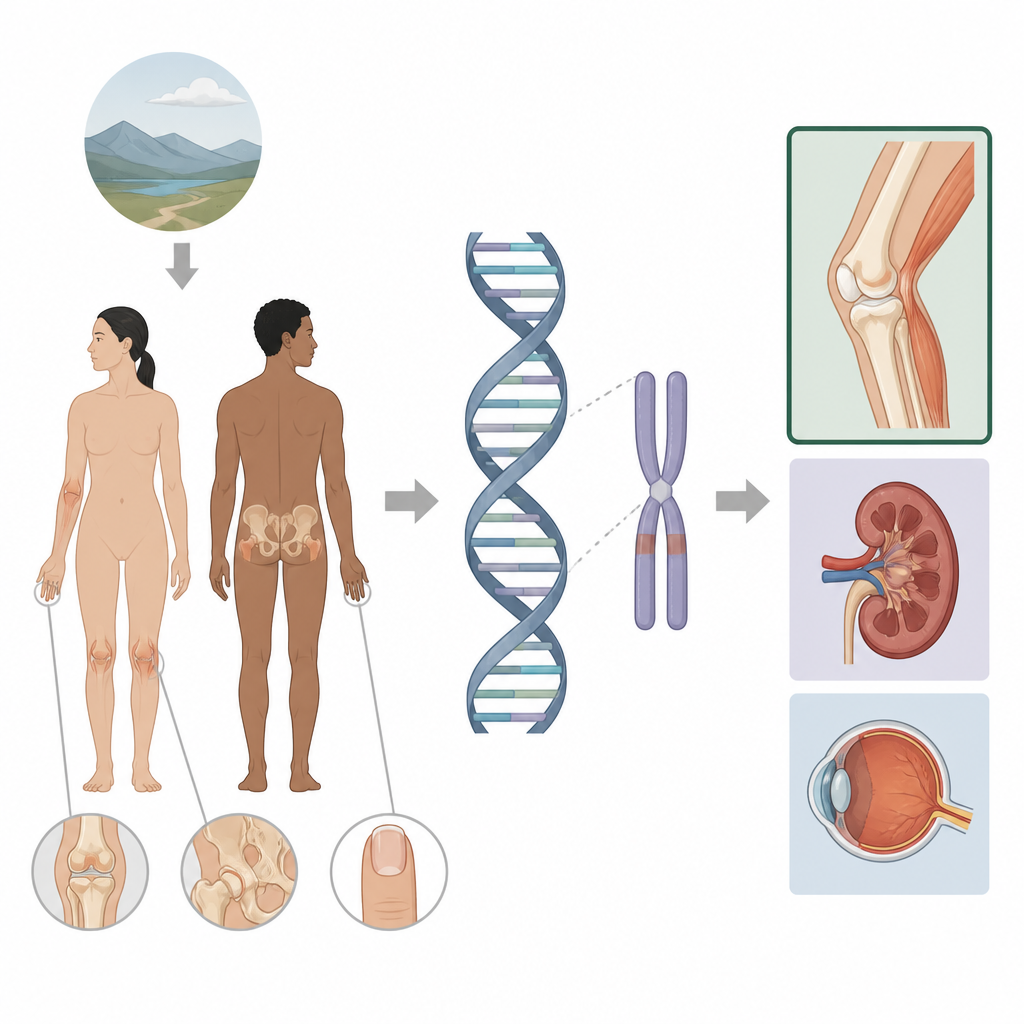
Nail Patella syndrome is an inherited condition that affects nails, knees, elbows and hip bones, and can sometimes involve the kidneys and eyes. This study explores why some people with the syndrome have only limb problems while others also develop kidney disease or glaucoma. By looking beyond the usual parts of a gene and into nearby control regions, the authors show how small changes in the so called non coding genome can fine tune where and when a gene is active, opening the door to more tailored medical follow up for affected families.
How a single gene shapes limbs, kidneys and eyes
Nail Patella syndrome is usually caused by damage to a gene called LMX1B, which helps shape the back side of our arms and legs and also plays a role in kidney filters and the front of the eye. When one copy of this gene is faulty, people often have absent or small kneecaps, bony bumps on the hips, and distinctive nail changes, and they may later develop kidney trouble or glaucoma. Standard genetic tests look at the protein coding part of LMX1B and nearby introns and already explain about 95 percent of known cases. Yet a small group of patients with clear clinical signs still had no detectable change in the gene itself, prompting the authors to search more widely around the gene.
Hidden switches in the DNA
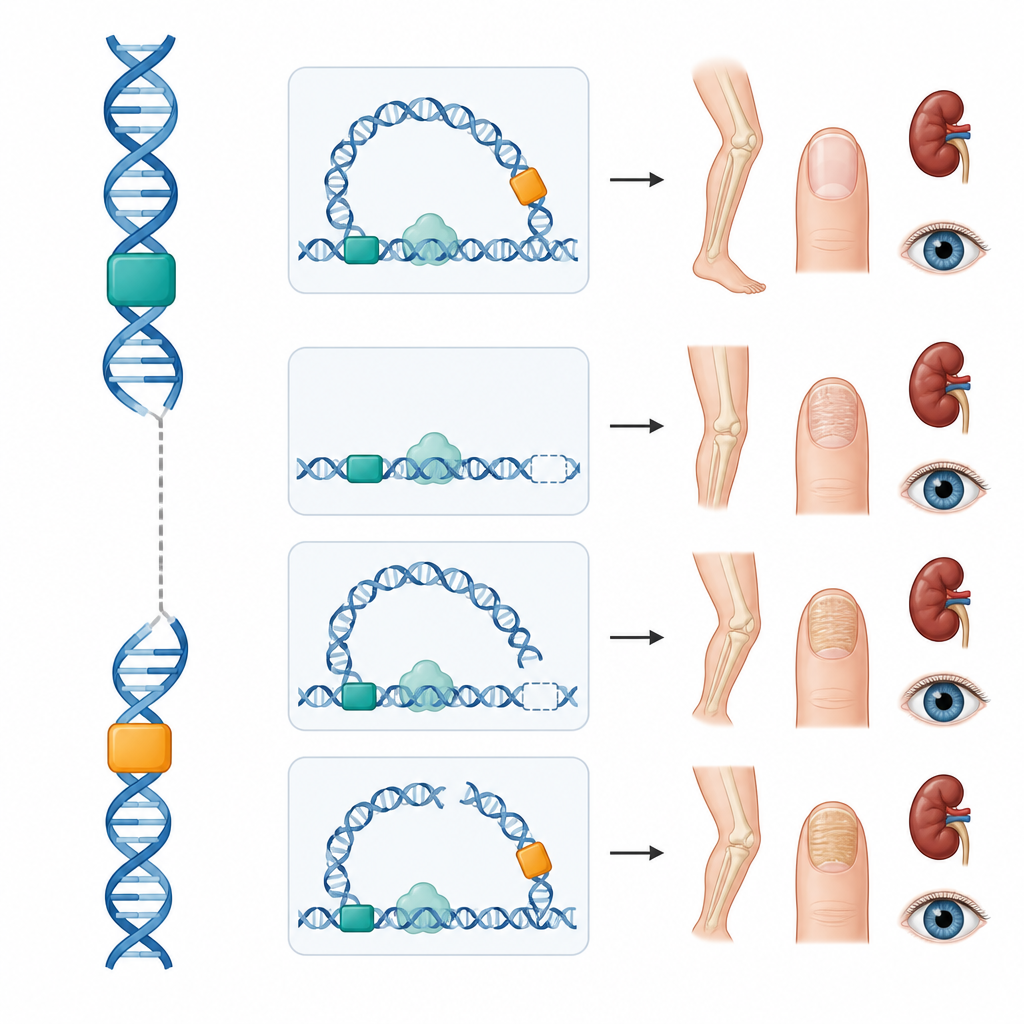
Recent work in mice revealed that LMX1B is controlled in the limb by two key DNA switches, called LARM1 and LARM2, that sit tens of thousands of letters away from the gene. These switches do not code for protein but act as enhancers, boosting gene activity in the developing limb. Turning both off in mice erases LMX1B activity in limbs while sparing kidneys and eyes, leading to skeletal changes without the full syndrome. Inspired by this, the researchers mapped the three dimensional folding of DNA around human LMX1B and combined public data on chemical marks and protein binding to predict additional switches that might control the gene in kidney and retina cells, all packed with the gene inside a shared neighborhood of the genome.
Four families with unusual genetic changes
The team then studied four people with Nail Patella syndrome who had normal LMX1B coding sequences. One young woman had a deletion that removed both limb enhancers while leaving the gene intact; she and several relatives had typical bone and nail findings but no kidney or eye disease. Two teenagers carried new chromosomal swaps in which a piece of chromosome 9 containing LMX1B had exchanged segments with chromosomes 16 or 5. In both, the break occurred between the gene and its limb enhancers, likely cutting the physical loop needed for these switches to talk to the gene. Again, the result was a limb only form of the syndrome. In the fourth family, a small change in the front untranslated part of LMX1B created a short extra reading frame that reduces the amount of LMX1B protein made, a mechanism previously shown in the lab; both mother and son were affected.
What this means for care and inheritance
Together, these cases show that changes outside the protein coding region can either block communication between enhancers and the gene or alter how the gene message is read. Because the limb switches seem to be the ones disrupted in these families, their kidneys and eyes appear spared so far, suggesting that follow up might be adapted once more is known. These findings also explain why the condition can sometimes behave as if it were recessive or limited to the skeleton when only certain switches are affected, complicating genetic counselling.
Looking ahead to more precise follow up
By extending genetic diagnosis to include non coding control regions, the authors raise the success rate of finding a molecular cause for Nail Patella syndrome to nearly 100 percent in their series. For patients and clinicians, knowing whether the gene itself or only particular switches are altered may help estimate the risk of kidney and eye problems and guide the intensity of monitoring. More broadly, this work illustrates how hidden DNA switches can underlie isolated malformations in many organs and highlights the need for careful analysis of structural changes in the genome when routine gene testing leaves questions unanswered.
Citation: Brunelle, P., Jourdain, AS., Escande, F. et al. Non-coding genome in nail-patella syndrome: Genetic diagnosis as a guide for personalized follow-up. Eur J Hum Genet 34, 597–602 (2026). https://doi.org/10.1038/s41431-026-02062-5
Keywords: Nail Patella syndrome, LMX1B, non coding DNA, enhancer, genetic diagnosis