Clear Sky Science · en
Sex-Specific regional brain activity and cognitive function in mild cognitive impairment: An rs-fMRI study
Why this research matters to families
Mild cognitive impairment is often described as a middle ground between normal aging and dementia. Many families want to know who is most at risk, how the brain is changing, and whether men and women are affected in the same way. This study uses brain scanning to look at resting brain activity in older adults, asking whether subtle differences between male and female brains with mild memory and thinking problems might explain why women are more likely to develop dementia.
Looking at the resting brain
Scientists in Guangzhou, China, invited 86 people with mild cognitive impairment and 107 healthy older adults to take part. All volunteers completed a broad set of memory and thinking tests covering language, attention, problem solving, and visual skills. They also lay quietly in an MRI scanner while a special type of brain scan, called resting-state functional MRI, measured natural activity patterns across the brain. Instead of focusing on tasks, this scan watches how tiny signals in neighboring brain areas rise and fall together over time.
Two key brain hubs stand out
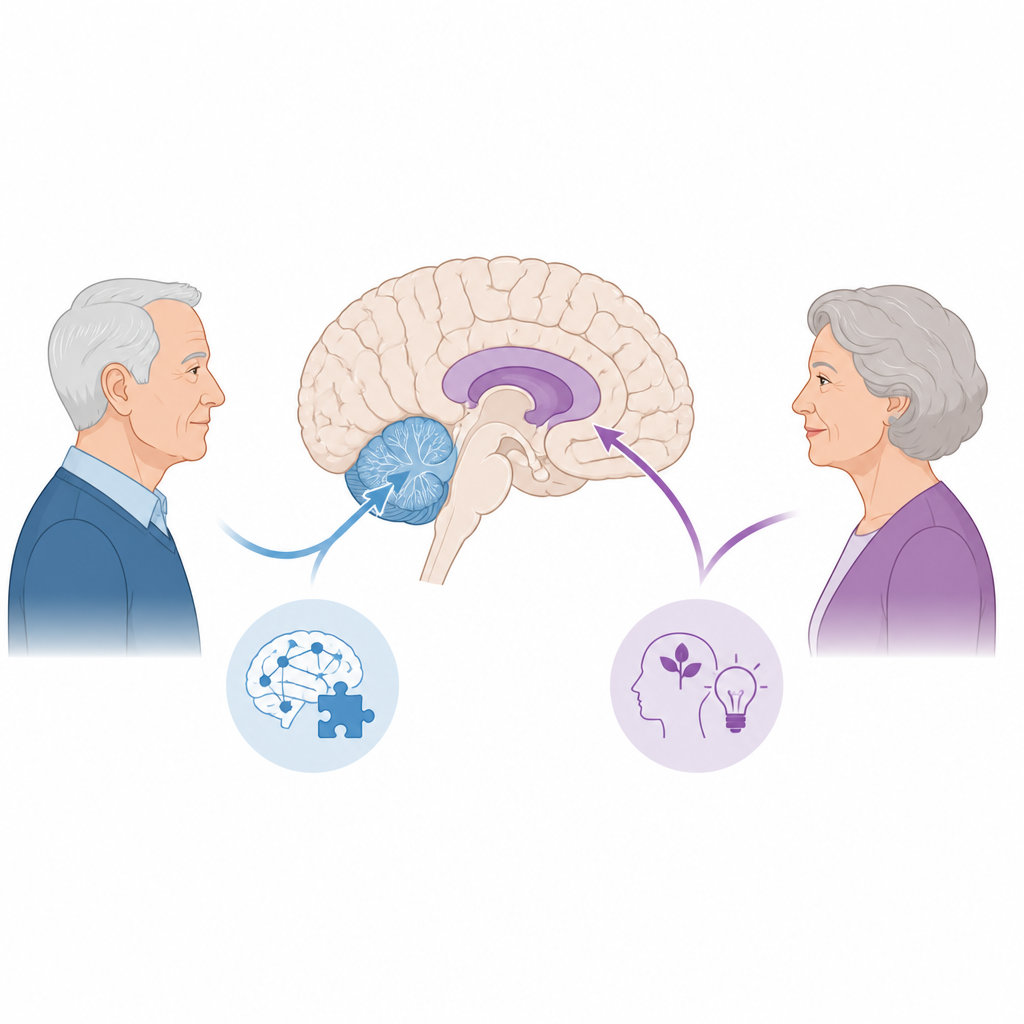
The team calculated a measure called regional homogeneity, which tracks how tightly a small cluster of brain cells "fires" in sync. They compared four groups: men with mild cognitive impairment, women with mild cognitive impairment, and similarly aged healthy men and women. Two regions emerged as especially important. One was the lower part of the cerebellum at the back of the brain, better known for balance but also involved in thinking. The other was the hippocampus deep inside the brain, which plays a central role in memory and attention.
Different patterns for men and women
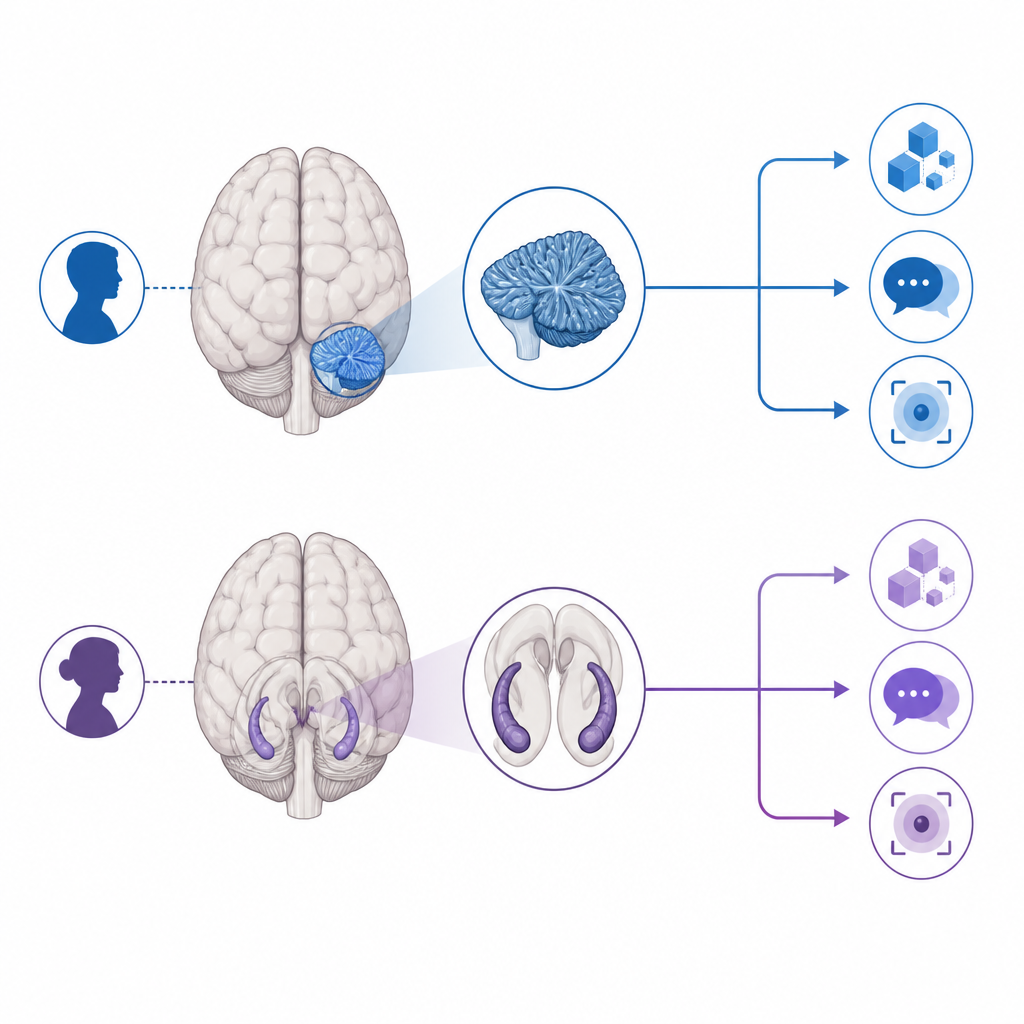
Women with mild cognitive impairment showed higher regional homogeneity in the right lower cerebellum than both healthy women and men with the condition. Men with mild cognitive impairment, in contrast, showed higher regional homogeneity in the left hippocampus than healthy men and women with the condition. These sex-specific patterns were not seen in the same way among the healthy volunteers, suggesting that early brain changes in mild cognitive impairment follow different routes in men and women rather than simply being weaker or stronger versions of the same change.
Linking brain signals to everyday thinking
The researchers then asked how these local activity patterns related to test scores. In men with mild cognitive impairment, activity in the right lower cerebellum was tied to performance on complex drawing and clock tasks that tap visual and spatial skills. In women with the condition, the same cerebellar region was linked to language tasks and drawing a clock. For the hippocampus, men showed a connection between its activity and a detailed verbal memory test, while women showed links to overall thinking scores and attention span. Statistical models suggested that sex itself shaped how strongly these brain measures and thinking scores were related in mild cognitive impairment, but not in healthy aging.
What this means for future care
To a lay reader, the main message is that mild cognitive impairment does not affect all brains in the same way. In this study, women with the condition showed a stronger signal in a cerebellar region tied to language and spatial skills, while men showed a stronger signal in the hippocampus tied to memory and attention. These sex-specific patterns and their different links to test performance hint that men and women may travel along somewhat different brain paths on the way to dementia. In the long run, mapping these differences could help doctors design screening tools and brain-based treatments that are better tailored to the needs of women and men rather than assuming one pattern fits all.
Citation: Liu, Q., Chen, B., Su, T. et al. Sex-Specific regional brain activity and cognitive function in mild cognitive impairment: An rs-fMRI study. Transl Psychiatry 16, 271 (2026). https://doi.org/10.1038/s41398-026-03985-9
Keywords: mild cognitive impairment, sex differences, resting-state fMRI, cerebellum, hippocampus