Clear Sky Science · en
Normative age-related structural brain deviations underlying psychopathology, cognitive impairment and neurological soft signs in schizophrenia spectrum disorders
Why Brain Changes in Schizophrenia Matter
Schizophrenia spectrum disorders are often thought of as illnesses of thoughts and emotions, but they also leave subtle fingerprints in the structure of the brain. This study asks a practical question with real-world implications: can we use large brain databases to spot when an individual’s brain is aging or developing differently, and do those differences help explain everyday problems with thinking, attention, and movement in people with schizophrenia? The answer could shape earlier diagnosis and more tailored treatment.
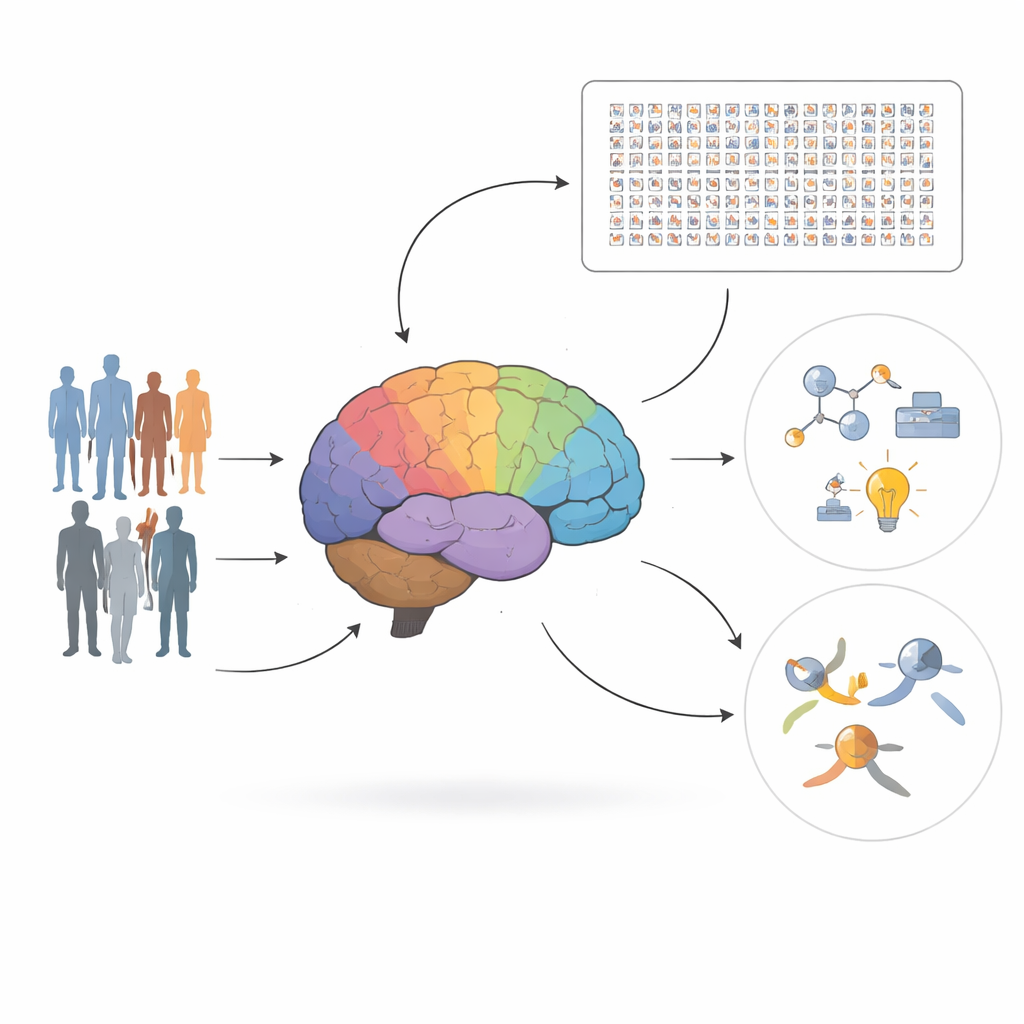
Looking for What Is "Normal" in the Brain
Instead of simply comparing patients to healthy volunteers on average, the researchers used a “normative” approach. They started from an existing model built from brain scans of about 57,000 healthy people across many sites and ages. This model captures how features such as cortical thickness and the size of deep brain structures usually change over the lifespan. The team then took MRI scans from 831 people in six separate groups—some with schizophrenia spectrum disorders and some without—and asked, for each person and each brain region, how far they deviated from what would be expected for someone of the same age and sex.
Teaching a Computer to Tell Brains Apart
Using these deviation maps, the team trained a machine-learning method called a random forest to distinguish people with schizophrenia spectrum disorders from healthy controls. Crucially, they tested the model in a stringent way: always leaving out an entire study site and asking whether a model trained on the others still worked. The system reached a balanced accuracy of about 65 percent—well above chance, but not perfect—showing both that structural differences are real and that schizophrenia is highly variable from person to person. The total amount of gray matter, the average thickness of the cortex, and changes in regions involved in emotion and movement emerged as especially informative.
Connecting Brain Changes to Thinking and Movement
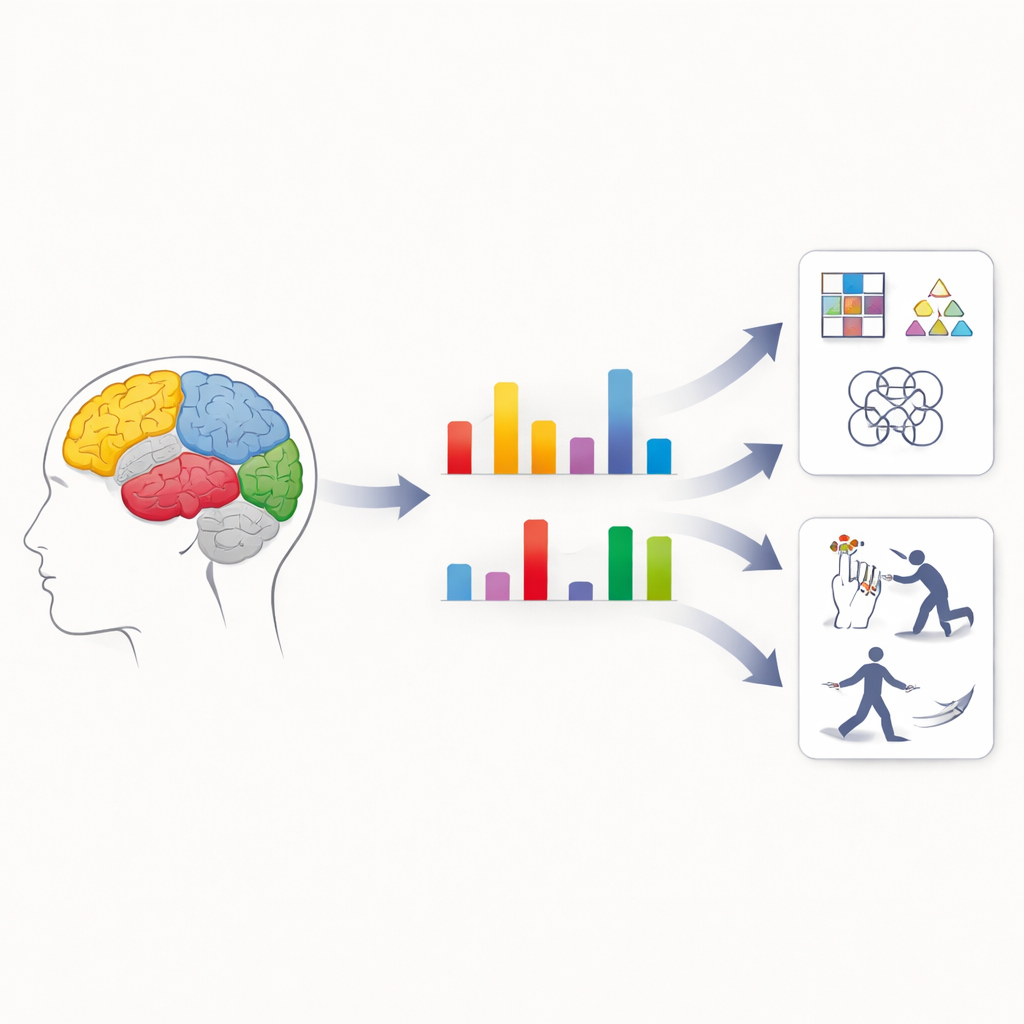
Next, the authors moved beyond simple classification to ask what these deviations actually mean for daily life. In two deeply characterized patient groups, they related brain deviations to performance on thinking tests and to so‑called neurological soft signs—subtle problems with coordination, complex movements, and spatial orientation. People whose brains showed more extreme negative deviations, especially in motor and limbic areas, tended to have slower mental processing, weaker attention, and more movement-related signs. A multivariate analysis that considered many brain measures and behaviors at once revealed a robust pattern: larger fluid-filled spaces and altered deep structures went hand-in-hand with poorer coordination and thinking skills, while lower overall gray matter and thinner sensorimotor cortex were linked to cognitive slowing.
Many Paths, Not One, to the Same Diagnosis
When the team counted how many brain regions in each person fell far below the normal range, they saw a clear difference between patients and healthy volunteers. Most people with schizophrenia spectrum disorders had at least one strongly affected region, and many had several. Yet only a handful of specific regions showed extreme deviations in more than one in ten patients. In other words, there was no single “schizophrenia brain”; instead, individuals showed different constellations of changes that nonetheless pointed toward similar problems in thinking speed and bodily control.
What This Means for Future Care
For non-specialists, the bottom line is that this work uses large-scale brain charts to move psychiatry closer to the personalized tools already seen in other areas of medicine. By anchoring each person’s scan to an age-appropriate norm, the approach can highlight which brain systems are unusually affected in that individual and how those changes relate to attention, planning, and movement. While the current accuracy is not yet sufficient for diagnosis on its own, the study shows that transferred normative models can work across hospitals and scanning centers. Over time, combining this type of structural mapping with other brain and behavioral data may help clinicians identify earlier who is at risk, track disease progression more precisely, and tailor interventions to the specific brain–behavior profile of each patient.
Citation: Volkmer, S., Kubera, K.M., Fritze, S. et al. Normative age-related structural brain deviations underlying psychopathology, cognitive impairment and neurological soft signs in schizophrenia spectrum disorders. Transl Psychiatry 16, 197 (2026). https://doi.org/10.1038/s41398-026-03956-0
Keywords: schizophrenia, brain structure, cognition, neuroimaging, precision psychiatry