Clear Sky Science · en
EGFR ligand Angiogenin predicts response to ALK5 inhibition in pancreatic cancer via a TNF-α paracrine axis in tumor-associated macrophages
Why this research matters for patients
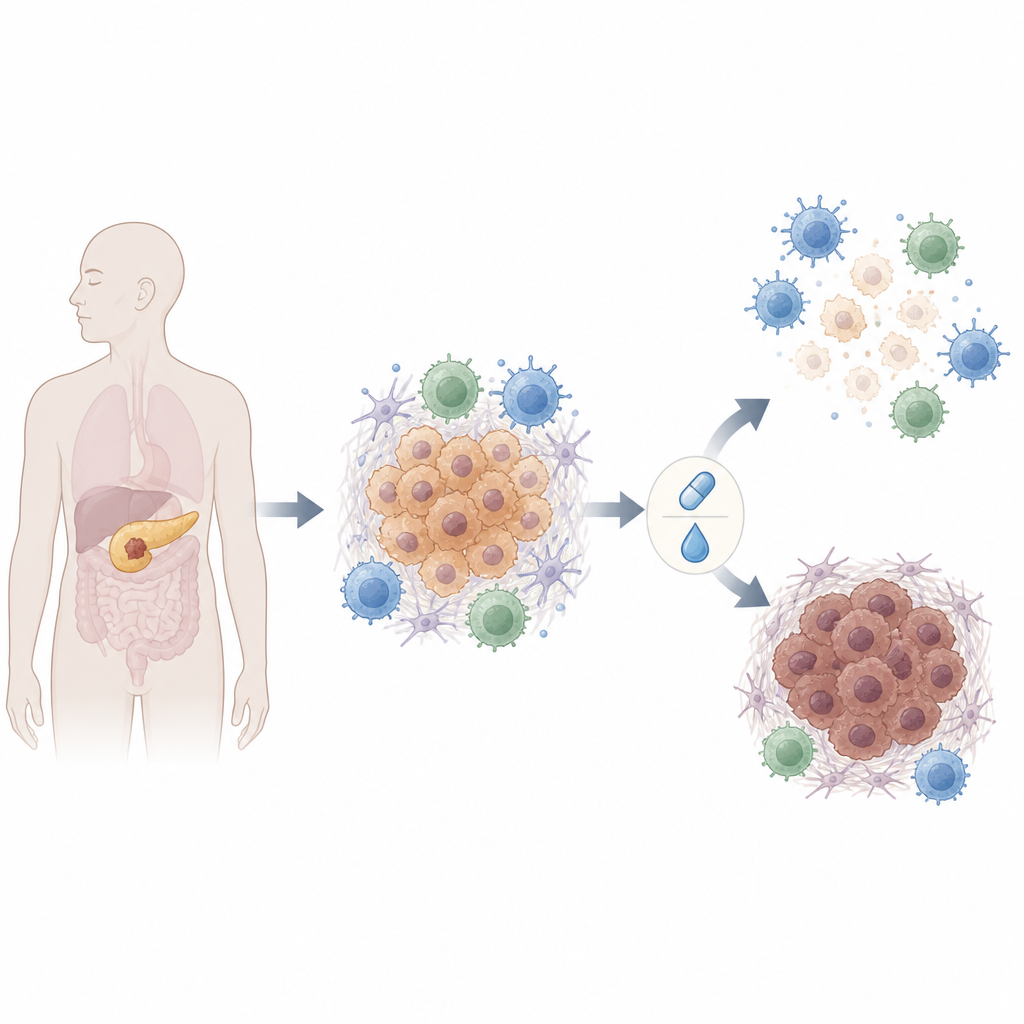
Pancreatic cancer is one of the hardest cancers to treat, with most patients living only a short time after diagnosis. Many drugs that look good in the lab fail in real people because tumors differ from patient to patient. This study asks a simple but crucial question: can we find a blood marker that tells us which patients will benefit from a specific experimental drug added to standard chemotherapy?
A signal hidden in the blood
The researchers focused on a protein called angiogenin, which is released by tumor cells into the bloodstream. In a clinical trial where people with advanced pancreatic cancer received standard chemotherapy with or without an experimental drug that blocks a pathway called ALK5, they measured angiogenin levels before treatment. Patients with high angiogenin did worse when they received chemotherapy alone, surviving only about half as long as those with low levels. Yet when the ALK5-blocking drug galunisertib was added, the high-angiogenin group lived significantly longer than similar patients given chemotherapy alone. This turned angiogenin into a double-edged marker: bad news for prognosis, but good news for predicting who might benefit from adding ALK5 inhibition.
How tumor and immune cells team up
To understand why angiogenin matters, the team turned to mouse models and cell cultures. They found that tumors producing a lot of angiogenin grew faster and were packed with a particular type of immune cell called tumor-associated macrophages. These cells can behave either like fighters that attack cancer or like helpers that protect it. In high-angiogenin tumors, macrophages were pushed into the helper state, often called an M2-like state, which supports tumor growth and weakens the response of killer T cells. When the scientists reduced angiogenin in tumor cells, tumors grew more slowly and macrophages shifted back toward a more hostile, tumor-fighting state.
A chain of signals that drives resistance
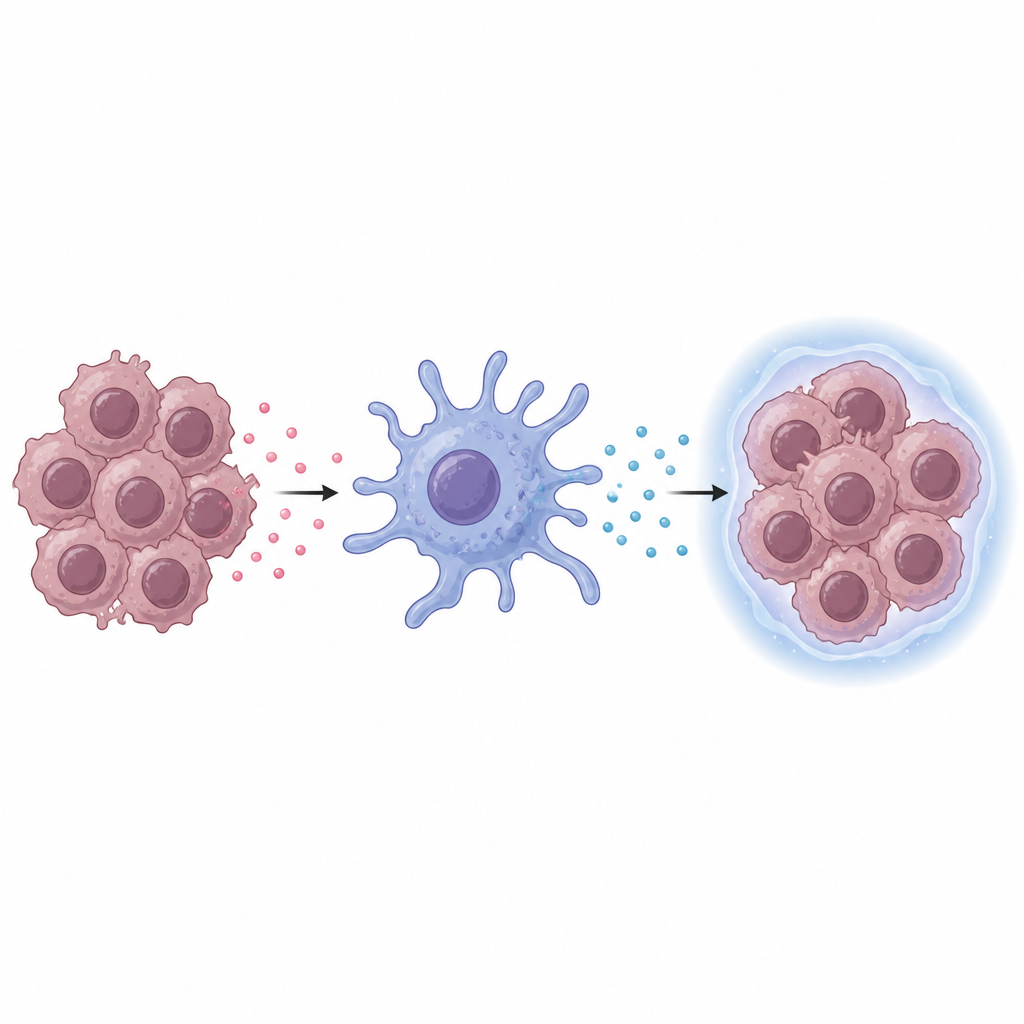
Zooming in further, the researchers discovered that angiogenin does not act alone. It binds to a well-known surface molecule called EGFR on macrophages, which then reshapes their internal skeleton and switches on a signaling route controlled by ALK5. This, in turn, makes macrophages release an active form of another protein, TGFβ, onto themselves, locking in the helper state. A key consequence is that these reprogrammed macrophages start producing large amounts of the inflammatory molecule TNFα. TNFα then bathes nearby tumor cells and flips on a survival program known as NF-κB, making cancer cells less sensitive to the chemotherapy drug gemcitabine.
Blocking the loop to restore drug sensitivity
Armed with this map of signals, the team tested whether breaking the chain could restore chemotherapy response. In mice with angiogenin-high tumors, adding the ALK5-blocking drug to gemcitabine lengthened survival, reduced the number of helper-like macrophages, lowered TNFα levels in the blood, and kept NF-κB out of the tumor cell nuclei, where it would normally drive resistance genes. In contrast, tumors with low angiogenin saw little benefit from adding the ALK5 blocker. In cell culture, blocking either ALK5 or TNFα made high-angiogenin tumor cells more sensitive to gemcitabine when macrophages were present, and adding extra TNFα could undo the benefit of ALK5 inhibition.
What this could mean for future care
The researchers then returned to their clinical trial samples and confirmed that patients with high angiogenin also tended to have higher levels of TNFα in their blood. Among these high-angiogenin patients treated with galunisertib and gemcitabine, those whose TNFα levels fell during therapy lived notably longer than those whose TNFα stayed high. For a layperson, the take-home message is that the tumor sends a signal (angiogenin) that reprograms nearby immune cells to secrete another signal (TNFα), which shields cancer cells from chemotherapy. Blocking the ALK5 step in this loop can weaken that shield, but only in tumors that rely heavily on angiogenin. Measuring angiogenin, and possibly TNFα, in the blood may therefore help doctors select pancreatic cancer patients most likely to benefit from adding ALK5-targeted drugs to standard chemotherapy.
Citation: Pietrobono, S., De Vita, V., Mangiameli, D. et al. EGFR ligand Angiogenin predicts response to ALK5 inhibition in pancreatic cancer via a TNF-α paracrine axis in tumor-associated macrophages. Oncogene 45, 1901–1913 (2026). https://doi.org/10.1038/s41388-026-03774-0
Keywords: pancreatic cancer, angiogenin, tumor microenvironment, chemotherapy resistance, tumor-associated macrophages