Clear Sky Science · en
Hedonic hotspot in rat olfactory tubercle: map for mu-opioid, orexin, and muscimol enhancement of sucrose ‘liking’
The Brain’s Sweet Spot for Pleasure
Why does a spoonful of sugar feel so good, and how does the brain turn a simple taste into a burst of pleasure? This study pinpoints a tiny “pleasure zone” deep in the rat brain that boosts the joy of sweetness—and an opposing zone nearby that can dampen it. Understanding how these circuits work in animals may eventually help explain why some people overeat, lose enjoyment from food, or experience changes in pleasure when the sense of smell is damaged.
A Small Area with a Big Role in Enjoying Food
Researchers focused on a little-studied structure called the olfactory tubercle, a part of the brain that receives smell signals but is also wired into major reward circuits. Earlier work showed that its front inner portion tends to drive approach toward food-related smells, while its outer side is more involved in avoidance of threatening odors. What was unknown is whether this region does more than guide approach or avoidance—specifically, whether it can turn up or turn down the actual pleasant feeling of sweetness itself. To test this, the team examined rats’ instinctive facial reactions to sugar water, a well-established window into how much animals “like” or “dislike” tastes.
Watching Faces to Read Pleasure and Disgust
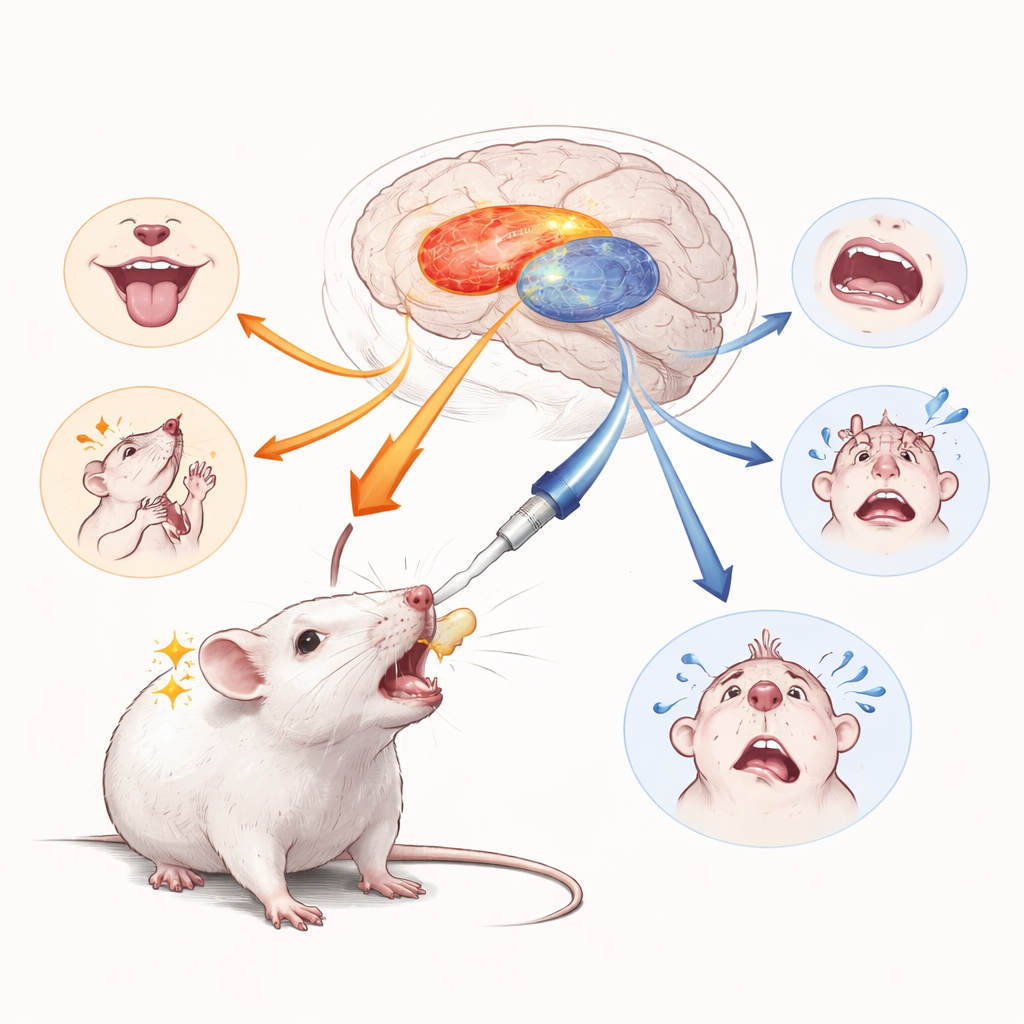
Rats received tiny injections of three different brain-acting substances into either the inner front (anteromedial) or outer front (anterolateral) part of the olfactory tubercle. The drugs were chosen because they are known to boost pleasure in other reward centers: a mu-opioid stimulator (similar in family to the body’s own endorphins), an orexin peptide involved in appetite and arousal, and a GABA-based compound that briefly quiets local brain cells. After each injection, the researchers gently pumped a weak sugar solution directly into the rats’ mouths and filmed their natural mouth and body movements. Licking paws, rhythmic tongue flicks, and certain types of lip movements signaled “liking,” while gapes, head shakes, and face washes indicated “disgust.” Every frame of video was scored to see how the drugs changed these reactions compared with a harmless saltwater injection.
A Pleasure Hotspot and a Neighboring Cold Zone
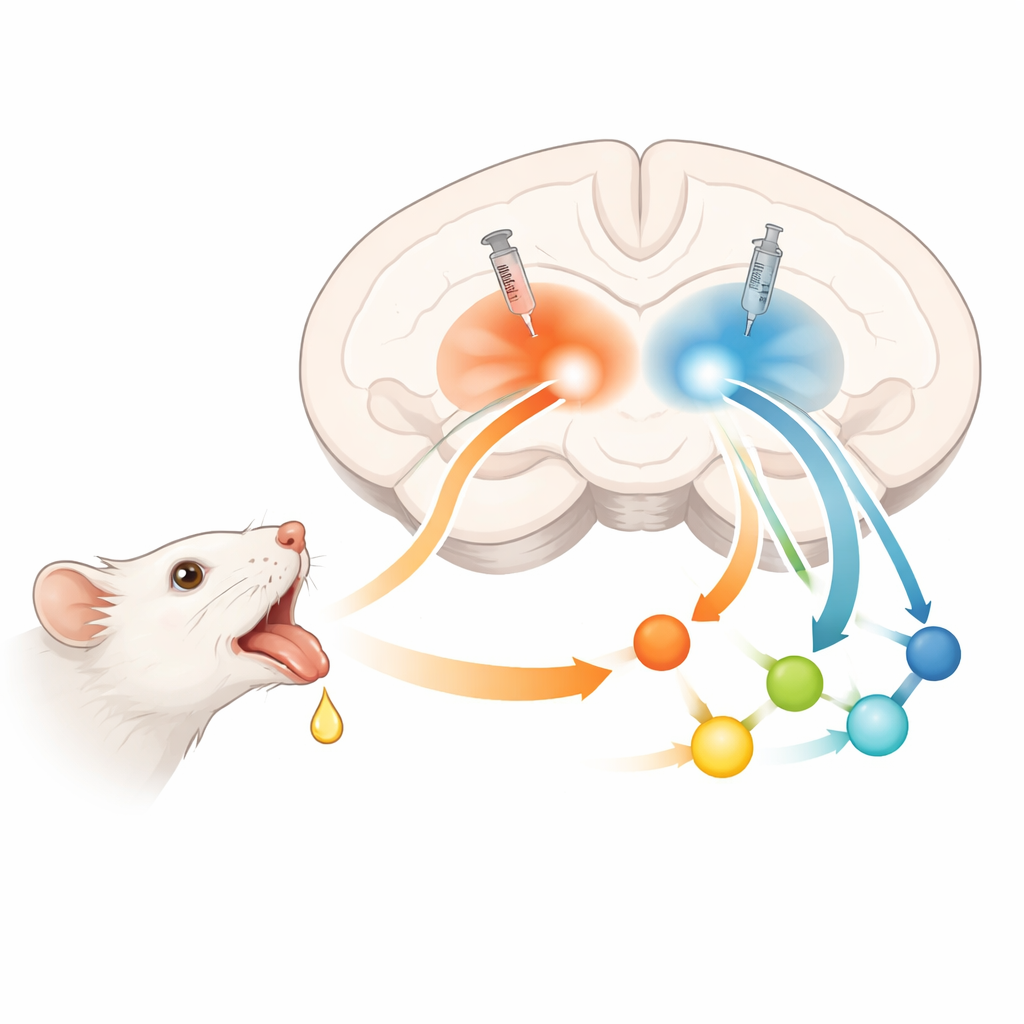
The results revealed a striking emotional map inside the olfactory tubercle. When any of the three drugs were placed into the anteromedial region, rats showed far more “liking” reactions to the same sugar taste—often nearly twice as many as usual. At the same time, occasional mild “disgust” responses to the sweet solution became even rarer. This pattern identifies the anteromedial olfactory tubercle as a “hedonic hotspot,” a small patch of tissue where the right chemical nudge can strongly magnify the pleasure of sweetness. In sharp contrast, similar injections into the anterolateral side did not increase pleasure. In fact, mu-opioid stimulation there reduced “liking” and pushed behavior in a more negative direction, suggesting a nearby “coldspot” that can mute or oppose positive feelings.
A Network That Spreads the Feeling of Pleasure
To see how far the ripple of pleasure spreads, the researchers looked for activation of a marker called Fos, which lights up in neurons that have recently been strongly active. After boosting the anteromedial hotspot with the mu-opioid drug, they found a compact “plume” of activated cells right around the injection site, confirming that the effect was local. But they also saw increased activity in several distant regions already known to take part in pleasure, including parts of the ventral pallidum and orbitofrontal cortex, along with other reward- and appetite-related hubs. This pattern suggests that switching on the olfactory tubercle hotspot does not work in isolation; instead, it recruits a wider network of brain areas that together shape how good sweetness feels.
Smell, Flavor, and the Joy of Eating
Because the olfactory tubercle sits at the crossroads of smell and reward, this newly charted hotspot may help explain why odors and flavor are so important for the enjoyment of food. Damage to smell pathways often robs people of the joy of eating, and brain imaging in humans links activity in this region to how pleasant scents are judged. By showing that a specific piece of the olfactory tubercle can amplify or suppress “liking” for sweetness, this work adds a crucial piece to the puzzle of how the brain turns sensory signals into rich, emotionally colored experiences—and why, when these circuits go awry, pleasure from food and other rewards can be distorted or lost.
Citation: Murata, K., Berridge, K.C. Hedonic hotspot in rat olfactory tubercle: map for mu-opioid, orexin, and muscimol enhancement of sucrose ‘liking’. Neuropsychopharmacol. 51, 984–996 (2026). https://doi.org/10.1038/s41386-026-02374-6
Keywords: food pleasure, olfactory tubercle, brain reward, sweet taste, hedonic hotspot