Clear Sky Science · en
Multifunctional fiber-optic theranostic probe for closed-loop tumor photothermal therapy
A Tiny Fiber Fighting Hidden Tumors
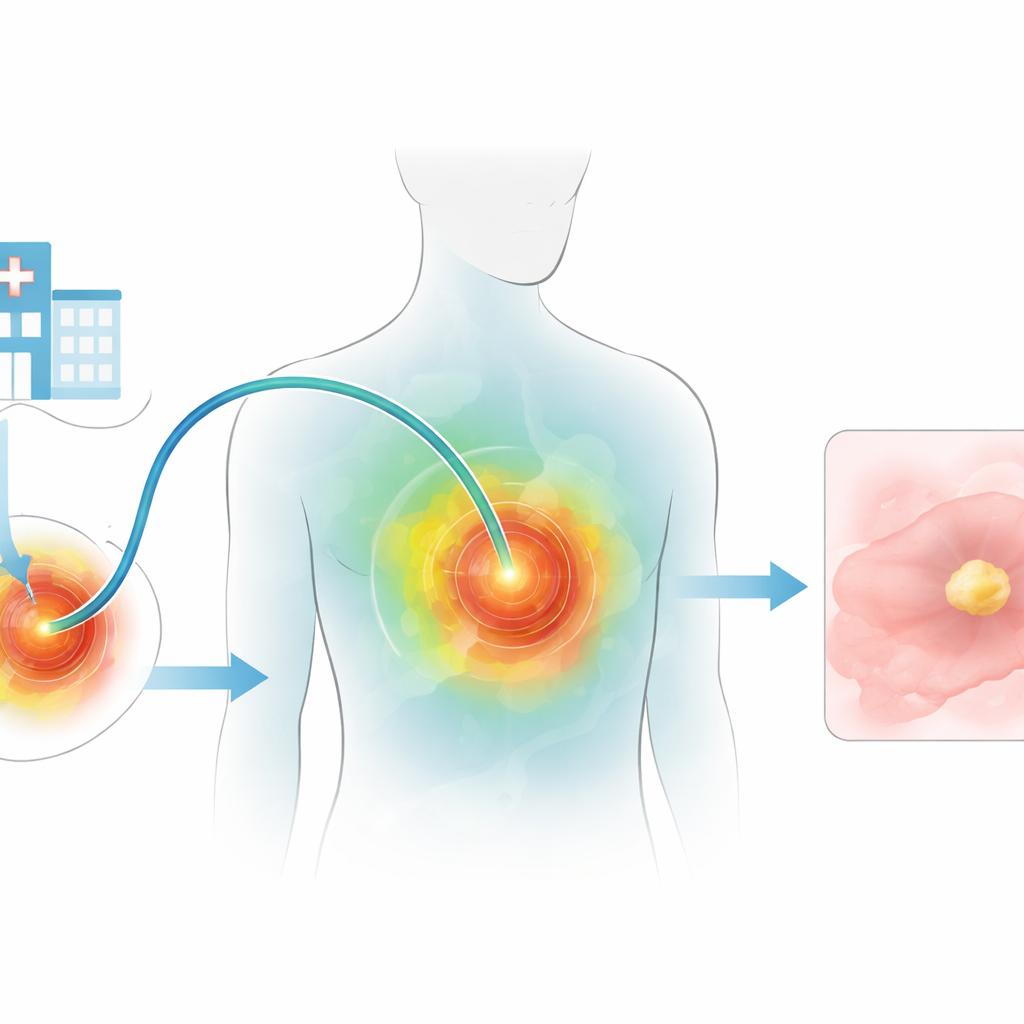
Cancer specialists face a stubborn problem: how to precisely destroy tumors buried deep in the body without cutting large openings or harming nearby healthy tissue. This study introduces a hair-thin optical fiber probe that can slip directly into a tumor, heat it to deadly temperatures, and at the same time "listen" to the tumor’s chemistry and temperature in real time. The result is a closed-loop treatment tool that can find tumor edges, apply just enough heat, and quickly judge whether the therapy is working.
Why Heating Tumors Is Hard
Light-based cancer treatments promise highly localized damage to tumors, sparing the rest of the body. But light does not travel far through tissue, and many current methods rely on nanoparticles that circulate throughout the body, raising concerns about long-term toxicity. Existing fiber probes usually do only one job per fiber—either treat or sense—and often require multiple separate fibers, which means bigger incisions, stiffer devices, and more irritation for patients. Clinicians also rarely get live feedback during treatment, making it difficult to avoid underheating the tumor or overheating healthy tissue.
A Single Fiber That Sees, Heats, and Checks
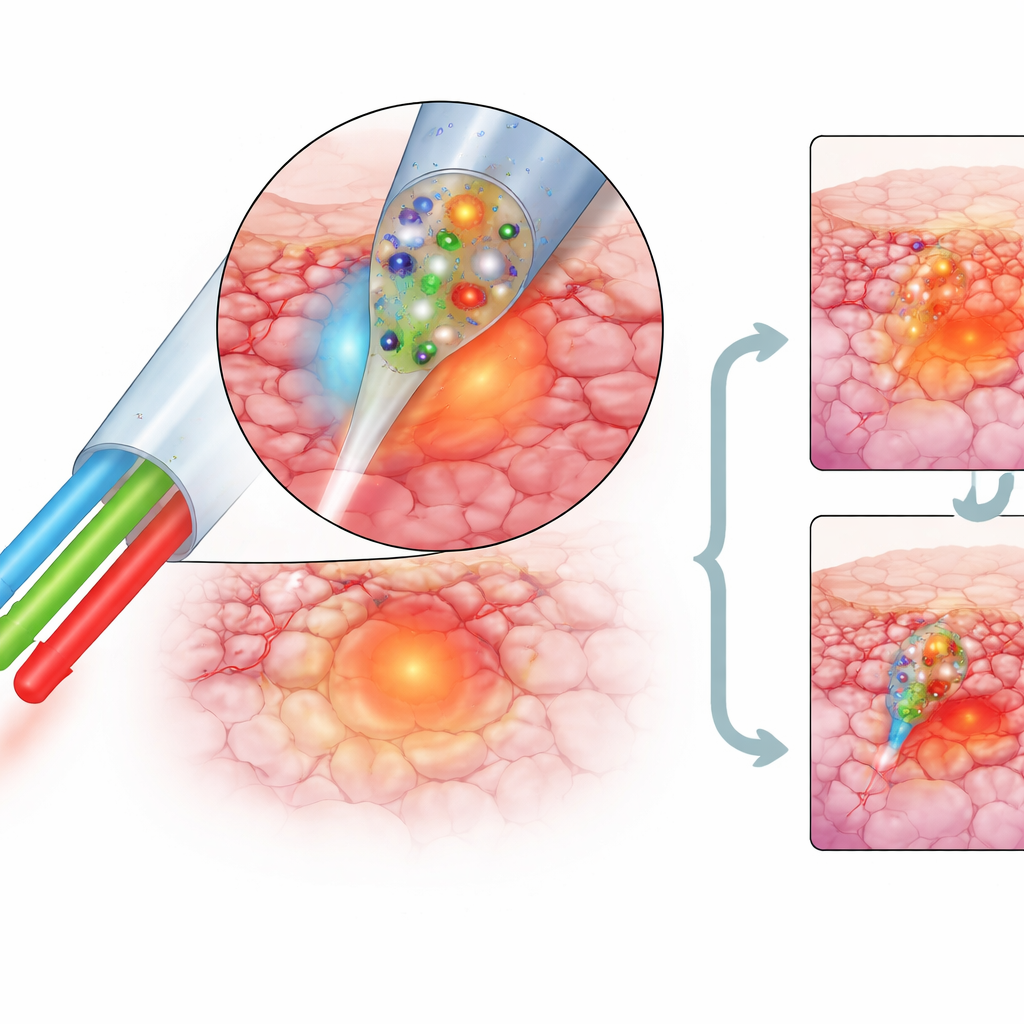
The researchers tackled these challenges by packing three different light-responsive ingredients onto the tapered tip of a single optical fiber. The tip, only about as wide as a human hair, is coated with a thin hydrogel layer that holds: a pH-sensitive dye to map how acidic the tumor environment is, a temperature-sensitive material to read out local heat, and a dye that converts near-infrared light into heat for therapy. Crucially, each component responds to a different color of light, a strategy borrowed from telecommunications called wavelength division multiplexing. By simply changing the input wavelength, doctors can switch the same fiber between pH sensing, temperature sensing, and heating without the signals interfering with one another.
Listening to the Tumor’s Chemistry
Many tumors create an acidic environment around themselves, and the degree of acidity is closely tied to how aggressive they are. The team’s pH sensor can detect tiny shifts in acidity—smaller than two-hundredths of a pH unit—in the range relevant to both healthy and cancerous tissue. In mice with colorectal tumors, the probe clearly distinguished tumor tissue from normal tissue and could even tell where the tumor ended and healthy tissue began, based on how the acidity changed from the center to the edge. After treatment, the same probe tracked a gradual shift toward less acidic conditions, signaling healthier tissue behavior and providing an early marker that the therapy was taking effect.
Smart Heating with Built-In Temperature Control
To ensure the tumor is destroyed without harming nearby structures, the probe continuously measures its own temperature. A specially designed light-emitting material inside the coating changes its color balance as it warms, allowing the system to infer temperature with a precision of about a third of a degree Celsius near body temperature and with even higher sensitivity at higher treatment temperatures. When the heating dye is activated by an infrared laser delivered through the same fiber, the tip can reach more than 100 degrees Celsius in the lab using less power than many nanoparticle systems require. In living mice, the researchers held the fiber at about 65 degrees Celsius for 15 minutes, enough for the tumor’s outer regions to reach a therapeutic temperature without obvious harm to the animals.
Results Inside Living Tumors
In mouse experiments, this closed-loop approach proved both effective and gentle. Before heating, the pH readings helped locate the tumor and define its boundaries. During treatment, the probe’s temperature readout guided the heating dose. Afterward, repeated pH measurements showed a steady reduction in acidity, reflecting improved blood flow and fewer active cancer cells. Over the following days, most treated tumors shrank or disappeared, while untreated tumors kept growing. Tissue analysis confirmed widespread tumor cell death, reduced signs of oxygen starvation, and lower cell proliferation in treated animals, with no major damage detected in vital organs.
What This Could Mean for Patients
In simple terms, the authors have built a multifunctional "fiber doctor" that can find a tumor, burn it from the inside with light, and immediately check whether the job is done—all through a single, very small probe. Because the system separates each function by color, more sensing and treatment modules could be added in the future without needing extra fibers. The same design ideas could be translated to softer, more flexible fibers for long-term implants. If developed further for human use, this technology could enable more precise, less invasive cancer treatments with real-time feedback, helping clinicians tailor therapy to each patient while minimizing collateral damage.
Citation: Li, Z., Li, Z., Cheng, Z. et al. Multifunctional fiber-optic theranostic probe for closed-loop tumor photothermal therapy. Light Sci Appl 15, 216 (2026). https://doi.org/10.1038/s41377-026-02219-3
Keywords: fiber-optic cancer therapy, photothermal tumor ablation, tumor microenvironment pH, minimally invasive theranostics, real-time temperature sensing