Clear Sky Science · en
Studies on pottery bodies of Caoxieshan site during Majiabang-era and a preliminary exploration of tremolite
Ancient pots and hidden trade routes
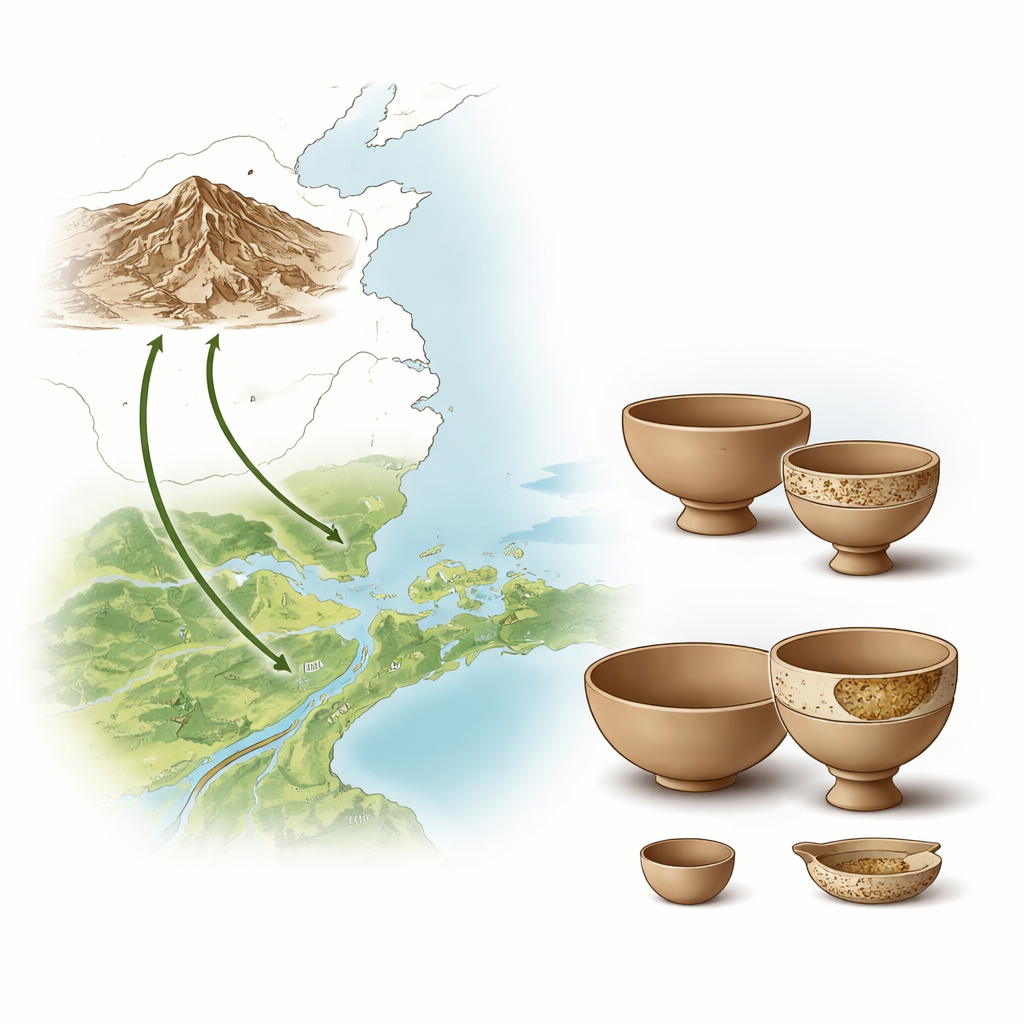
Long before silk roads and bronze bells, communities around China’s Taihu Lake were already linked by the quiet traffic of clay, stone, and skill. This study looks at broken pots from the Caoxieshan site, a Neolithic settlement near today’s Suzhou, to ask a surprisingly modern question: how far did everyday materials travel, and what does that say about early Chinese civilization? By peering inside the pottery with microscopes and chemical tools, the researchers uncover evidence for sophisticated craftsmanship and long-distance movement of a prized stone usually known from jade, pushing back the story of technological innovation and exchange in the Yangtze River Delta.
A lakeside village in a changing world
Caoxieshan sits on the eastern edge of the Taihu Lake plain, in a landscape of low, wet fields and tangled waterways that favored early rice farming. The site preserves layers of occupation from about 7000 years ago into historic times, but this study focuses on pottery from the late Majiabang culture, roughly 6000 years before present. At that time, the region’s warm, humid climate and fertile silty soils supported dense settlements and a rich tapestry of cultures along both the Yangtze and Yellow Rivers. Archaeologists see Caoxieshan as a key reference point for understanding how Neolithic societies in the Lower Yangtze developed, interacted, and eventually gave rise to later, more famous cultures such as Liangzhu.
Looking inside the pots
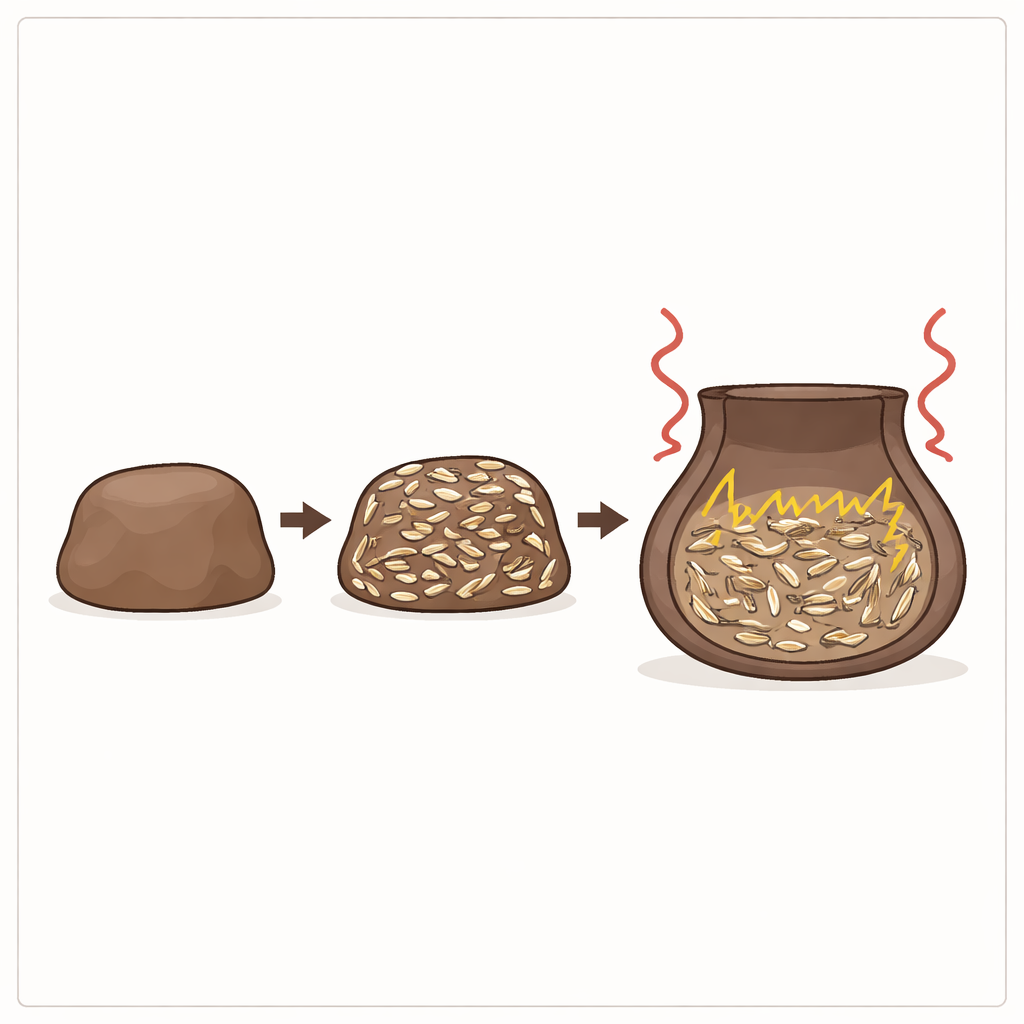
To move beyond surface style and decoration, the team selected 47 sherds from everyday contexts—bowls, basins, and stemmed dishes—from carefully dated layers of the late Majiabang period. They combined several laboratory techniques to probe the pottery bodies: microscopes to study grain size and texture, X‑ray–based methods to measure chemical composition and identify minerals, and high‑magnification imaging and micro‑probes to analyze tiny inclusions. On visual grounds, the sherds fell into three main recipes: fine clay without added grit, sand‑tempered pottery where mineral grains were mixed into the clay, and charcoal‑tempered pottery containing tiny black fragments, likely plant charcoal. These recipes affect how easy the clay is to shape and how well the vessels survive drying and firing.
A surprise ingredient: the jade mineral
Chemical and mineral tests showed that most of the pottery types shared a similar, clearly local raw clay: rich in quartz and mica, with iron minerals giving many sherds a red hue. One group stood out, however—sand‑tempered vessels with especially fine paste. These sherds contained much more magnesium and calcium than the others. Thin sections and X‑ray diffraction revealed that their temper was dominated by tremolite, a fibrous mineral better known as the main component of China’s classic nephrite jade. Under the microscope, tremolite appeared as delicate, intergrown needles; electron‑probe measurements confirmed its identity and showed that its chemical signature closely matches nephrite from the Xiaomeiling deposit, a known jade source about 120 kilometers west of Caoxieshan.
Stone that travels and pots that endure
Geologists have not found tremolite‑bearing rocks near Caoxieshan, and the local bedrock and sediments are poorly suited to forming this mineral. That means the tremolite in the pottery must have come from afar, likely from a mountain zone like Xiaomeiling. Ethnographic studies of traditional potters suggest that people rarely walk more than a few kilometers to gather clay or temper; importing stone from over 100 kilometers away would have required some kind of exchange network or redistribution system. At the same time, the fibrous tremolite wasn’t just exotic—it improved the pots. The fibers help the clay body resist cracking as it dries, aids venting of gases during firing, and toughens the finished ceramic against thermal shock, making vessels better suited to cooking and repeated heating and cooling.
Early links in a broader cultural web
The appearance of tremolite‑tempered pottery at Caoxieshan is crucial because similar technology was previously documented only much later, in the celebrated Liangzhu culture, over a thousand years afterward. The close match in both raw materials and pottery recipes suggests a long‑lived craft tradition linking Majiabang and Liangzhu communities, rather than isolated inventions. Given that tremolite is also the primary material for high‑status jade objects, its presence in everyday ceramics hints at workshops, specialized artisans, and social distinctions within these early villages. Together, the modest sherds show that by 6000 years ago, people in the Lower Yangtze were already experimenting with advanced composite materials and were tied into interregional networks that moved valued stone, ideas, and techniques across the landscape—laying some of the groundwork for later Chinese civilizations.
Citation: Chen, Z., Wang, X., Wang, X. et al. Studies on pottery bodies of Caoxieshan site during Majiabang-era and a preliminary exploration of tremolite. npj Herit. Sci. 14, 279 (2026). https://doi.org/10.1038/s40494-026-02548-x
Keywords: Neolithic pottery, Caoxieshan, tremolite jade, Yangtze River Delta, ancient trade networks