Clear Sky Science · en
Transfer entropy, multidimensional multiple correlation network, and risk contagion of bank capital shortage
Why bank troubles matter for everyone
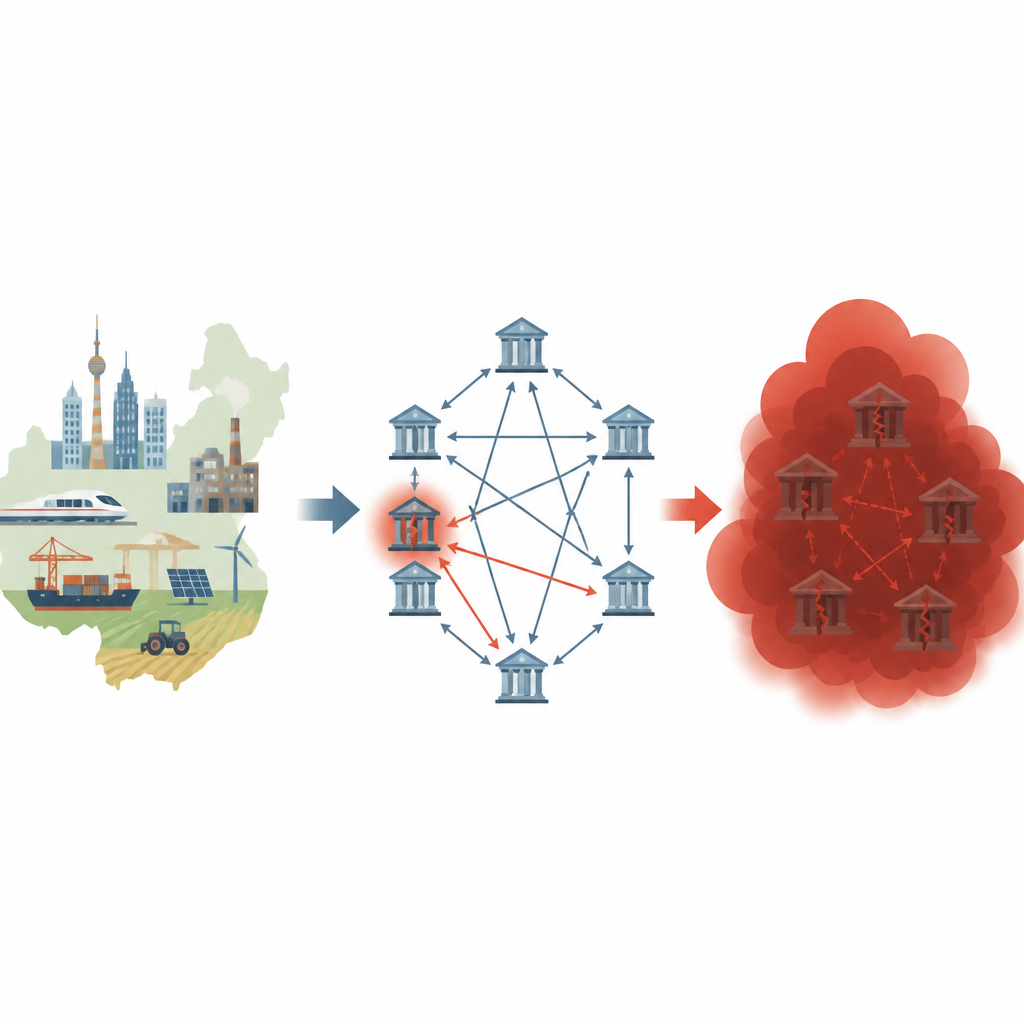
When we put money in the bank, we expect it to be safe and available on demand. But banks are tightly linked to one another and to the wider economy, so hidden weaknesses in a few large institutions can ripple through the whole system. This study looks at how shortages of capital in Chinese banks can spread across the network of banks and markets, and what that means for keeping the financial system stable.
Following the trail of hidden weaknesses
The authors focus on China, where banks hold more than 90 percent of all financial assets and where business models have become more alike over time. They use a risk yardstick called the Relative Systemic Risk Index to estimate how much extra capital each major listed bank might need in a severe, long lasting market downturn. This measure blends three simple ideas: how big a bank is, how much it has borrowed compared with its own funds, and how strongly it moves with the rest of the system. By tracking this index for 16 large Chinese banks over nearly a decade, the study identifies which institutions matter most for the stability of the whole network.
Mapping how risk jumps from bank to bank
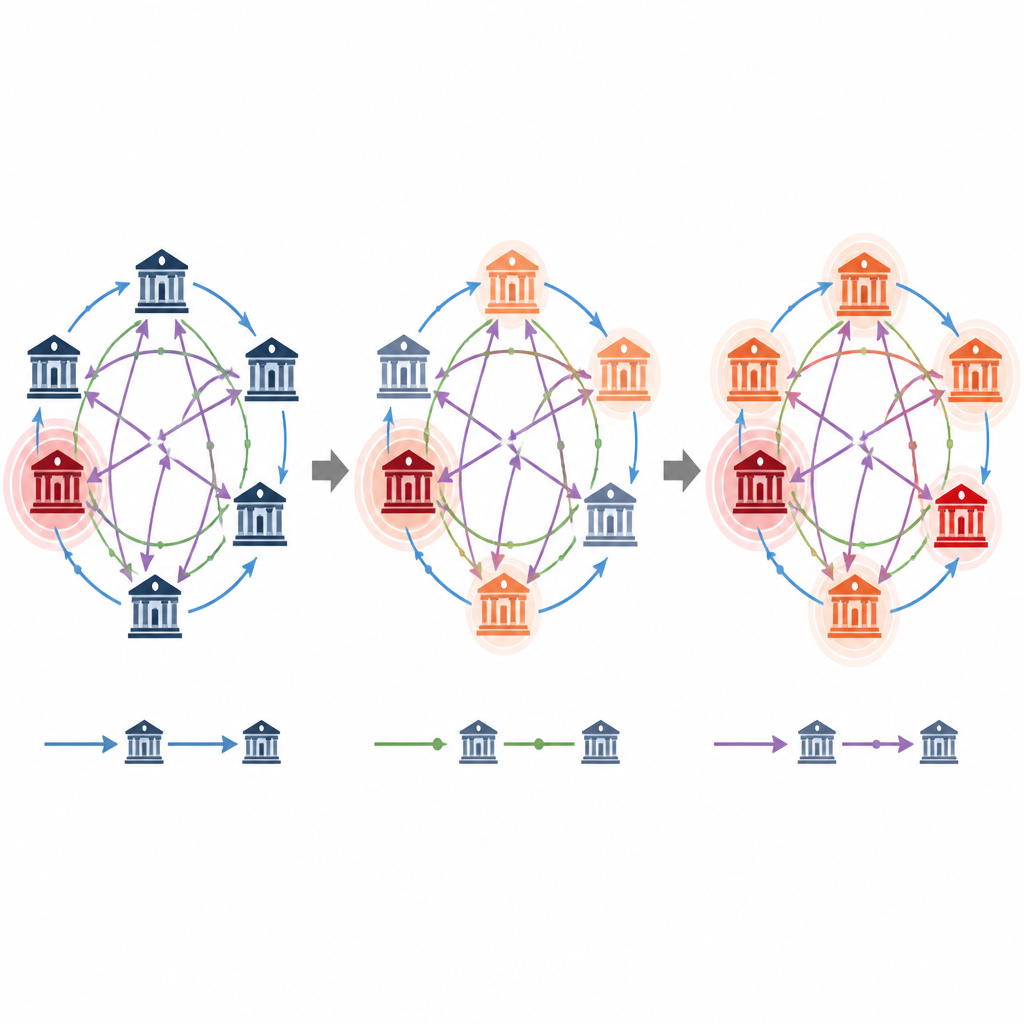
Risk does not stay put inside one balance sheet. Banks lend to each other, hold similar assets such as real estate loans, and share investors in the stock market. To capture how distress can move along these links, the researchers build a multilayer map of connections among banks. One layer reflects direct lending between banks, another tracks how strongly their real estate exposures move together, and a third captures how their share prices co-move. A final layer uses an information tool called transfer entropy to see which banks tend to transmit new risk information to others over time. The result is a dense web that shows who is most central in passing shocks along.
What the network reveals about China’s big banks
The network picture shows that China’s largest state owned banks sit at the heart of this web. Industrial and Commercial Bank of China, Agricultural Bank of China, China Construction Bank, Bank of China, and Bank of Communications all have high values of the systemic risk index. They are large, heavily connected, and strongly linked to the rest of the system. The risk network built from these links has two striking features often seen in complex systems: it is “scale free,” meaning a few hubs carry many connections, and it has “small world” properties, meaning that shocks can travel from one bank to almost any other through very few steps. This combination makes the system sturdy against random small hits, but fragile if trouble strikes one of the central hubs.
Many forces push risk up or down
The study then looks at which bank features and economic conditions raise or reduce the chance of a capital shortfall. Using a spatial panel model that separates local effects from spillovers across the network, the authors find that being more central in the network, holding higher formal capital buffers, upbeat investor mood, fast growth of the broad money supply, and rising foreign currency deposits are all linked to higher capital shortfall risk. In contrast, earning more from traditional interest income, matching loans and deposits more carefully, keeping bad loans in check, and growth in foreign currency lending tend to ease this risk. Many of these factors also work through neighbors: for example, one bank’s role as an intermediary in the web can amplify shocks felt by others.
What this means for financial stability
For readers, the main takeaway is that banking safety depends not only on how sound each bank looks on its own, but also on how it is wired into the rest of the system. In China’s bank centered economy, a small group of very large and highly connected banks plays an outsized role in spreading or absorbing trouble. The authors argue that watchdogs should pay special attention to these hubs, adjust capital rules over the financial cycle, and design tools that slow down the spread of distress when early signs appear. By doing so, they hope to reduce the chance that a local capital shortage snowballs into a system wide crisis that would ultimately affect households and businesses.
Citation: Wei, W., Wang, Z., Wang, Y. et al. Transfer entropy, multidimensional multiple correlation network, and risk contagion of bank capital shortage. Humanit Soc Sci Commun 13, 743 (2026). https://doi.org/10.1057/s41599-026-07085-3
Keywords: systemic risk, Chinese banking, financial networks, capital shortfall, risk contagion