Clear Sky Science · en
Vegetable interventions in crisis settings: a scoping review of practices
Why vegetables matter in times of crisis
When disaster strikes, we often picture sacks of grain or bottled water arriving as aid. Less obvious, but increasingly important, is support that helps families grow their own vegetables. This article reviews what is known about such vegetable projects in crisis-hit communities around the world, and asks a simple question that matters to all of us: do these gardens and seed packages really help people eat better and rebuild their lives, and how well has this been measured? 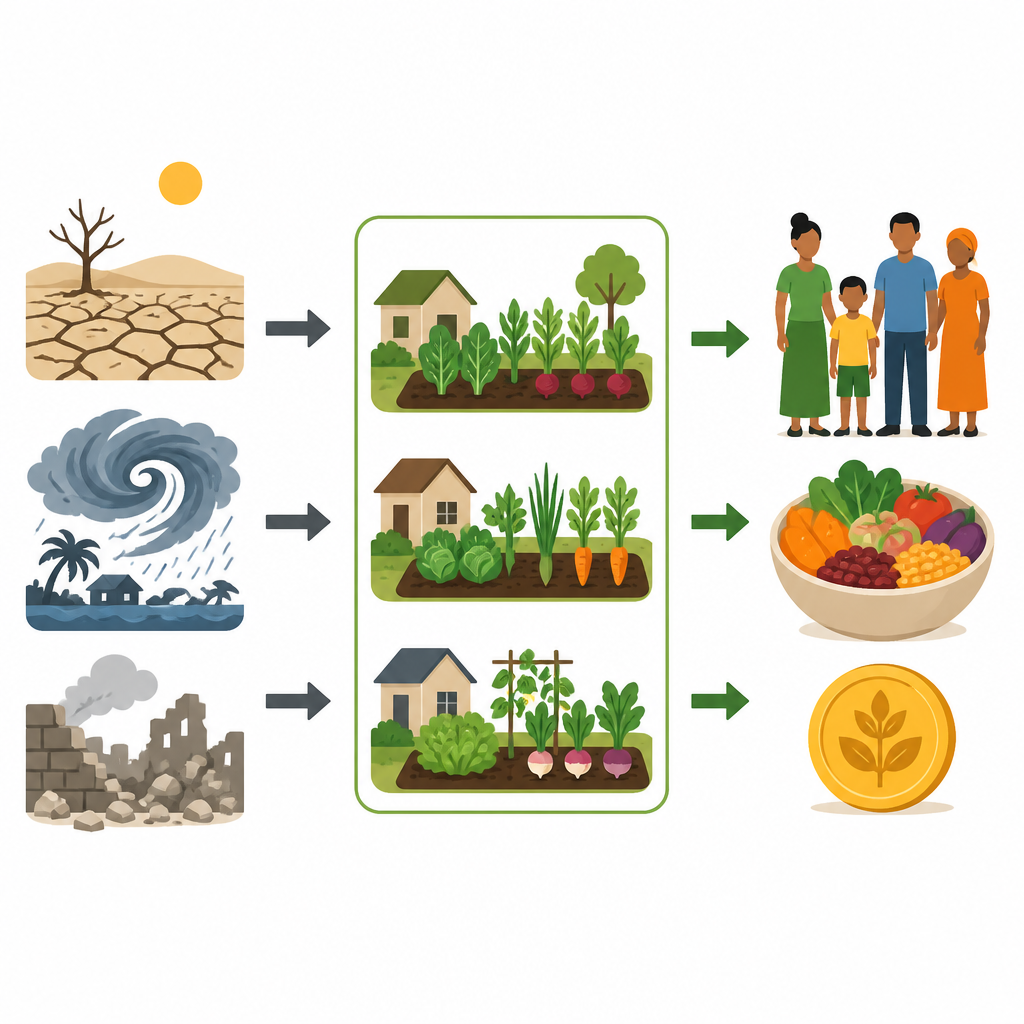
How the researchers searched for answers
The authors carried out a scoping review, a kind of wide-angle survey of existing studies, rather than a single experiment. They pulled together information from scientific journals and reports produced by aid agencies between 1990 and 2023, focusing on low and middle income countries and refugees from those countries living elsewhere. Following established guidelines for this type of review, they sifted through more than 800 documents and ended up with 53 that clearly described projects where people in crisis situations received some kind of vegetable support, such as seeds, training, tools or irrigation.
Where the projects took place and who was helped
Most of the documented projects were in sub Saharan Africa, with others in South Asia and the Middle East. Crises ranged from slow building droughts and crop pests, to sudden floods and earthquakes, to long running conflicts and economic trouble. Projects rarely focused on vegetables alone; they were usually part of broader efforts that might also cover cereals, livestock, water and sanitation, or nutrition education. Women were most often targeted, along with low income families, children and displaced people living in camps or host communities. In many cases, families needed at least a small piece of land or space near the home to be eligible for support.
What vegetable help looked like on the ground
Across settings, two features appeared again and again: free packets of vegetable seed and some form of training. Home gardens were the dominant approach, sometimes backed up with simple irrigation like buckets, small dams or drip kits. Training could cover how to grow and water crops, manage pests, store produce, or prepare more varied meals. Yet many reports left out important details. Only about a third named which vegetables were promoted, and these were usually familiar global types such as cabbage and carrot rather than hardy local greens that might be richer in nutrients. None of the studies said whether the seeds were local or imported, or how often and how much seed was given, making it hard to judge if families could keep gardening once outside support stopped. 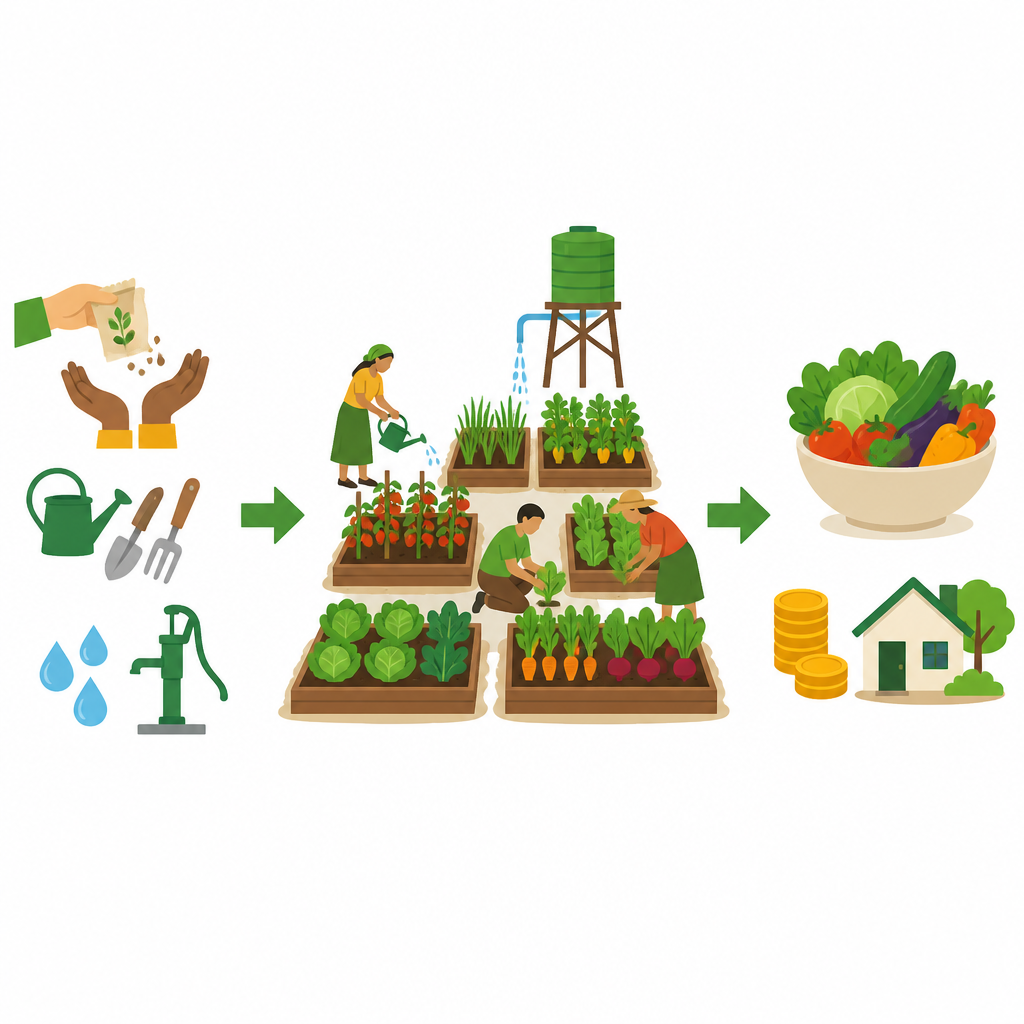
What changed for diets and livelihoods
The projects aimed mainly to improve food security, nutrition and resilience to future shocks. Many measured whether families adopted new farming practices, ate more fruits and vegetables, or enjoyed more diverse diets. Income from selling surplus produce was another frequent outcome. Some studies also tracked crop yields or signs of women’s empowerment. Overall, these measures pointed in a positive direction, but the strength of the evidence was limited. Only one study used a randomized trial design, the strictest way to test impact, and fewer than one in six studies appeared in peer reviewed journals. Mixed method and qualitative evaluations were common, yet often lacked clear questions or systematic analysis, and very few examined children’s growth, body nutrient levels, or environmental effects.
What this means for future crisis responses
To a lay reader, the bottom line is that helping crisis affected families grow vegetables is widely practiced and likely helpful for diets and livelihoods, but the way these projects are designed and reported leaves many blind spots. Free seed and short trainings are standard, yet there is little transparency about where the seed comes from, whether it suits local conditions, or how long support lasts. Evidence that projects truly improve nutrition and income, especially over the long term, remains patchy. The authors call for clearer reporting and stronger, but still practical, evaluation methods so that agencies can learn which kinds of vegetable support work best, for whom, and under what crisis conditions.
Citation: Mwambi, M., de Bruyn, J., Boset, A. et al. Vegetable interventions in crisis settings: a scoping review of practices. Humanit Soc Sci Commun 13, 644 (2026). https://doi.org/10.1057/s41599-026-06919-4
Keywords: vegetable interventions, humanitarian crises, home gardening, food security, nutrition