Clear Sky Science · en
Exploring post-pandemic life satisfaction in young adults: a dual analytical perspective
Why this study matters now
As the world emerges from the COVID-19 pandemic, many young adults are asking a simple but urgent question: “Am I satisfied with my life?” This study looks for answers among university students in southern China. It explores how money and family background, along with inner strengths like a sense of control and a feeling that life has meaning, come together to shape how content young people feel with their lives after years of disruption.

Young adults finding their footing after COVID
The researchers surveyed 862 students aged 18 to 29, all navigating early adulthood while still feeling the pandemic’s aftershocks in education, work prospects, and family life. On average, students rated themselves as “slightly satisfied” with life—more positive than negative, but far from truly thriving. Because the study is a snapshot rather than a before-and-after comparison, it cannot say exactly how much the pandemic lowered satisfaction. Still, in a period marked by lingering uncertainty, this modest level of contentment suggests both strain and resilience in how young adults are adapting.
Money, status, and the world around you
One focus of the study is socioeconomic status, or SES—both the concrete side (parents’ jobs) and the personal side (how high or low young people feel they stand in society). Students from better-off families tended to report higher life satisfaction. But the way they perceived their family’s standing turned out to be especially important. Feeling relatively advantaged appeared to ease worries about survival and future prospects, which in turn supported a more hopeful view of life. In a culture where family reputation and social comparison are strong, this sense of relative standing may matter as much as, or more than, the actual material resources.
Inner strength: control and meaning
The study also examined two key inner resources: a sense of control and a sense of meaning in life. Students who believed they could shape their own lives (high “personal mastery”) and who were actively searching for meaning tended to feel more satisfied. These psychological factors partly explained how family background translated into life satisfaction. High SES seemed to support feelings of control and an active search for purpose, which then lifted overall contentment. Surprisingly, simply already feeling that life is meaningful played a smaller role than the ongoing effort to look for meaning. Even when the outer world felt hard to manage, believing in one’s own abilities to act still encouraged young people to explore what makes life worthwhile.
Three types of young people, three life paths
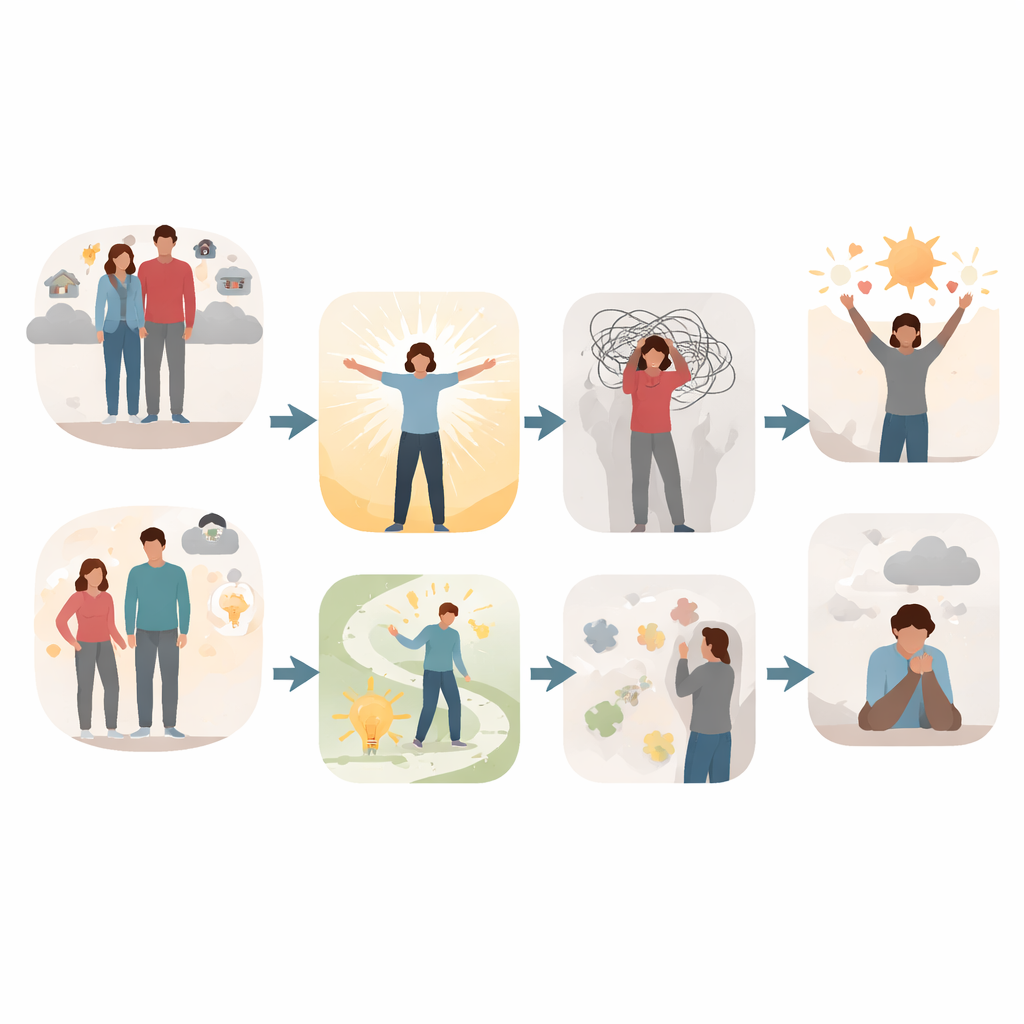
To move beyond averages, the researchers grouped students into three broad profiles. The largest group had both relatively high SES and strong psychological resources; they reported the highest life satisfaction. A second, smaller group enjoyed higher SES but weaker inner resources—they were materially comfortable but less confident, less purposeful, and less in control, and their life satisfaction was only moderate. The third group combined low SES with low psychological resources and had by far the lowest satisfaction. This pattern shows that material security helps, but without inner strength and meaning, it does not guarantee a satisfying life. At the same time, those who lack both money and psychological resources are at particular risk and contribute most strongly to the overall link between background and well-being.
What this means for young people’s futures
For a lay reader, the central message is straightforward: in the wake of COVID-19, young people’s life satisfaction is shaped by a mix of outer circumstances and inner resources. Growing up in a better-off family can ease recovery from crisis, but feeling capable, having some control, and actively searching for purpose matter just as much—and sometimes more. Policies and programs that support struggling students, teach practical skills, build confidence, and help young adults explore what gives their lives meaning may be as crucial as financial aid. A satisfying life after the pandemic, this research suggests, depends on strengthening both the foundations around young people and the psychological tools they carry within.
Citation: Li, L., Li, H. & Zhang, L. Exploring post-pandemic life satisfaction in young adults: a dual analytical perspective. Humanit Soc Sci Commun 13, 356 (2026). https://doi.org/10.1057/s41599-026-06708-z
Keywords: life satisfaction, young adults, post-pandemic, socioeconomic status, meaning in life