Clear Sky Science · en
The impact of AI-mediated instruction on speaking proficiency, enjoyment, anxiety, and emotional engagement: a mixed-methods approach
Talking to a Machine to Learn to Talk
For millions of people learning English around the world, speaking out loud can be the scariest part of the journey. Class time is limited, native speakers are hard to find, and many learners fear making mistakes in front of others. This study asks a simple but timely question: can an everyday AI voice assistant on a phone give learners the extra practice and confidence they need—possibly even more effectively than traditional speaking activities with classmates?
How the Study Was Set Up
The researchers worked with 68 Chinese university students who were all at an intermediate level of English. They split them into two groups for ten weeks. Both groups had the same amount of class time, practicing everyday situations like ordering food, asking for directions, and debating current issues. The difference lay outside class: one group practiced speaking each day with an AI voice assistant on their phones, while the other followed a schedule of traditional practice such as recording themselves, repeating audio models, and talking with peers.
What the AI Conversations Looked Like
Students in the AI group used a voice assistant configured for English practice. They held short daily conversations on topics like travel, hobbies, and news, played simple speaking and vocabulary games, and repeated tricky sounds that are especially hard for Chinese learners. The AI responded instantly with spoken and on-screen feedback, and its tasks automatically became easier or harder depending on how well each student was doing. A monitoring system quietly tracked how often and how long they practiced, helping teachers offer encouragement when students fell behind. 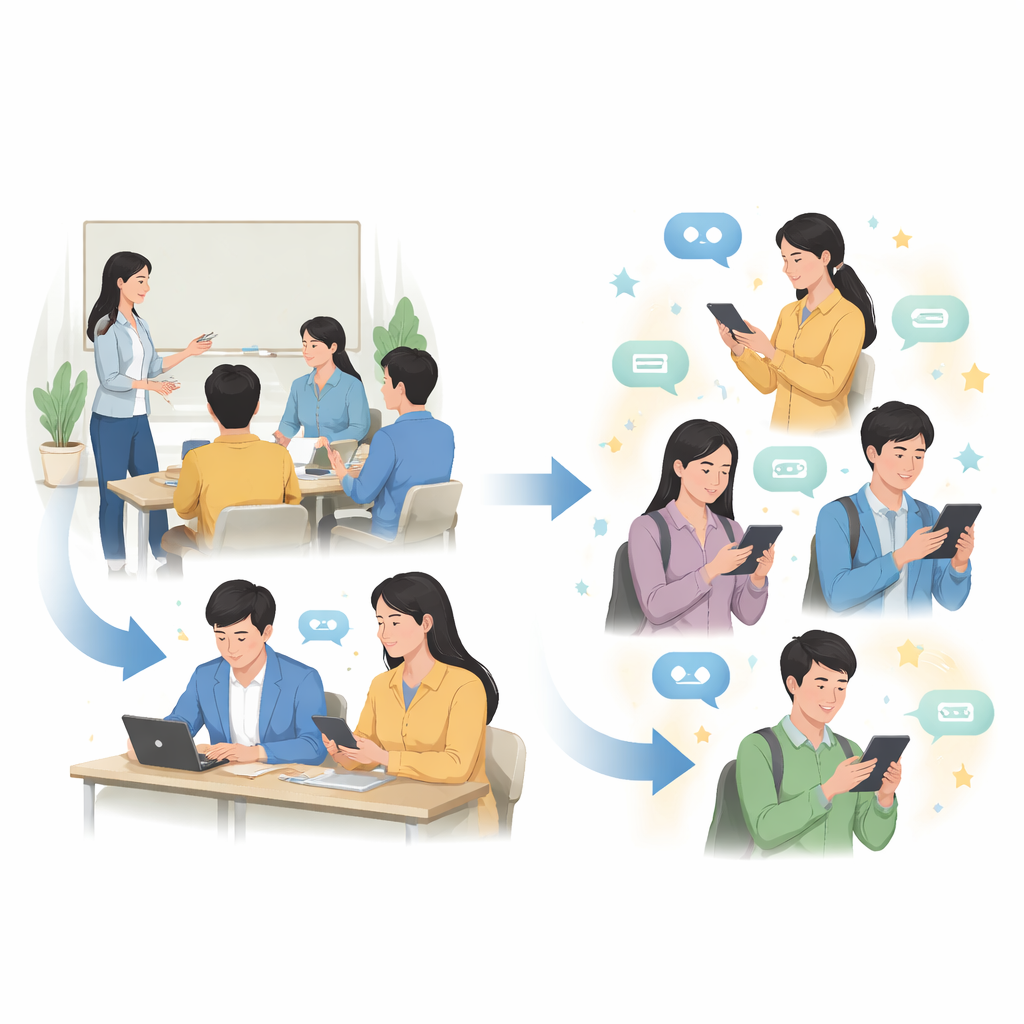
Measuring Skills and Feelings
To find out what changed, the team tested students before and after the ten weeks. Trained examiners gave all participants official-style IELTS speaking interviews and rated their fluency, vocabulary, grammar, and pronunciation. The students also filled out three questionnaires: one about how much they enjoyed learning English, one about how anxious they felt in language class, and one about how emotionally engaged and enthusiastic they were. Afterward, ten students from the AI group took part in in-depth interviews about what it actually felt like to talk to a machine every day.
Stronger Voices, More Joy, Less Fear
Both groups improved over the ten weeks, but the AI group pulled ahead on every measure. Their speaking scores rose more than twice as much as those of the control group, and they reported bigger jumps in enjoyment and emotional engagement alongside a sharper drop in anxiety. Statistical analyses that controlled for starting levels confirmed that AI practice made a meaningful difference, not just a small bump. In interviews, students said that having to rephrase themselves when the AI misheard them pushed them to think more carefully about pronunciation and word choice. Many discovered unexpected fun in game-like tasks and daily “challenges,” and several described becoming more self-directed—setting goals, tracking their own weak points, and using the AI as a personal coach. At the same time, they were clear that talking to a device did not feel as rich or emotionally “real” as talking to another person. 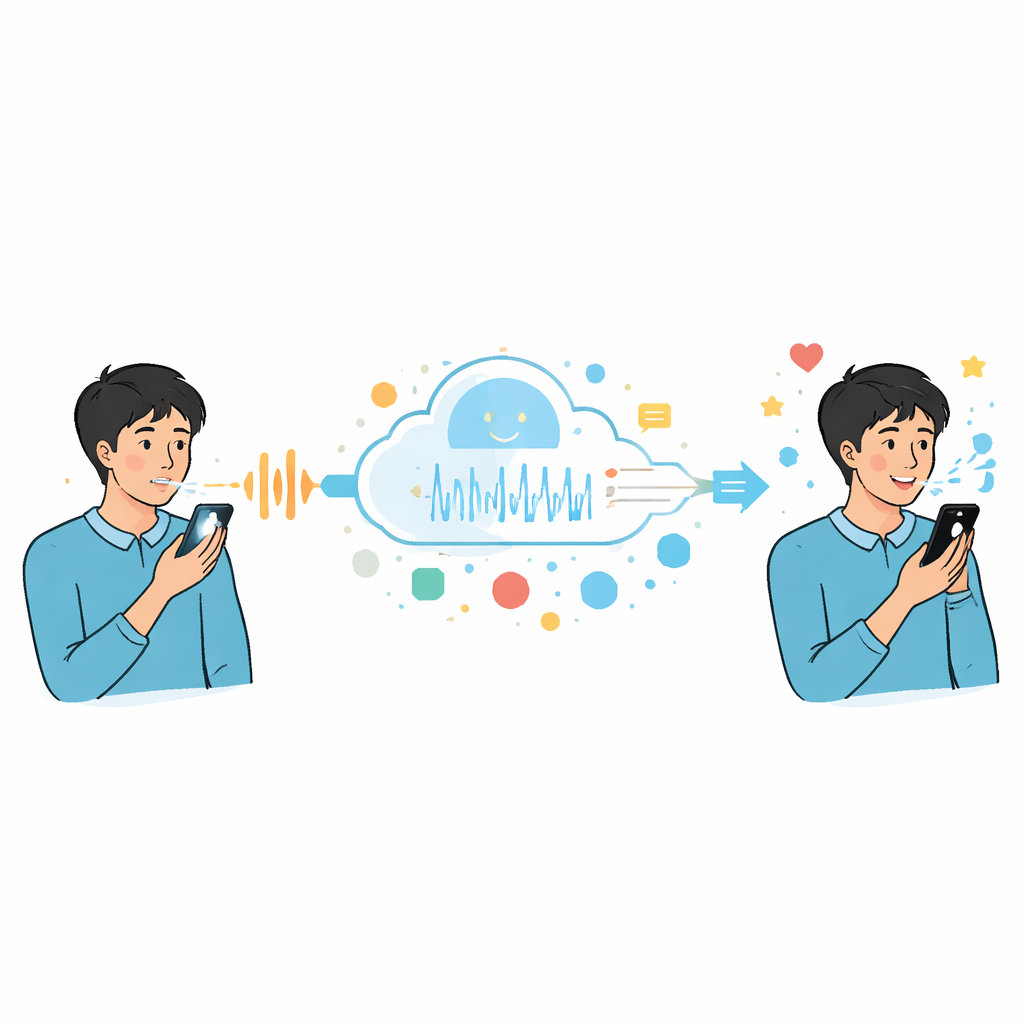
What This Means for Everyday Learners
The study suggests that an ordinary voice assistant on a smartphone can do more than drill grammar: it can help learners speak more fluently and clearly, enjoy the process more, feel less afraid of making mistakes, and stay emotionally invested in learning. The AI offers endless low-pressure chances to practice and immediate feedback tailored to each learner’s level. Yet it cannot replace the warmth, spontaneity, and subtle cues of human conversation. For teachers and students, the message is practical and hopeful: using AI as a daily speaking partner—alongside real conversations with classmates and teachers—can create a more supportive, enjoyable, and effective path to finding one’s voice in a new language.
Citation: Yan, H., Singh, M.K.S. The impact of AI-mediated instruction on speaking proficiency, enjoyment, anxiety, and emotional engagement: a mixed-methods approach. Humanit Soc Sci Commun 13, 568 (2026). https://doi.org/10.1057/s41599-026-06705-2
Keywords: AI language learning, English speaking practice, foreign language anxiety, student engagement, voice assistants