Clear Sky Science · en
Exploring the psychological appeal of curved streets: a multivariate analysis of expectation formation in urban spaces
Streets That Spark Curiosity
Most of us know the feeling of walking down a street that gently curves away, making us wonder what might be just out of sight. This paper dives into that everyday experience and asks a simple question: how do the shapes and proportions of curved streets influence our curiosity, comfort, and desire to keep walking? By turning real streets from around the world into carefully controlled digital scenes, the authors show that the geometry of a street can quietly guide how we feel and behave in cities.
Why Bends in the Road Feel Different
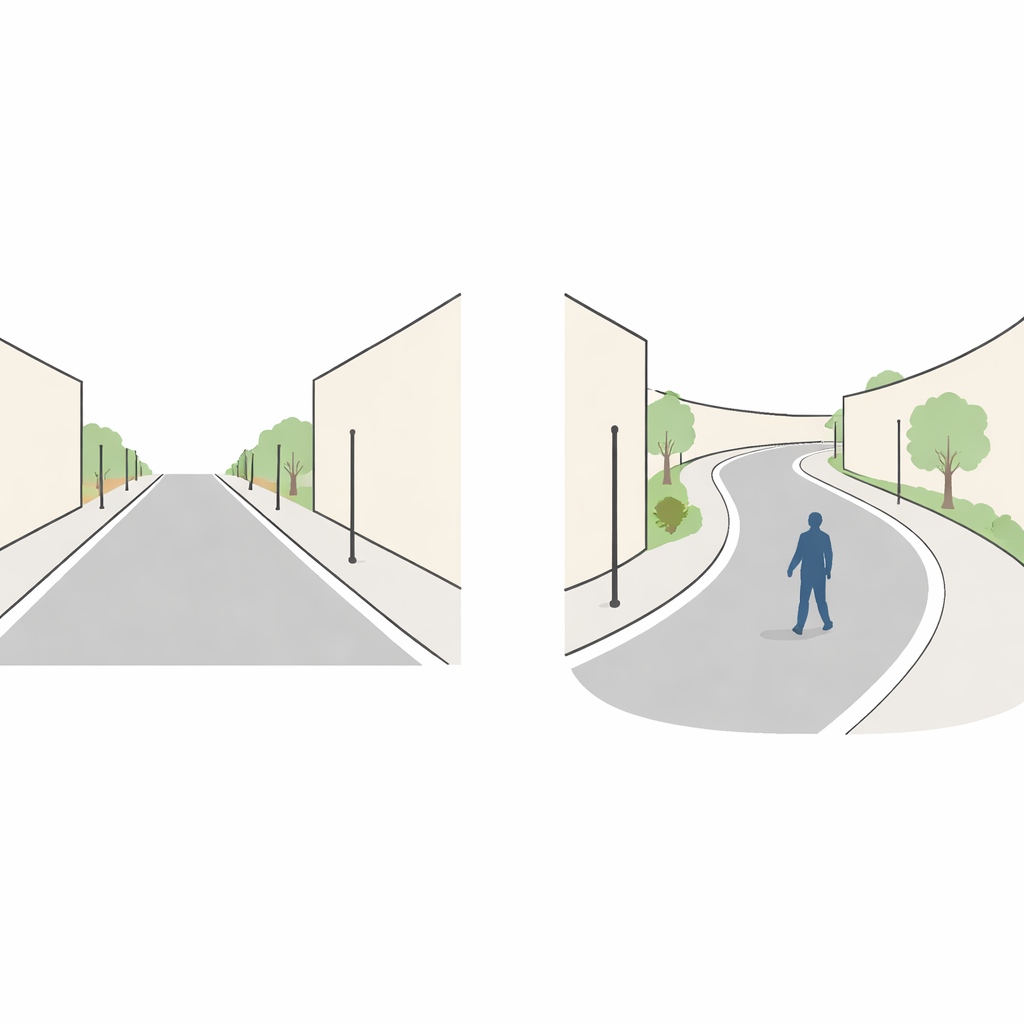
Unlike straight streets, which reveal everything at a glance, curved streets reveal space bit by bit as we move. Earlier thinkers in architecture and psychology have suggested that this unfolding view can create a sense of “looking forward” and wondering what lies ahead. The authors build on these ideas and define “expectation” as that tug of interest you feel when the next part of a street is partly hidden. They argue that this isn’t just a matter of taste: it affects how people navigate, whether they pause, and how strongly they engage with a place. Yet, until now, there has been little hard evidence tying specific street shapes to these psychological effects.
From Old City Streets to Virtual Test Beds
To ground their work in real places, the researchers first documented 78 curved pedestrian streets in 14 countries, focusing on walkable areas with buildings lining both sides. They noted how much each street bent, how far apart the facing walls were, how often the façades were broken by columns or gaps, and how continuous the building edges felt. From this global sample—mostly in historic districts of Europe and East Asia—they distilled a set of typical layouts. These were then converted into simplified three-dimensional computer scenes, stripped of color, texture, signs, and other distractions so that only shape and proportion remained.
Testing Where Expectation Peaks
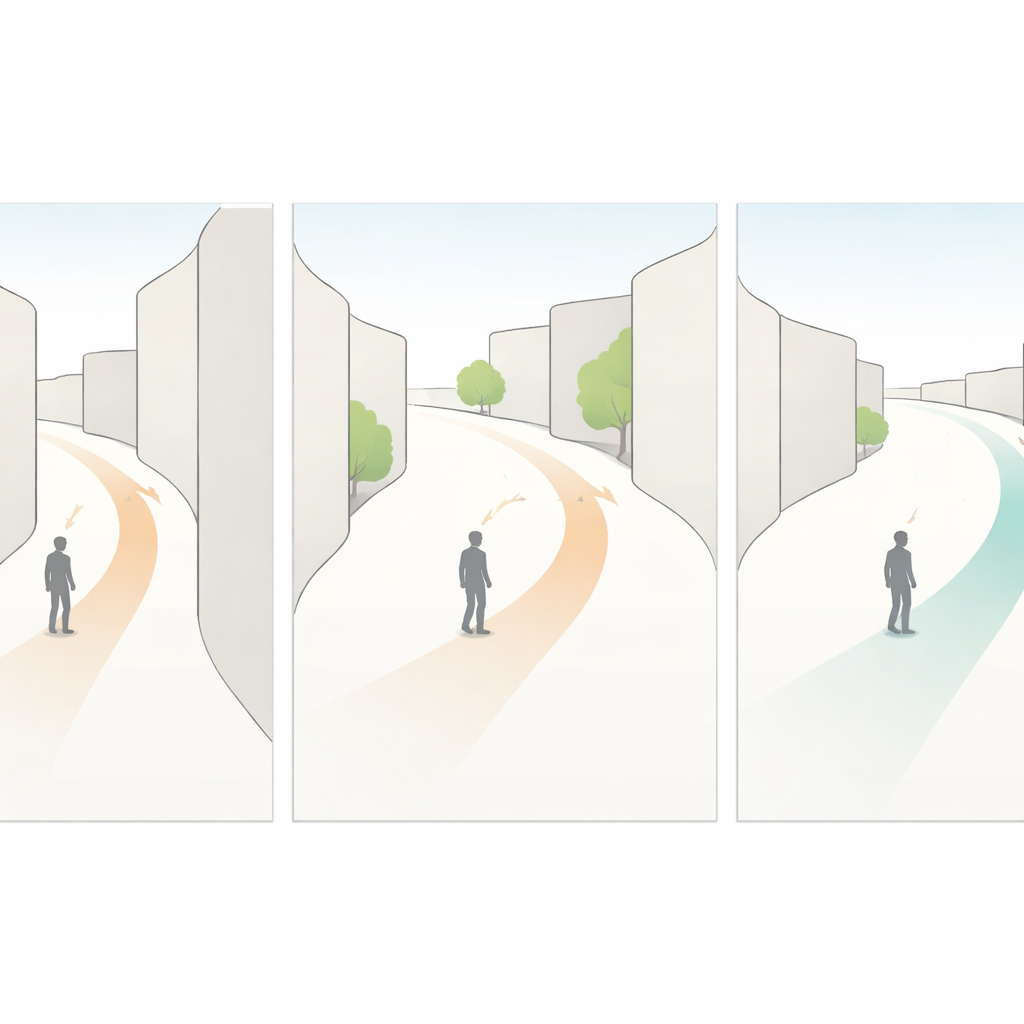
In laboratory sessions, 223 volunteers viewed these virtual streets on large screens. They had never visited the original locations, so their reactions came from first impressions rather than memories. In one set of tasks, people watched simulated walks along the streets and paused the video at the spot where their sense of expectation felt strongest—the “maximum expectation position.” In another, they rated how strong that feeling was overall, using a standard reference scene for comparison. Because the digital models varied only in key geometric features—such as curvature, wall spacing, and how often walls were broken into segments—the researchers could use statistical models to see which combinations mattered most.
How Street Shape Steers the Mind
The results show that expectation is not random: it follows clear patterns tied to geometry. Gentle curves, rather than very sharp or perfectly straight alignments, tended to create stronger anticipation by extending how far people felt they could see into the distance. Wall spacing also had a “sweet spot.” As the space between buildings widened, people’s sense of expectation first grew and then weakened once the street became too open. A similar balance appeared with the distance between breaks in the walls or columns: regular segments of about six meters worked best to keep attention and curiosity high. Together, these features shaped not only how strong expectation felt but also where along the curve it peaked, effectively “placing” the most engaging point on the route.
Designing Streets People Want to Explore
To a non-specialist, the takeaway is straightforward: the way we draw our streets can either dull or sharpen the everyday pleasure of walking through a city. Curved streets with moderate bends, thoughtfully spaced building fronts, and a steady rhythm of openings invite people to look ahead and keep going, without feeling lost or shut in. While the study used simplified, screen-based scenes and did not yet factor in color, greenery, or sound, it provides a clear, testable link between physical form and psychological response. Future work with virtual reality and richer environments could refine these findings, but the message is already clear: if we want urban spaces that feel inviting, memorable, and human-centered, we should pay close attention to how a simple curve in the street can quietly shape our expectations.
Citation: Wang, R., Shang, W. Exploring the psychological appeal of curved streets: a multivariate analysis of expectation formation in urban spaces. Humanit Soc Sci Commun 13, 366 (2026). https://doi.org/10.1057/s41599-026-06648-8
Keywords: urban design, curved streets, pedestrian experience, spatial perception, street geometry