Clear Sky Science · en
Divergent urban vegetation inequality in Northern and Sunbelt United States cities under climate extreme events
Why City Greenery Is Not Shared Equally
City trees and parks do far more than look pretty—they cool neighborhoods during heat waves, clean the air, and even protect our health. But these benefits are not evenly shared. Some communities enjoy leafy streets and shady yards, while others bake under bare concrete. This study explores how that green divide changes when climate extremes like droughts, heat waves, and cold-wet spells strike cities across the United States, revealing who is most vulnerable as the climate warms. 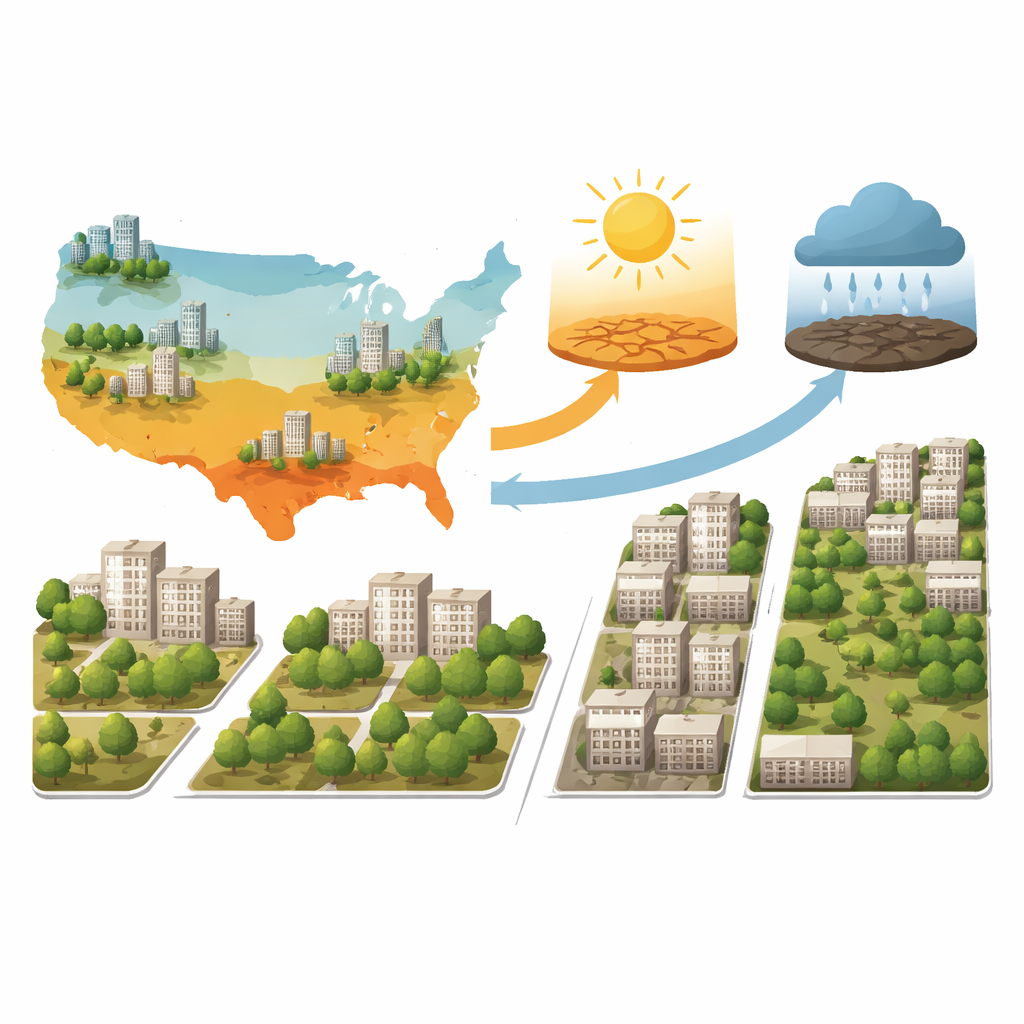
Measuring the Green Divide
To compare cities, the researchers needed a simple way to capture how unevenly vegetation is spread within each urban area. They turned to satellite images that record a standard greenness signal for every 250-by-250-meter patch of land. For each of 245 large U.S. cities, they compared the greenest 10 percent of patches with the least green 10 percent and combined them into a single score they call the Vegetation Polarization Index. A higher score means a starker gap between lush areas and bare ones—essentially, greater urban vegetation inequality. This approach focuses on the extremes, where differences in shade, cooling, and access to nature are most pronounced.
North–South Differences Across the Map
Looking back from 2001 to 2020, the team found that cities in the nation’s dry western and southern regions—especially places like Phoenix and Las Vegas—have the highest levels of vegetation inequality. In these arid cities, small pockets of very green neighborhoods contrast sharply with widespread low-green areas. Yet trends over time are not uniform. In many Sunbelt cities, the green divide has grown worse, while many northern and eastern cities have seen slow improvement. On average, snowier, cooler cities have become slightly more equal in their greenness, whereas parts of southern California, Texas, Florida, and the southern East Coast have moved in the opposite direction.
When Weather Extremes Hit
The study then asked how bursts of unusual weather change this inequality from month to month. During droughts and especially during “hot droughts,” when heat and dryness occur together, nearly all U.S. cities experienced sharper green divides—but the effect was strongest in the Sunbelt. In these already dry, hot places, plants in less affluent neighborhoods may wither as outdoor watering becomes more expensive or restricted, while better-off areas manage to keep their lawns and trees alive. By contrast, in cooler northern cities, vegetation inequality tended to increase during colder or wetter periods, when chill and excess moisture limit plant growth more in some neighborhoods than others. Overall, the combination of heat and drought emerged as the single most damaging climate stress for maintaining fair access to urban greenery. 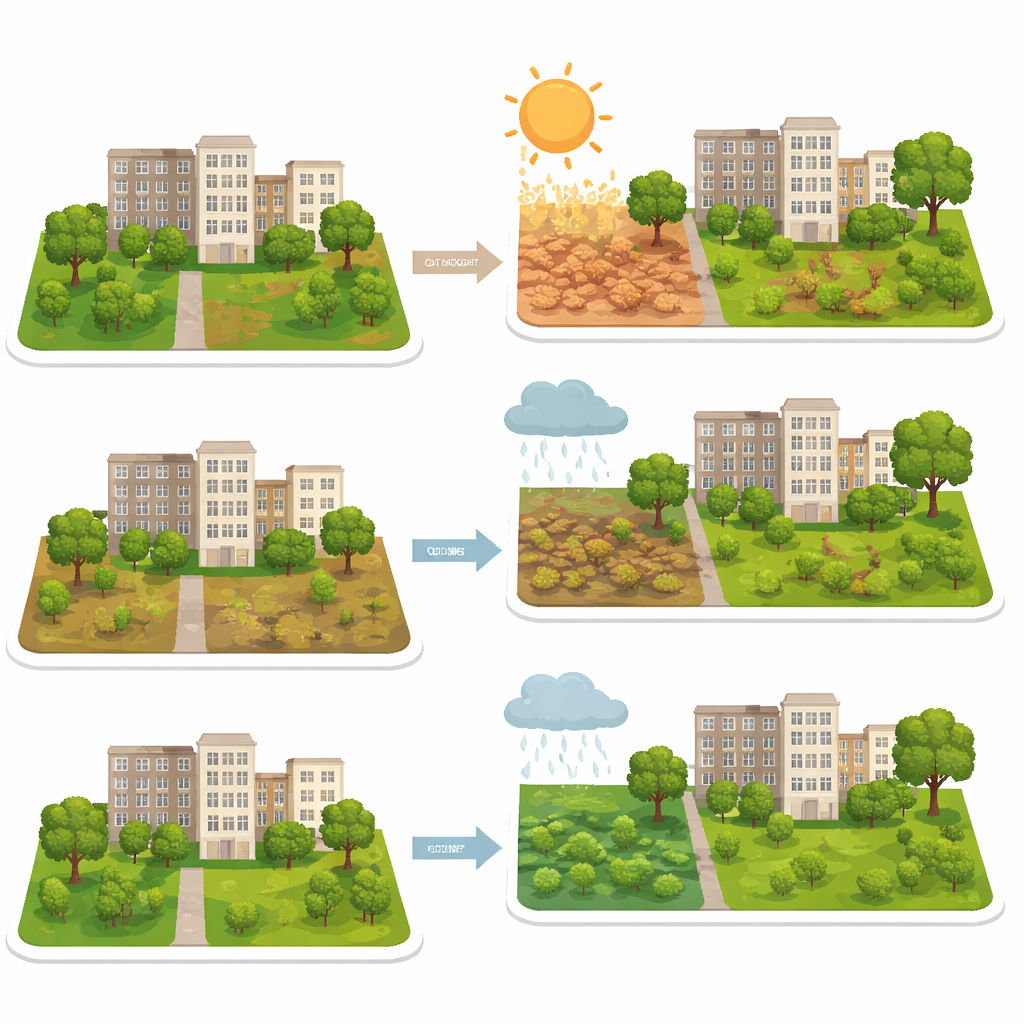
Climate, People, and Money
Climate alone does not tell the whole story. By combining greenness patterns with census data, the researchers found that long-term drying trends are closely linked to rising vegetation inequality, particularly in already arid regions. But socioeconomic patterns often matter even more. Cities with younger populations or larger shares of Hispanic residents tended to show faster growth in their green divide, while cities with older median ages or higher incomes in dry regions were more likely to see stable or improving conditions. These links do not prove cause and effect, but they suggest that who lives where—and what resources they have—strongly shapes who gains or loses greenery under climate stress.
What This Means for Everyday Life
The differences revealed by this study are not cosmetic. Greener neighborhoods can be several degrees cooler on hot days, and past research shows that tree cover and parks help reduce heat illness, flooding, and even depression and anxiety. By showing that climate extremes often widen the gap between leafy and bare neighborhoods—especially in Sunbelt cities as the climate grows hotter and drier—the study warns that environmental inequalities may deepen unless cities act. The findings point toward solutions such as climate-aware planting, fairer water management, and targeted greening of the least vegetated communities so that, in a warming world, everyone can share in the protective benefits of urban nature.
Citation: Yan, Y., Dong, C., Guo, J. et al. Divergent urban vegetation inequality in Northern and Sunbelt United States cities under climate extreme events. npj Environ. Soc. Sci. 1, 2 (2026). https://doi.org/10.1038/s44432-025-00001-1
Keywords: urban greening, climate extremes, environmental justice, heat inequality, Sunbelt cities