Clear Sky Science · en
A catalyst for innovation in global dementia policy and advocacy: insights from walking the talk for dementia
Why This Walk Matters
Dementia is often seen as a private family tragedy, but its impact stretches across health systems, economies, and entire societies. This article explores a strikingly different way to confront that challenge: a weeklong event called “Walking the Talk for Dementia” (WTD), where people living with dementia, their care partners, clinicians, researchers, artists, and advocates walk together and reflect on life with the condition. The study asks how this unusual gathering might spark better dementia policies around the world—especially more humane, fair, and stigma-free approaches.
From Long Walk to Big Ideas
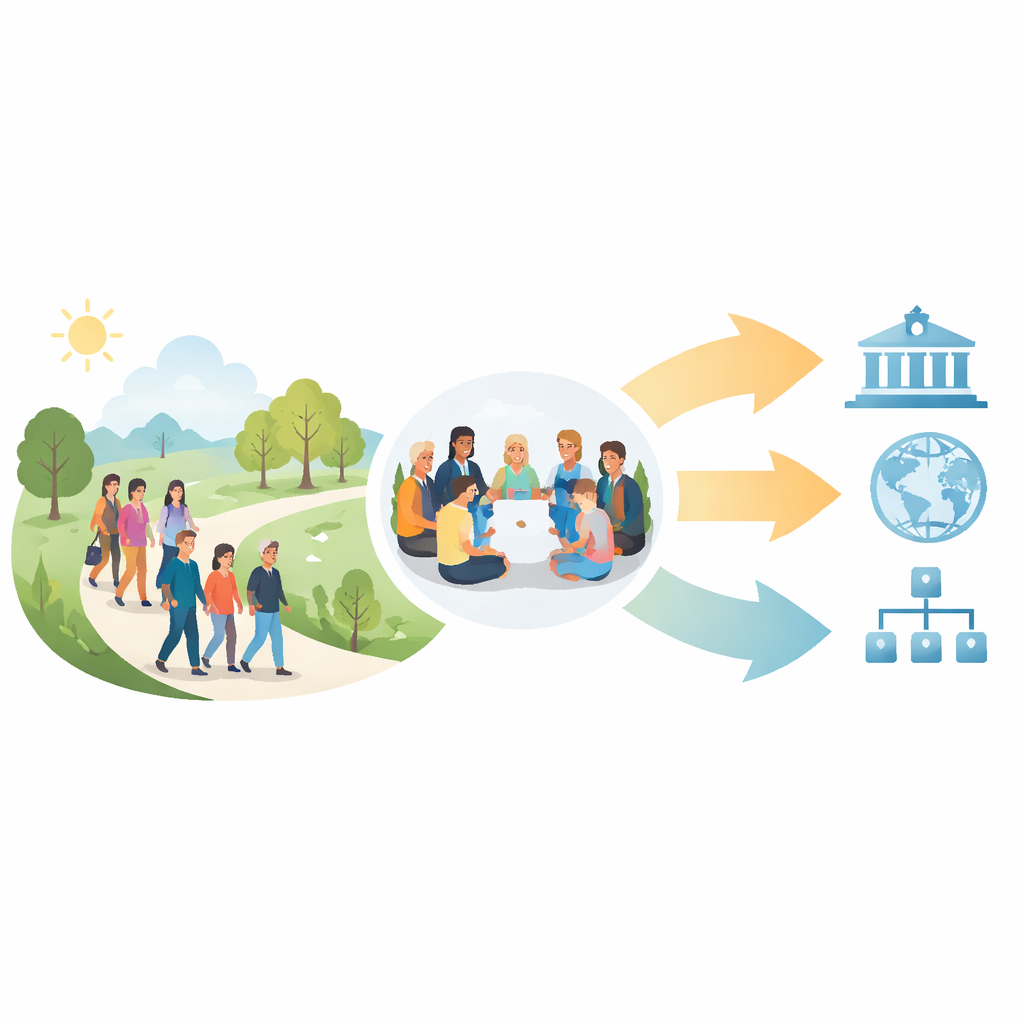
WTD combines a four-day, 40-kilometer walk on Spain’s Camino de Santiago with a two-day symposium and informal group activities. Seventy-nine participants from 27 countries joined the 2024 event. Unlike a typical conference, the experience is immersive and physical: people walk, talk, share stories, and spend extended time together across roles and cultures. The researchers collected 95 reflections (written, audio, or video) and a follow-up survey from 67 attendees, then used qualitative thematic analysis to see how this experience might shape participants’ future advocacy and influence on dementia policy.
Seeing Dementia with New Eyes
The first major theme was what the authors call a “transformative awareness” of what it means to live with dementia. Walking and living side by side with people who have dementia—and with their care partners—made the condition more visible, personal, and human for many participants. This deeper understanding can challenge stigma, which often paints dementia only in terms of decline and burden. Participants believed that such first-hand encounters could help decision-makers see dementia not just as a medical issue, but as a social and moral priority—potentially opening the door to more compassionate laws, funding, and services.
Building Bridges Across Countries
A second key theme was the co-creation of advocacy networks. Because WTD brings together people from low-, middle-, and high-income countries, it becomes a living laboratory for mutual learning. Participants described discovering how other nations design dementia plans, support caregivers, and fund services—and then imagining how those ideas might be adapted back home. Importantly, this exchange flowed in both directions: people from wealthier countries also learned from innovative, resourceful approaches in less-resourced settings. These new cross-border relationships and shared perspectives form the backbone of future campaigns, joint projects, and policy efforts.

Putting Lived Experience at the Center
The third theme focused on how organizations—clinics, advocacy groups, and research teams—might change their everyday practices. Participants reported feeling more committed to including people with dementia and their families in decisions about care, research priorities, and program design. Instead of treating them as passive “subjects,” WTD encouraged viewing them as partners and co-leaders. This shift aligns with an approach known as co-production, where policies and services are developed with, not just for, those most affected. If widely adopted, such practices could reshape how dementia care and support are planned and delivered.
Turning Energy into Policy Change
The fourth theme was “enhancing policy influence.” While the study could not yet prove direct changes in national laws or budgets, it documented clear intentions and early signals. Participants spoke of new collaborations, commitments to advocate for caregiver support and research funding, and improved recognition of dementia in their local contexts. In Santiago de Compostela, where WTD takes place, the event has already drawn interest from city leaders and community groups, hinting at how local partnerships may grow over time. The authors note that involving more policymakers in future walks could strengthen this link between personal experience and formal decision-making.
What This Means for Families and Communities
In plain terms, the article concludes that a walk can be more than a walk: it can be a catalyst. By bringing together people living with dementia, those who care for them, and those who shape systems and policies, WTD helps break down stigma, sparks new alliances, and encourages policies grounded in real-life experience. While it is too early to measure the full impact, the authors argue that efforts to improve dementia care—from national plans to local services—must include the voices of people directly affected. If that happens, societies may move closer to a future where dementia is met not with fear and silence, but with understanding, shared responsibility, and thoughtful public action.
Citation: Dawson, W.D., Aguzzoli-Peres, F., Zegarra-Valdivia, J.A. et al. A catalyst for innovation in global dementia policy and advocacy: insights from walking the talk for dementia. npj Dement. 2, 22 (2026). https://doi.org/10.1038/s44400-026-00070-2
Keywords: dementia policy, stigma reduction, caregiver support, patient advocacy, global brain health