Clear Sky Science · en
The divisibility index as a theoretical tool to support public transport design
Why splitting a bus or train line can matter to you
Cities often face a simple-sounding choice: should a bus or rail line run straight across town as one long route, or be broken into two shorter lines that meet at a transfer stop? For riders, the first option usually means no transfer; for agencies, the second can mean better matching of service to where people actually travel. This paper develops a clear way to decide, in theory and in practice, when splitting a line helps both passengers and operators.
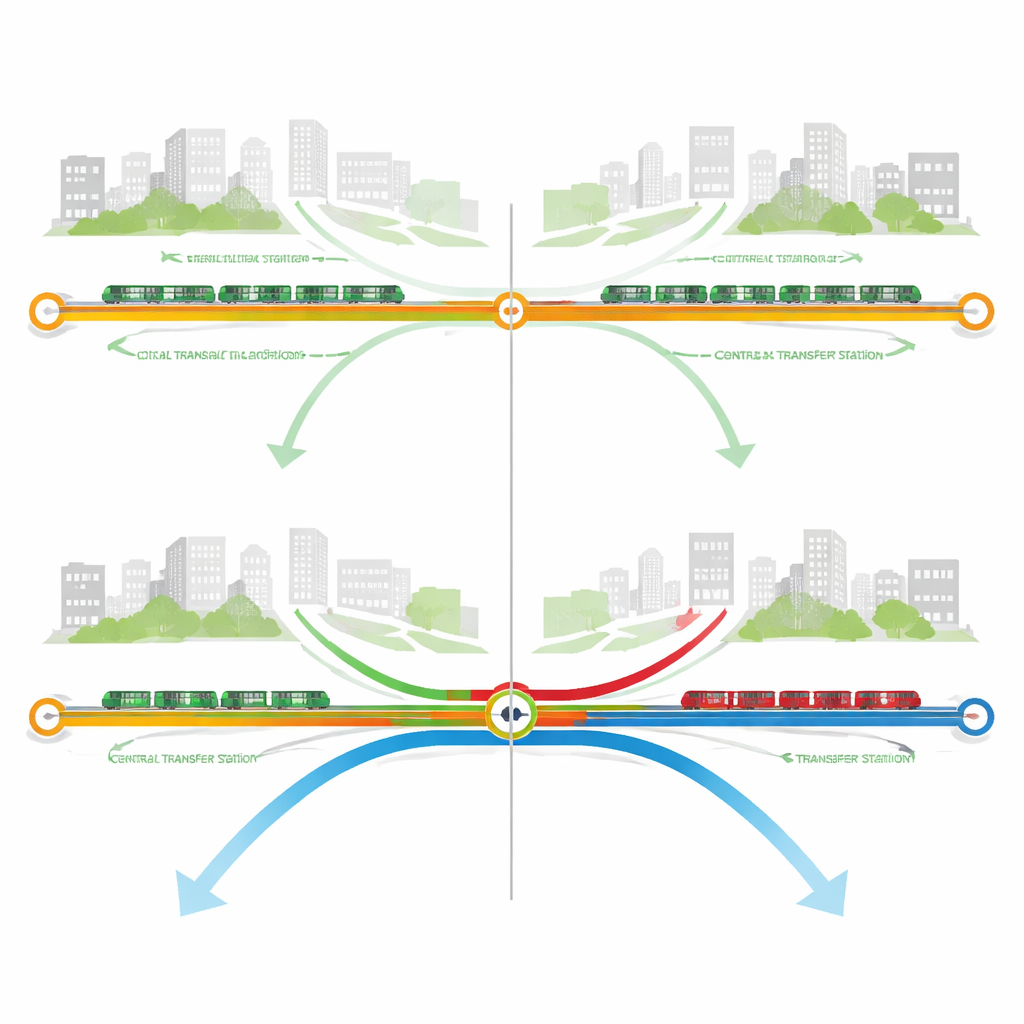
One long ride versus a well-timed change
Most public transport systems mix long routes that cross the whole city with shorter lines that require passengers to transfer. Traditional planning tools have tended to favor direct, no-transfer rides, and many optimization methods simply stretch lines to cover more ground. But real-world examples from Santiago, Melbourne, and Canberra show that split lines can sometimes offer more seats and better frequency where demand is highest, even if some riders must change vehicles. The authors ask a focused question along a single corridor: is it better to run one continuous line, or divide it into two lines that meet at a shared stop?
Finding the sweet spot for a smart split
To answer this, the researchers first build an idealized "linear city" model: a chain of stops spaced evenly along a corridor, with passengers all traveling in the same direction. Within this simplified setting they can write exact formulas for the total cost of running either a single line or two overlapping lines, where cost includes both operator expenses (fleet size, vehicle capacity) and passenger burden (time spent waiting, riding, and transferring). Comparing these formulas reveals three intuitive conditions that make a split attractive: few passengers needing to transfer at the split point; a big difference in the busiest passenger flow on each side of that point; and a long segment where demand is relatively low, so that running high-capacity vehicles there would waste resources.
A single index to guide complex networks
Building on these conditions, the authors introduce the Divisibility Index, or DI. This single number, calculated for each potential split stop along a line, captures how promising it is to divide there. The DI combines three ingredients: how many riders would have to transfer; how uneven the passenger loads are between the two sides of the stop; and how long the lighter-demand side would be. High DI values signal good candidates for splitting, low values warn against it. Because the DI depends only on observed or modeled passenger flows and travel times, it can be computed quickly for any line in a real network, without solving a full-blown optimization problem each time.
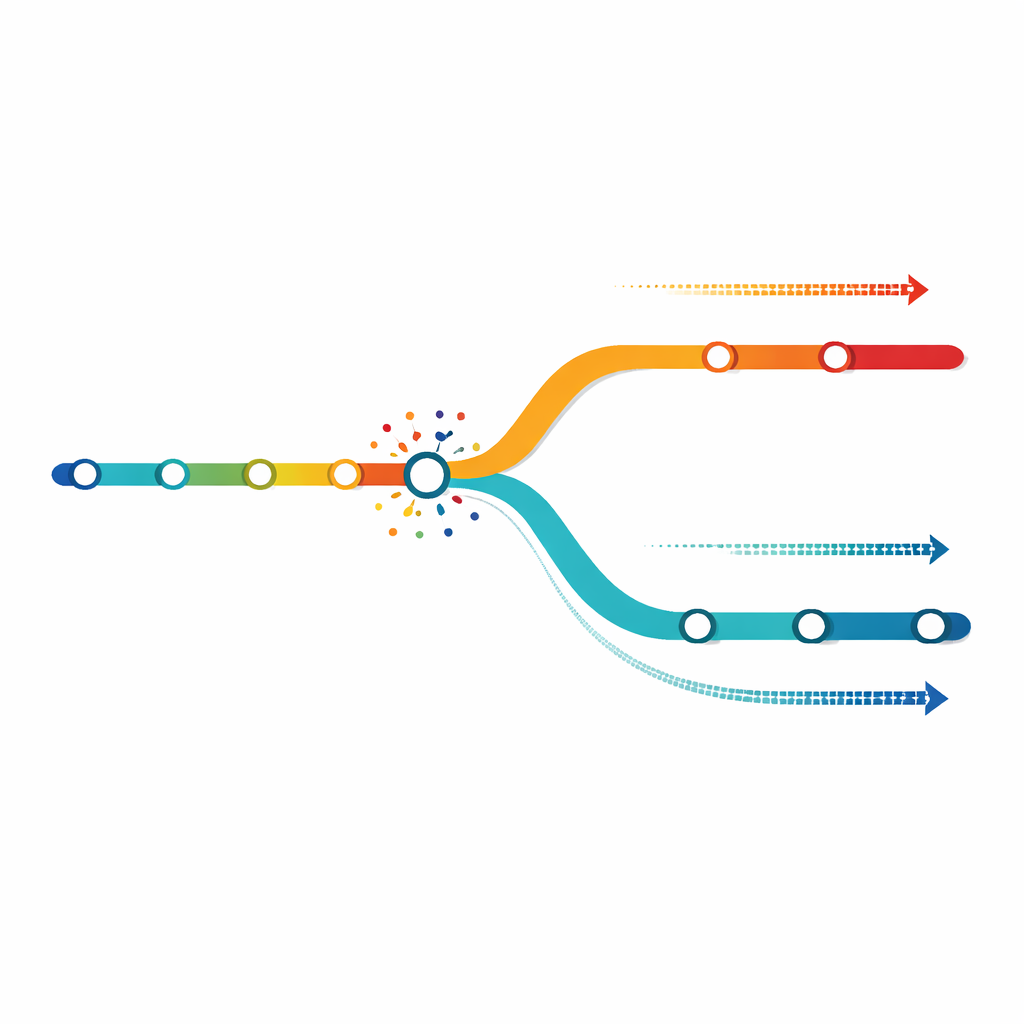
Fast decision recipes that closely match the optimum
The paper then proposes two simple algorithms that use the DI. The first, more exact approach uses the DI to pick the single most promising split point, then evaluates in detail whether splitting there truly reduces total cost; if it does, the line is cut and the process can repeat on each new segment. The second, faster approach skips the detailed calculation: if the best DI along a line is above a tuned threshold, the line is split at that stop; otherwise it is left intact. In tests on a stylized "Linear Parametric City" that represents different city types—from monocentric to polycentric—the algorithms almost perfectly reproduce the mathematically optimal line layouts, with average cost errors well below one percent.
From theoretical corridor to real city rail
To show that the idea works beyond toy models, the authors apply the DI to Canberra’s light-rail corridor, which has a single line and uneven demand along its thirteen stops. Using real smartcard data, they find that, under current patterns, no split beats the existing single-line design: the heaviest flow is from one end of the route straight to the other, so a division would simply impose transfers without real savings. When they artificially reshape demand so that an intermediate stop becomes the main destination, the DI correctly flags that stop as the best place to split, and the resulting two-line design outperforms the single line.
What this means for everyday riders
The study’s central message is that transfers are not always a bad thing: when placed carefully, they can enable more frequent and better-sized service where it is most needed, while trimming waste elsewhere. The Divisibility Index offers planners a fast, transparent way to see where that trade-off pays off, potentially improving bus and rail design tools used worldwide. For riders, this could mean slightly more transfers in some corridors, but also shorter waits, less crowding in busy segments, and a more efficient system overall.
Citation: Gómez, V., Jara-Díaz, S. & Fielbaum, A. The divisibility index as a theoretical tool to support public transport design. npj. Sustain. Mobil. Transp. 3, 32 (2026). https://doi.org/10.1038/s44333-026-00101-8
Keywords: public transport planning, bus and rail corridors, service frequency, transit line splitting, urban mobility