Clear Sky Science · en
Human-induced climate change intensifies spatially compounding fire weather extremes across European countries
Why many fires can strike Europe at once
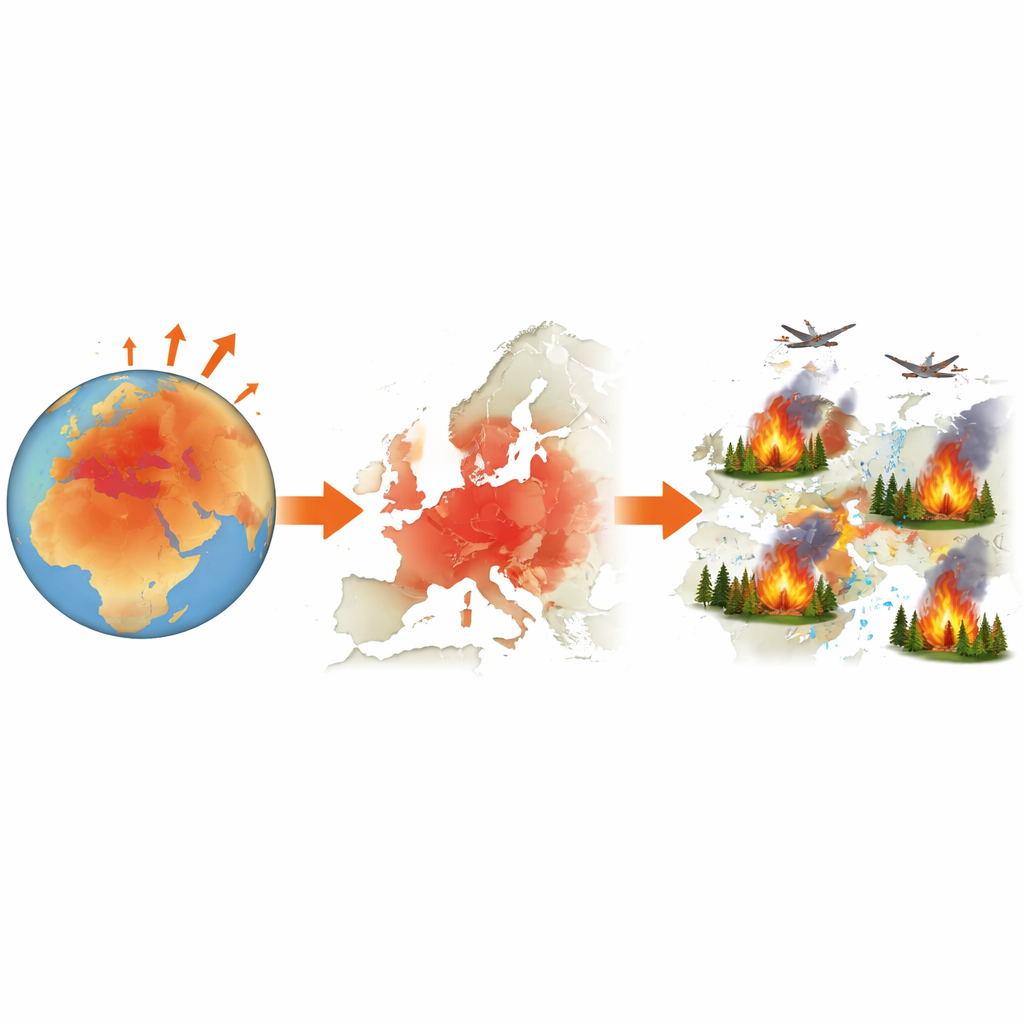
Across Europe, summers are bringing not just hotter days but fire seasons that feel longer, larger, and harder to control. This study asks a pressing question for anyone who cares about forests, towns, and shared emergency services: how often does dangerous fire weather hit many countries at the same time, and how much worse is this becoming because of human-driven climate change? The answers matter, because when several regions burn at once, even a well-organized European response system can struggle to keep up.
When the whole map lights up
The researchers focus on “fire weather” – the mix of heat, dryness, wind, and lack of rain that makes it easier for wildfires to ignite and spread. Instead of looking at single locations, they examine days when large parts of Europe are under extreme fire weather together. Using a standard international fire danger indicator based on weather data from 1950 to 2024, they track how much land is under very high fire danger on each day from May to October, the main fire season. They combine this with satellite-based records of burned area between 2001 and 2015 to see how days with especially widespread dangerous conditions relate to how much land actually burns.
More land at risk means more land burned
The results show a clear pattern: when extreme fire weather covers a larger share of Europe on a given day, total burned area across the continent tends to be much higher. This does not mean every hot, dry place burns at once – fires still depend on sparks, fuels, and firefighting – but it reveals that widespread dangerous weather sets the stage for very large fire losses. The team also shows that fire weather is not acting in isolation country by country. Because the same broad weather systems often sit over many countries at the same time, dangerous conditions line up across borders far more often than they would if each nation’s weather behaved independently. This spatial “in sync” behavior greatly boosts the odds of days when many countries face extreme fire danger together.
Slow-building heat and dryness behind the extremes
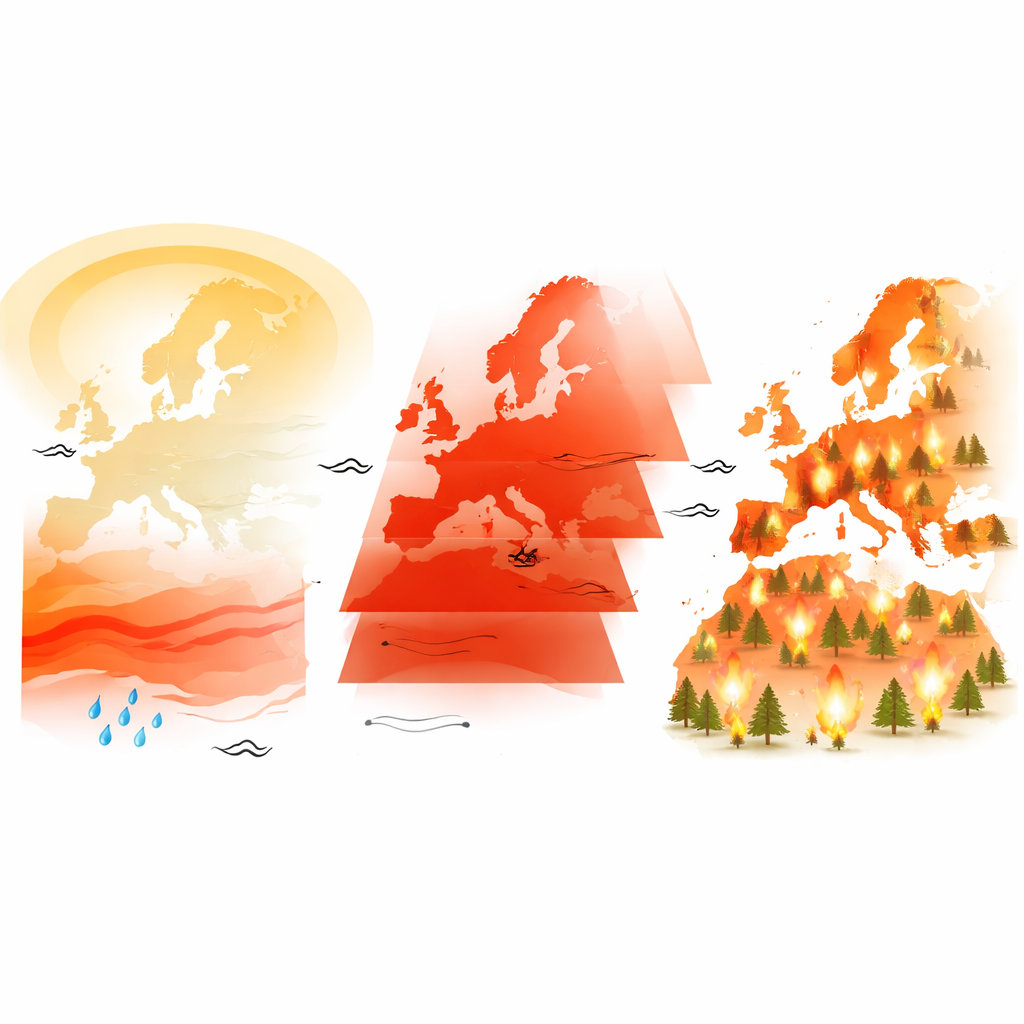
To understand what drives the worst pan-European fire weather days, the authors zoom in on the ten most extreme events since 1950. They find that these episodes do not appear out of the blue. Instead, fire danger gradually climbs for weeks as heat and dryness build up, then peaks when temperatures spike and the air becomes especially parched. Rain is scarce in the run-up, relative humidity drops to very low values, and winds tend to strengthen around the day of peak danger. This slow preconditioning dries out vegetation over wide areas, so that when a few very hot, dry days arrive, fire danger rises sharply across many countries at once.
How climate change is loading the dice
Next, the study teases apart which aspects of the changing climate are pushing Europe toward more of these synchronized danger days. Long-term weather records show that, in recent decades, summer-season temperatures across Europe have risen markedly, while the air has become drier, as reflected by declining relative humidity. By carefully removing trends in each weather variable from the data, the authors show that rising temperatures and falling humidity are the main reasons the area under extreme fire weather has expanded in recent decades. Climate model simulations, compared to a preindustrial baseline, point to human-induced climate change as a key driver: on average over the past decade, it has increased the maximum area of European land simultaneously under extreme fire weather by about 15 percent, with most models agreeing that temperature is the dominant cause.
What this means for people and preparedness
For a non-specialist, the takeaway is stark but clear. Human-driven warming is not just raising the risk of fires in familiar hotspots; it is making it more likely that large parts of Europe will face dangerous fire weather on the same days. As the zone of extreme conditions spreads north and west, more countries are drawn into these continent-scale events, which can stretch shared firefighting aircraft, crews, and support systems to their limits. The study suggests that European fire planning and cooperation must reckon with this new reality: in a warming climate, big fire years are increasingly shaped by rare but growing episodes when the weather turns hot and dry across borders at once, leaving less room for one region to come to another’s rescue.
Citation: Gauthier, E., Bevacqua, E. Human-induced climate change intensifies spatially compounding fire weather extremes across European countries. npj Nat. Hazards 3, 39 (2026). https://doi.org/10.1038/s44304-026-00201-y
Keywords: wildfires, fire weather, climate change, Europe, relative humidity