Clear Sky Science · en
Climate-driven changes in zoonotic risk of arenaviral hemorrhagic fevers in South America
Why climate and mice matter to human health
As the climate warms and landscapes are reshaped by farms and cities, disease-carrying animals are on the move. In South America, several species of wild rodents harbor viruses that can cause deadly hemorrhagic fevers in people. This study asks a pressing question: as temperature, rainfall, and land use change over the coming decades, where might the risk of these rodent-borne infections grow or shrink—and what does that mean for communities living in those regions? 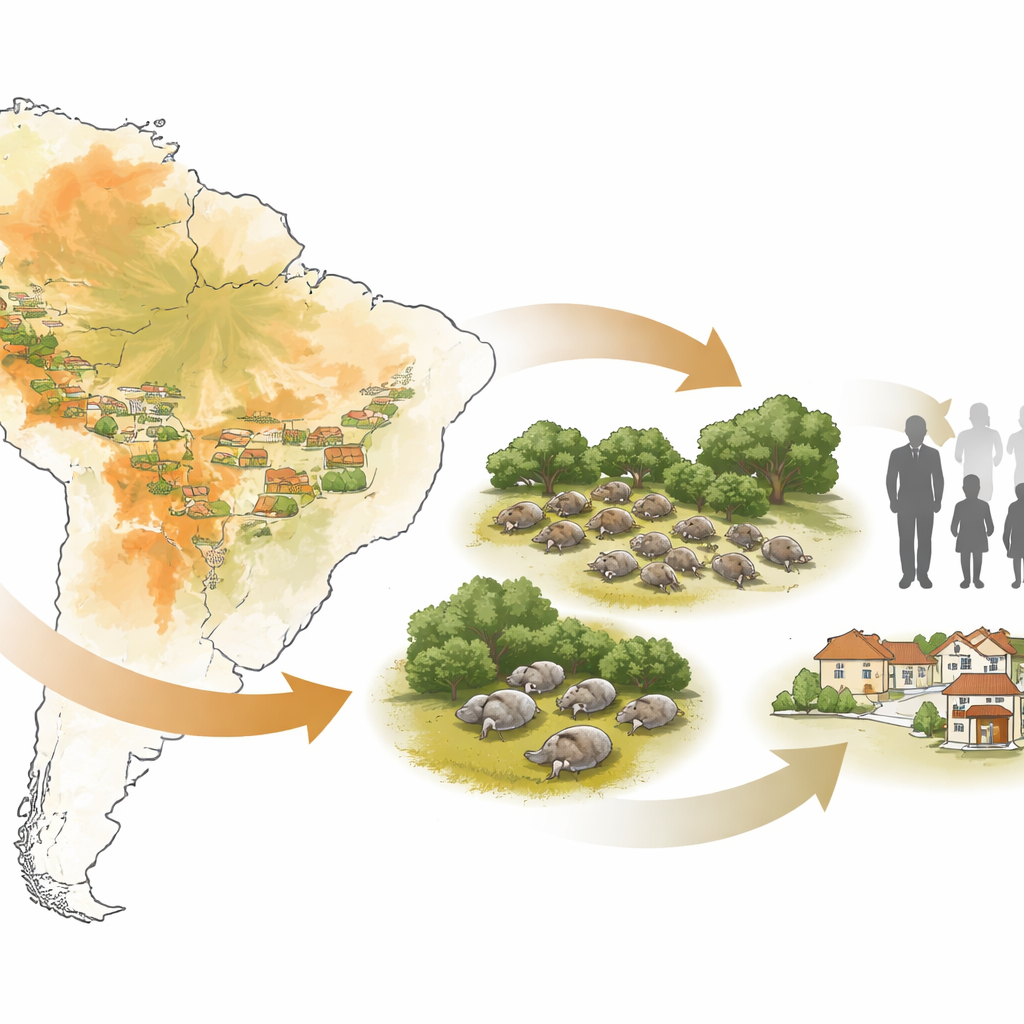
Deadly fevers and their hidden carriers
The research focuses on three “New World” arenaviruses: Guanarito virus in Venezuela and Colombia, Machupo virus in Bolivia and Paraguay, and Junin virus in Argentina. Each causes a severe hemorrhagic fever with fatality rates that can reach 30 percent. These viruses quietly circulate in specific rodent species that thrive in grasslands, farmlands, and forest edges. People are usually infected when they inhale dust or come into contact with food and surfaces contaminated by rodent droppings. Until now, most detailed climate–disease studies of this virus family centered on Lassa fever in West Africa; much less was known about how climate change might reshape arenavirus risk in South America.
Mapping future danger zones
To explore the future, the authors built computer models that first estimated where the rodent hosts can live today and where their habitats are likely to shift by mid-century (2041–2060). They combined these rodent “habitat maps” with present and projected human population densities to calculate a force-of-infection—a measure of how often infectious rodents and people are likely to meet. They ran these simulations under two widely used climate pathways: a moderate warming-and-emissions route and a more extreme one. Across both scenarios, the models point to a clear pattern: the overall risk of virus spillover from rodents to humans increases for all three viruses compared with today, and high-risk areas broaden beyond currently recognized endemic zones. 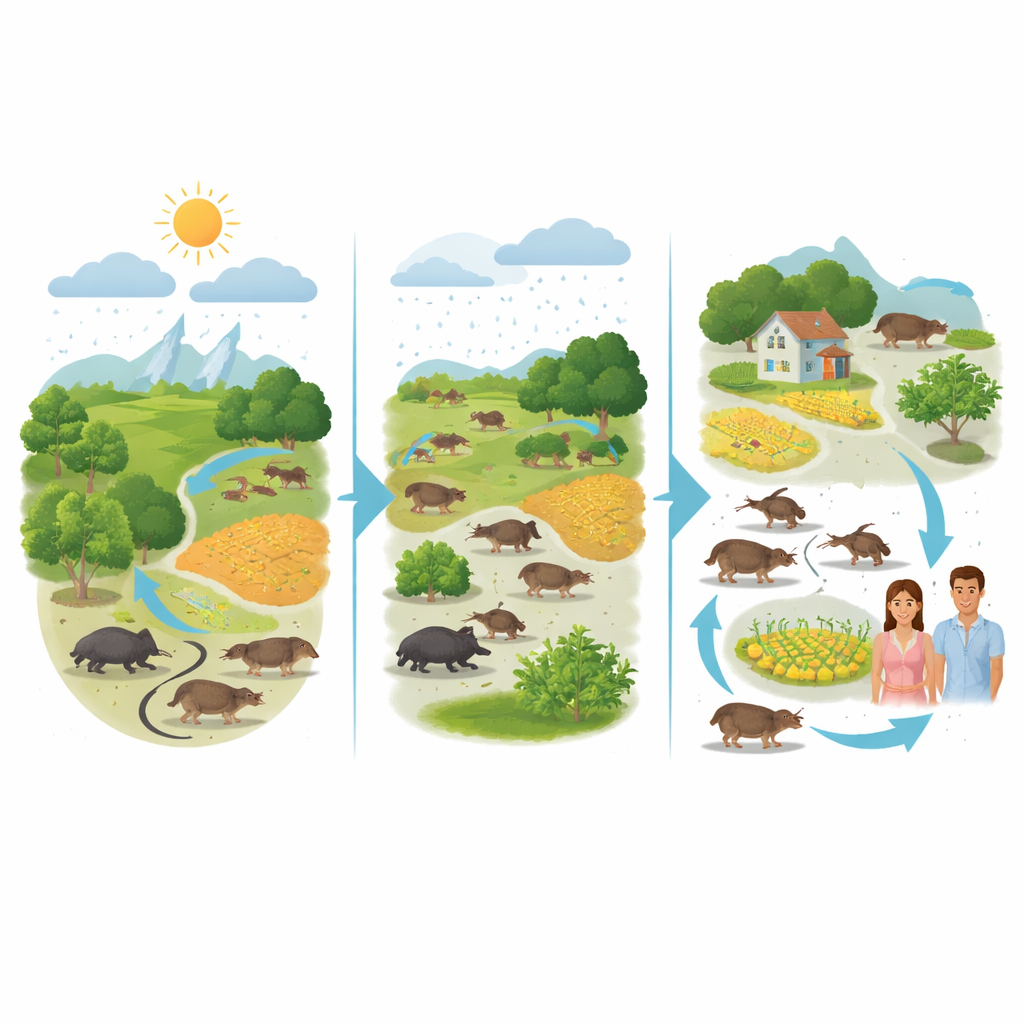
How heat, drought, and land use push risk around
The study goes beyond simple “warmer equals worse” thinking by examining which features of the changing environment matter most. For Guanarito virus, greater swings in temperature from season to season and the spread of cropland are linked to higher spillover risk, while wetter wet seasons and more forest cover tend to dampen it. For Machupo virus, shifts toward cooler, drier conditions in some regions appear to favor risk moving from Andean foothills into interior grasslands. For Junin virus, growing urban areas and surrounding farmlands emerge as important drivers: even where risk declines in traditional agricultural heartlands, it climbs in nearby non-endemic zones and near large population centers. In all cases, the model suggests that rodents are likely to occupy broader and sometimes fragmented ranges, creating new “bridge” areas where viruses and people can meet.
From rodent maps to public health action
Although the exact numbers of rodents are uncertain, the modeling framework is designed to capture trends rather than precise case counts. By using ensembles of machine-learning models and repeating the analysis many times, the authors estimate not only where risk is highest but also where those estimates are most robust. They identify transboundary hotspots—areas straddling borders of Venezuela, Guyana, Suriname, Brazil, Bolivia, Paraguay, and Argentina—where multiple viruses or rodent species may overlap. These zones are particularly important because they often include rural communities with limited health services and shifting land use driven by agriculture, ranching, and urban expansion.
What this means for people on the ground
For a lay reader, the main message is straightforward: as South America warms and dries in key seasons, and as forests give way to farms and towns, the rodents that carry arenaviruses are expected to spread into new territories, bringing their viruses closer to more people. The study suggests that even under a moderate climate future, these changes are enough to widen the footprint of hemorrhagic fevers. That makes early, coordinated responses essential—ranging from cross-border surveillance and land-use planning to strengthening rural clinics and educating communities about reducing contact with rodents. In short, climate change is not only about rising seas and stronger storms; it is also quietly reshaping the map of infectious disease risk, and this work offers a forward-looking guide to where and how that may unfold in South America.
Citation: Kulkarni, P.S., Flores-Pérez, N.Y., Jian, A.H. et al. Climate-driven changes in zoonotic risk of arenaviral hemorrhagic fevers in South America. npj Viruses 4, 23 (2026). https://doi.org/10.1038/s44298-026-00189-2
Keywords: climate change and disease, rodent-borne viruses, South America health risk, zoonotic spillover, hemorrhagic fever