Clear Sky Science · en
Menstrual cycle variations in stress vulnerability and sociability relate to mental health symptoms and libido
Why your month-to-month feelings matter
Many women notice that their mood, social energy, and sex drive rise and fall across the month, but it is often unclear whether these shifts are "all in the head" or tied to real biological changes. This study followed women day by day across several menstrual cycles to see how changes in hormones relate to stress sensitivity, sociability, mental health symptoms, and libido. Understanding these patterns can help women anticipate harder days, protect their mental well-being, and recognize when symptoms may need professional attention.
Taking a close look over 75 days
The researchers tracked 68 healthy women aged 18 to 35 over 75 consecutive days, capturing two to three full menstrual cycles per person. Each evening, participants reported how vulnerable to stress they felt, how social and cooperative they were, and how dependable and achievement-focused they felt. They also rated common premenstrual mental health symptoms such as low mood, anxiety, irritability, and mood swings, as well as physical complaints and libido. At the same time, they collected daily saliva samples so estradiol and progesterone levels could be measured, and ovulation tests were used to precisely locate different cycle phases.
Windows of resilience and vulnerability
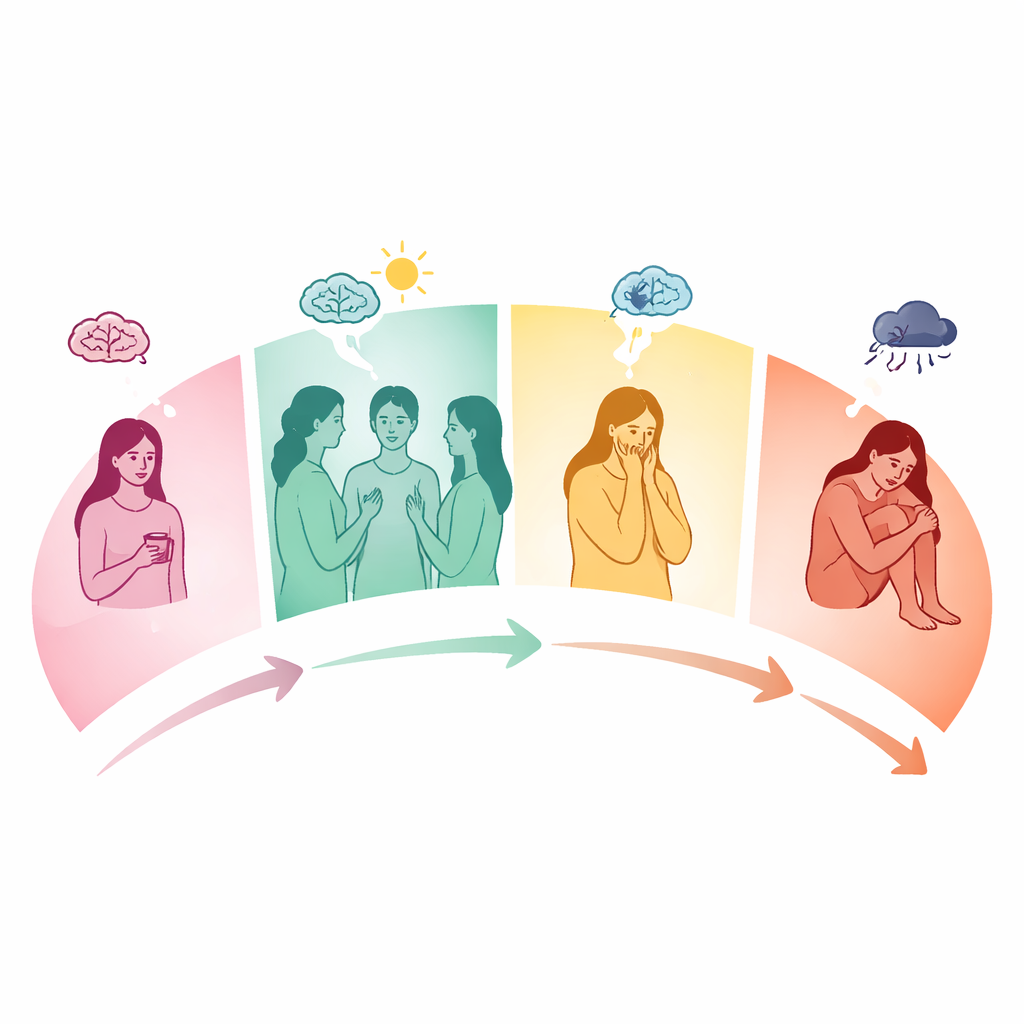
The team compared four key phases: mid-follicular (early cycle), peri-ovulatory (around ovulation), mid-luteal (about a week after ovulation), and peri-menstrual (the days just before and shortly after bleeding begins). Hormones behaved as expected: estradiol peaked around ovulation, progesterone peaked in the mid-luteal phase, and both dropped before menstruation. Personality and symptom patterns also showed clear shifts. Around the peri-menstrual phase, women reported higher stress vulnerability, lower sociability, and lower non-antagonistic orientation (feeling less patient and cooperative) than around ovulation. Mental health and physical symptoms were also highest in the peri-menstrual window, while libido was strongest around ovulation.
Not all personality traits move with the cycle
Interestingly, not every aspect of personality changed with the cycle. Dependability and achievement orientation remained stable, suggesting that some day-to-day traits—such as being organized or goal-driven—are less tied to hormonal rhythms. The traits that did shift showed only modest links to hormones themselves: sociability and non-antagonistic orientation tended to be lower when progesterone was higher, but stress vulnerability was not directly tied to hormone levels. Instead, changes in mental health symptoms and libido were much more strongly connected to how women rated their daily stress vulnerability and sociability than to which cycle phase they were in.
How daily mood and personality influence each other
Because the study collected data every day, the researchers could examine what predicted what from one day to the next. Stress vulnerability and mental health symptoms formed a feedback loop: feeling more stressed one day was linked to worse mental health the next, and vice versa. Sociability behaved differently. Lower sociability predicted worse mental health symptoms on the following day, but worsening symptoms did not reliably reduce sociability the day after. Non-antagonistic orientation (how friendly versus irritable someone felt) was tied to mental health only on the same day, suggesting it may reflect shared underlying states such as irritability rather than driving later changes on its own.
Many different personal patterns
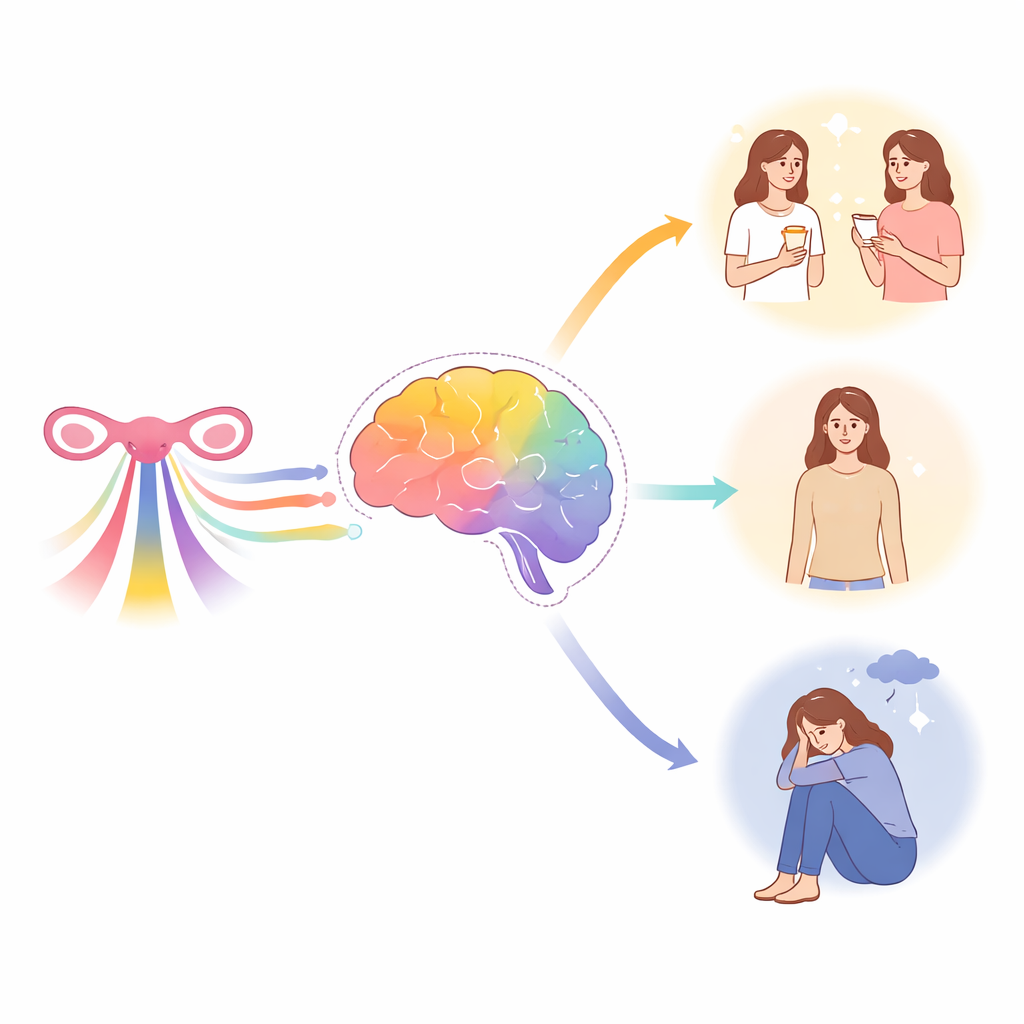
Although the group averages suggested a general pattern of higher sociability around ovulation and higher stress vulnerability before menstruation, individual women’s trajectories varied widely. Some showed strong cycle-linked swings that matched the average pattern; others showed almost no change; a few showed the opposite pattern. Women who had stronger premenstrual mental health symptoms showed more pronounced cycle-related changes in stress vulnerability and affect, but changes in sociability, cooperation, and libido were less tied to symptom severity. Overall, individual differences were often larger than the effects of cycle phase itself.
What this means for everyday life
For a layperson, the main take-home message is that some aspects of personality—especially how stress-sensitive, social, and cooperative we feel—do gently ebb and flow with the menstrual cycle, and these shifts can come before changes in mood and mental health symptoms. However, the effects are subtle, highly individual, and do not fully explain premenstrual changes in well-being. The study suggests that tracking one’s own patterns across cycles may be more informative than relying on a single "one-size-fits-all" timeline. It also highlights sociability as a possible early warning sign: when a usually social person feels less inclined to connect, that may be a signal to practice extra self-care or seek support before mental health symptoms intensify.
Citation: Pletzer, B., Hausinger, T., Thoms, N. et al. Menstrual cycle variations in stress vulnerability and sociability relate to mental health symptoms and libido. npj Womens Health 4, 18 (2026). https://doi.org/10.1038/s44294-026-00140-z
Keywords: menstrual cycle, stress vulnerability, sociability, mental health, libido