Clear Sky Science · en
Individual traits and experiences predict the content of dreams
Why Our Dreams Feel So Personal
Most people have had the feeling that their dreams somehow reflect their own lives, yet also seem strangely distant from everyday reality. This study asks a simple but powerful question: what, exactly, shapes the stories our sleeping minds tell? By combining modern language-analysis tools with thousands of dream reports, the researchers show how our personalities, habits of thought, sleep quality, and even world events like the COVID-19 pandemic leave a measurable imprint on what we dream about.
Listening Closely to Thousands of Dreams
To move beyond anecdotes and small case studies, the team collected a large, systematic set of reports from 287 adults in Italy. Over two weeks, 207 volunteers wore sleep trackers, recorded what they had just experienced upon waking, and did the same once a day during wakefulness when prompted by text message. This yielded 1,687 dream reports and 1,679 waking reports in the main dataset, plus 351 dreams from 80 people during the strict COVID-19 lockdown in spring 2020. Participants also completed extensive questionnaires on personality, mind-wandering, imagery, sleep habits, and anxiety, along with cognitive tests of memory and attention.
All spoken reports were carefully transcribed and cleaned of side comments so that only descriptions of inner experience remained. The researchers then used large language models—advanced artificial intelligence systems trained on vast amounts of text—to score each report along 16 semantic dimensions, such as visual detail, emotional intensity, thoughts, social interactions, and bizarreness. In a second, fully data-driven step, they grouped words into 32 “lexical domains” that captured recurring themes like nature, buildings, jobs, fantasy, or danger. Control experiments showed that AI ratings closely matched human judges and the dreamers’ own self-ratings, providing confidence that the automated approach captured key aspects of dream meaning.
How Dreams Differ from Everyday Thought
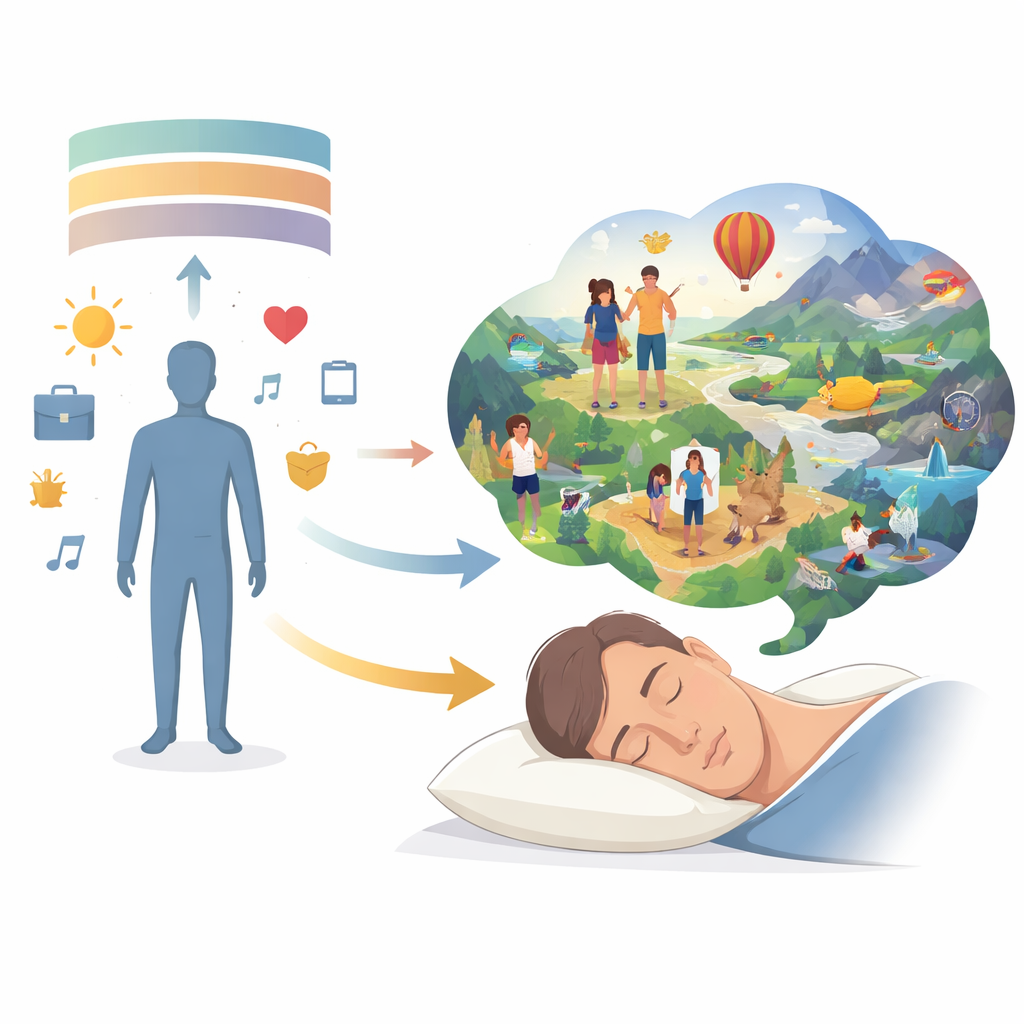
When the team compared dreams with waking reports from the same people, a clear pattern emerged. Dream descriptions were rich in sights, spaces, and shifting settings: more references to what things looked like, where events took place, and sudden scene changes. Dreams also featured more characters and social interactions, more animals and objects, and more strange or impossible events. Emotional tone was generally stronger and more negative, and people in dreams often faced limitations or obstacles that constrained their freedom to act. By contrast, waking reports were dominated by abstract thinking, planning, and self-directed actions, with greater awareness of time and bodily needs such as hunger or fatigue.
These differences suggest that, compared with everyday thought, dreams function more like immersive, film-like simulations. Rather than replaying daily life verbatim, the sleeping brain appears to build vivid scenes that rearrange familiar places, people, and concerns into new combinations. The study’s detailed language patterns fit with theories that see dreaming as a virtual reality engine: a way for the brain to explore emotionally charged or socially complex situations in a safe, offline mode.
How Personality and Sleep Habits Shape Dream Worlds
Not all dreams are alike, and the study reveals how stable traits tune what shows up at night. People with a strong interest in dreams tended to report more visually vivid and spatially detailed dreams, with higher emotional intensity and more odd, surprising features. A greater tendency to let the mind wander during the day was tied to more bizarre dreams and more frequent shifts in dream settings, reinforcing the idea that dreaming is a kind of intensified, nocturnal mind-wandering. Better visuospatial memory went hand-in-hand with more references to objects in dreams, while poorer self-reported sleep quality was linked to stranger, appearance-focused dream content.
Objective sleep tracking added a subtle twist: nights dominated by lighter, less deep sleep stages were associated with dreams that jumped more often between settings. Overall, however, broad sleep patterns played a smaller role than psychological traits. This implies that who you are—how you think, imagine, and relate to your own dreams—matters more than exactly how you slept on a given night when it comes to the themes and structure of your dream experiences.
When the World Enters Our Dreams
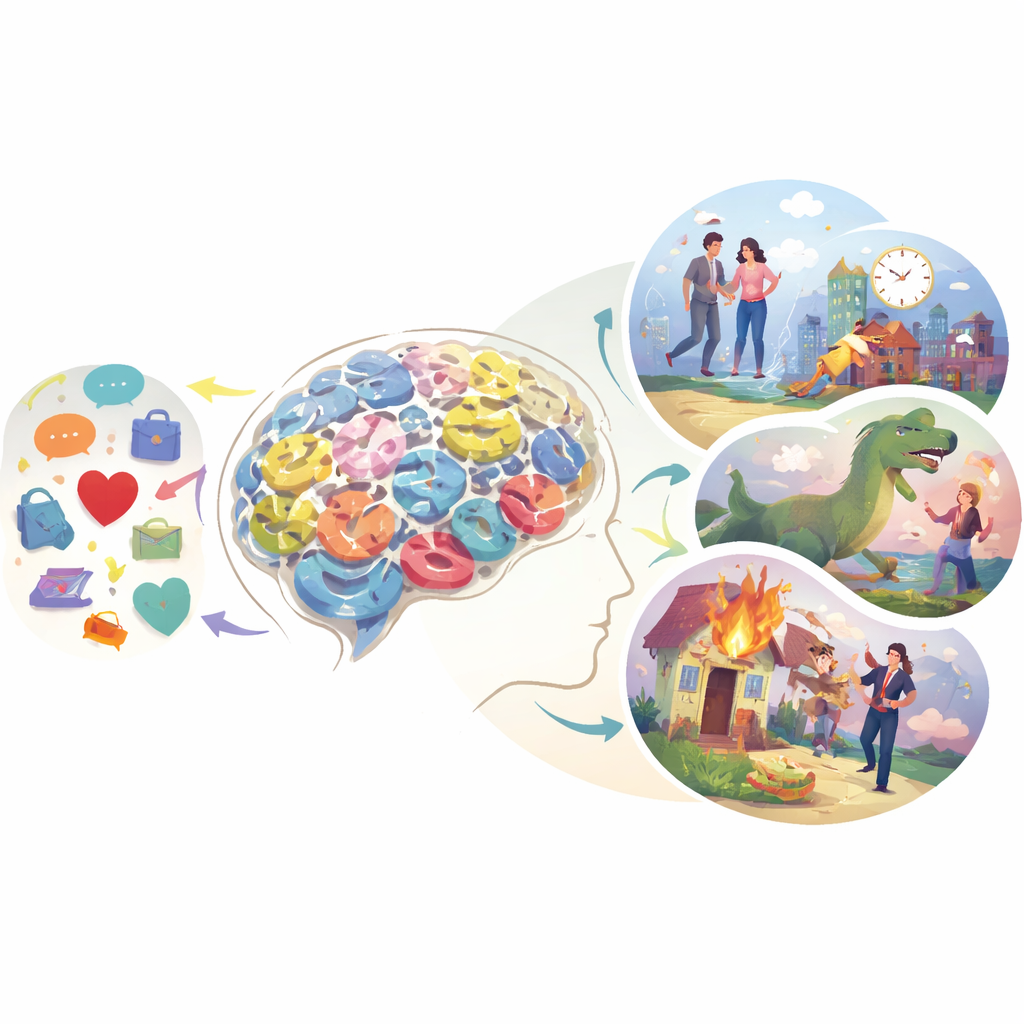
The unique lockdown dataset allowed the researchers to examine how a major shared stressor affects dreaming at the population level. During the early COVID-19 restrictions, dreams contained more references to limitations, intense emotions, bodily concerns, and social interactions, as well as more job-related and dramatic scenes. In other words, dreams remained fantastical but were more tightly anchored to the anxieties and constraints of daily life under lockdown. Looking across the four years after restrictions eased, the team observed a gradual shift: dream bizarreness declined, emotional tone became more positive, and references to limitation and societal themes faded. Waking reports showed parallel changes, suggesting a shared psychological recovery as the crisis receded.
What This Means for Understanding Dreams
Overall, the study shows that dreams are neither random noise nor simple replay. Instead, they are shaped jointly by enduring personal traits and by the pressures and events of the surrounding world. Our sleeping minds transform memories, worries, and personality quirks into vivid, often strange simulations that differ systematically from waking thought. By using powerful language-analysis tools on large collections of reports, the researchers provide a scalable way to map this hidden landscape. For the lay reader, the takeaway is that your dreams really do bear the signature of who you are and what you are living through—offering a nightly, if distorted, mirror of both your inner life and your times.
Citation: Elce, V., Bontempi, G., Scarpelli, S. et al. Individual traits and experiences predict the content of dreams. Commun Psychol 4, 69 (2026). https://doi.org/10.1038/s44271-026-00447-2
Keywords: dream content, mind wandering, sleep and emotion, COVID-19 lockdown, natural language processing