Clear Sky Science · en
Variable renewables fortify Ecuador’s power system against recurrences of drought-driven energy crises
Why keeping the lights on matters
Ecuador recently endured a year in which rivers shrank, dams ran low, and people spent up to half the day without electricity. This study asks a simple question with big consequences for daily life and the economy: could adding solar panels and wind turbines help a country that relies heavily on hydropower avoid such blackout years in the future?
When rain fails and rivers run low
The authors begin by recounting Ecuador’s 2023–2024 crisis, triggered by back‑to‑back failed rainy seasons linked to El Niño. Hydropower usually covers about 70 percent of the nation’s electricity, much of it coming from a chain of dams on the Paute River in the Andes. During the drought, this system’s main reservoirs nearly emptied, forcing long daily blackouts across the country. Similar drought‑driven power shortages have hit Brazil, China, southern Africa, Canada and Norway, underlining how vulnerable hydro‑dependent nations are when climate swings drain their reservoirs.
A new kind of backup from sun and wind
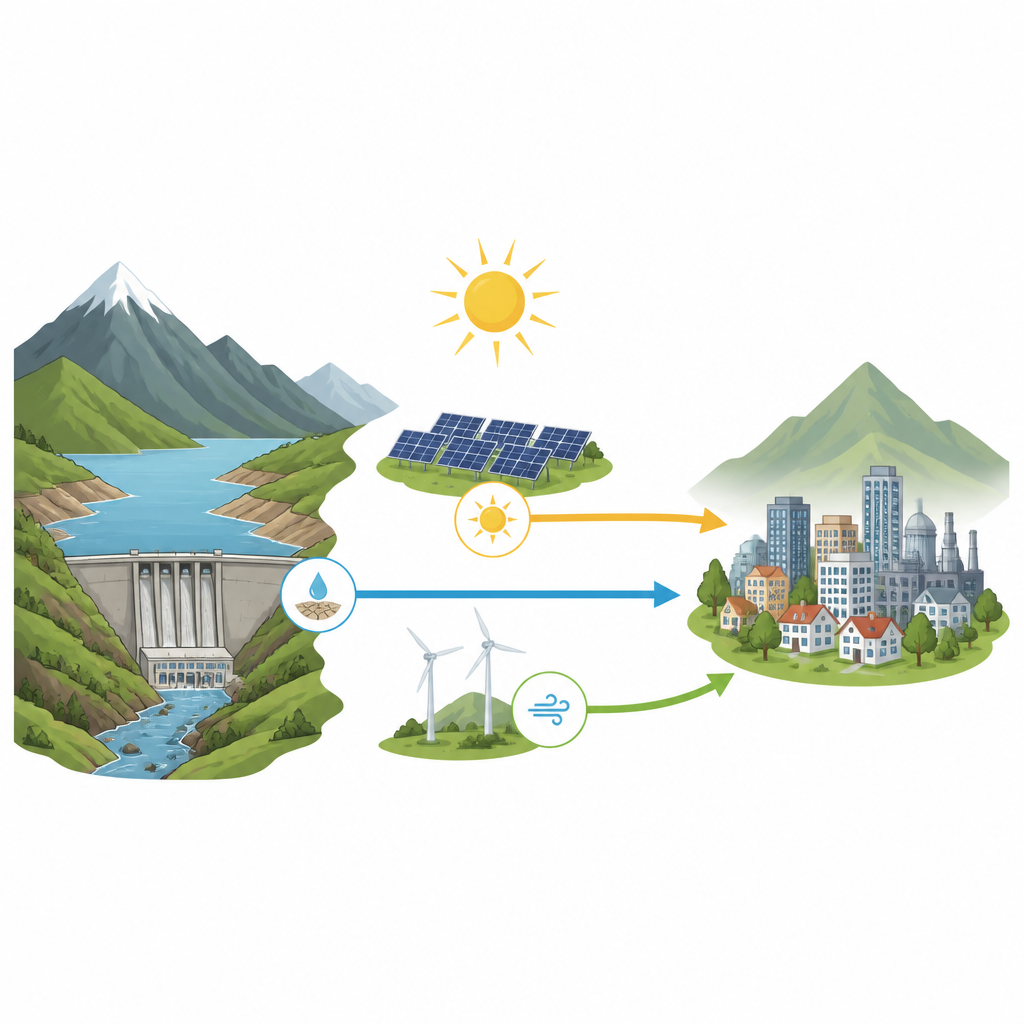
Many experts worry that solar and wind are too variable to be dependable during crises. The study challenges this view using detailed computer simulations of Ecuador’s largest hydro complex, Complejo Paute. The researchers show that while sun and wind do not neatly balance hydropower in typical years, they behave very differently in extreme dry years. During 2024, for instance, the worst river shortfalls happened in months when wind and sunshine were actually strong. The team calls this pattern “extreme‑year synergy”: in bad drought years, solar and wind often keep their seasonal peaks even as rivers fail, making them surprisingly valuable allies for struggling dams.
How smart operation saves water
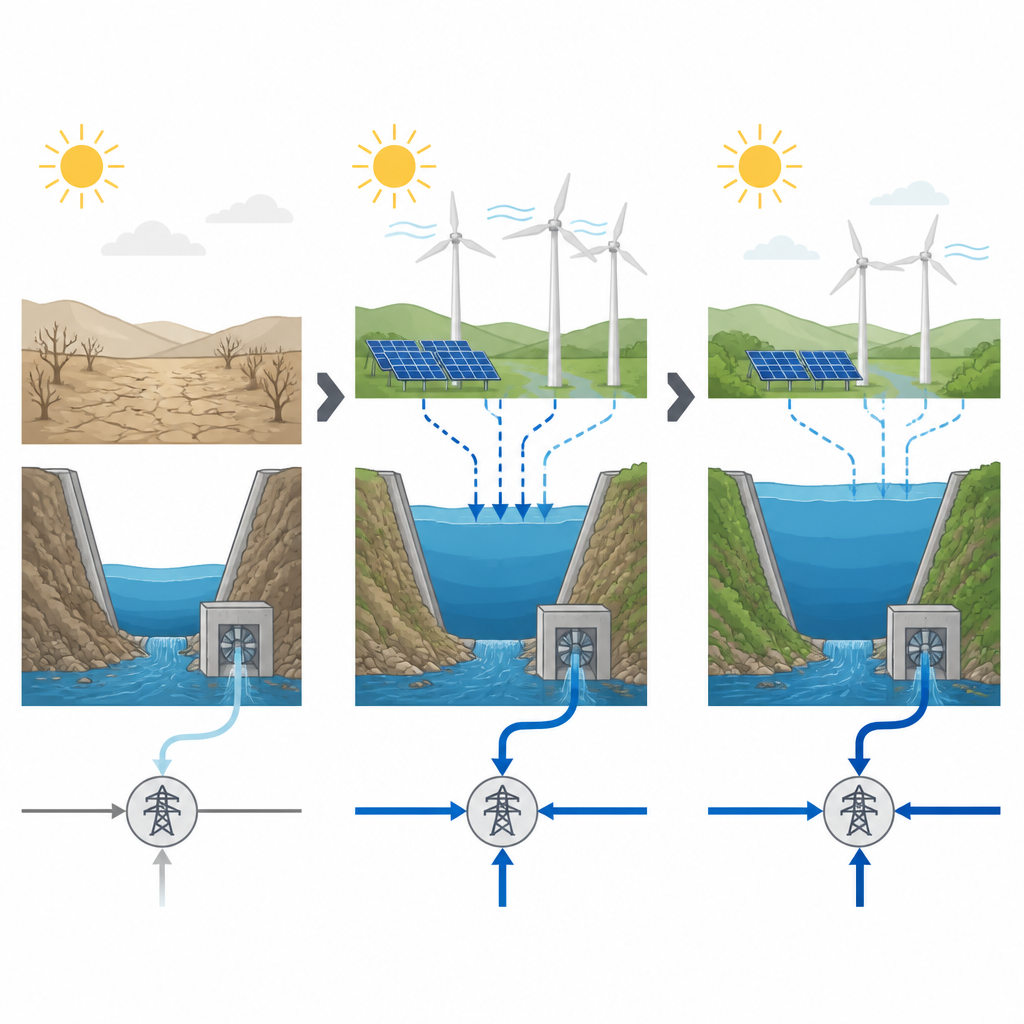
To test this idea, the authors model several futures in which Ecuador adds different amounts of solar and wind power while using its dams more flexibly. In their scenarios, hydropower plants cut back during sunny and windy hours, storing water instead of running full‑tilt, and then release more water when the air is calm and skies are cloudy. This strategy barely changes reservoir behavior in normal years but makes a big difference in a crisis year like 2024. With modest solar alone, reservoirs recover a little each day. When wind is added, water levels rise higher and faster in the key refill months, because wind often peaks when the sun does not. In the most ambitious scenario, the main Paute plant would have spent roughly half as many days shut down.
Safer planning for the next dry year
The study also examines how national‑scale decisions affect shortages. Today Ecuador largely runs its reservoirs aggressively to maximize hydropower in average years. The authors explore a “prudent” strategy that keeps slightly more water in storage, trading away about 2 percent of typical hydropower output to enter dry years in a stronger position. Alone, this helps; combined with a gigawatt‑scale build‑out of solar and wind, it dramatically cuts both the number of hours when the system lacks enough capacity and the total energy shortfall. During the worst month of 2024, this pairing would have shrunk the extra capacity needed by more than half and the missing energy by about 90 percent, leaving a gap small enough to cover with a single planned power link to neighboring Peru.
Lessons for a drying world
From a layperson’s perspective, the takeaway is straightforward: adding solar and wind, and operating dams a bit more cautiously, can turn existing hydropower into a far stronger safety net during drought. Even though sun and wind are not controllable in the usual sense, their presence during dry months lets hydro plants save water for when it is most needed. The authors argue that this “hidden backup value” could help many river‑powered countries reduce blackout risks without leaning more on fossil fuels. As climate change makes severe droughts more frequent, combining rivers, sun and wind in this way may be one of the most practical tools for keeping lights on and economies running.
Citation: Sterl, S., Pineda, L.E., Mast, T. et al. Variable renewables fortify Ecuador’s power system against recurrences of drought-driven energy crises. Nat Water 4, 571–585 (2026). https://doi.org/10.1038/s44221-026-00617-w
Keywords: hydropower, solar energy, wind power, drought, energy resilience