Clear Sky Science · en
Multichannel multicentroid motion-compensated single pixel imaging of a 2D arbitrarily moving rigid-body target
Sharper pictures from fewer pixels
Imaging technologies usually rely on large, complex camera chips packed with millions of tiny pixels. But there is a different approach: use just a single light sensor and let clever patterns and computation do the rest. This paper shows how that single-pixel idea can be pushed further, making it possible to track and clearly image small, fast-moving objects that twist, turn, and even slip partly out of view — all in real time.
Why one pixel can be enough
In single-pixel imaging, a scene is illuminated or filtered by a sequence of structured patterns, and a lone detector measures only the total brightness for each pattern. By combining all these measurements mathematically, a full image can be reconstructed. This approach is attractive whenever high-performance detector arrays are costly or impractical, such as in terahertz, X-ray, or single-photon imaging. It also works well with "compressed" sampling, so that far fewer measurements are needed than in traditional cameras. However, there is a major catch: the object normally has to stay still while the patterns are applied one after another. If it moves, the measurements no longer match up, causing blur and ghosting in the final picture.
The challenge of moving, spinning targets
Earlier attempts to handle motion in single-pixel imaging focused on simple straight-line movement. They often relied on sprinkling extra “locator” patterns into the sequence to estimate position, or on preview images or external cameras to measure motion. These tricks either reduce the effective frame rate, assume repetitive motion, or struggle when objects both translate and rotate. Rotational motion is especially tricky: even a small error in the estimated angle can translate into large shifts at the edge of the object, smearing fine detail. Existing schemes also tend to lose track when the object drifts partly outside the field of view, a common occurrence in real tracking tasks.
A new way to follow and freeze motion
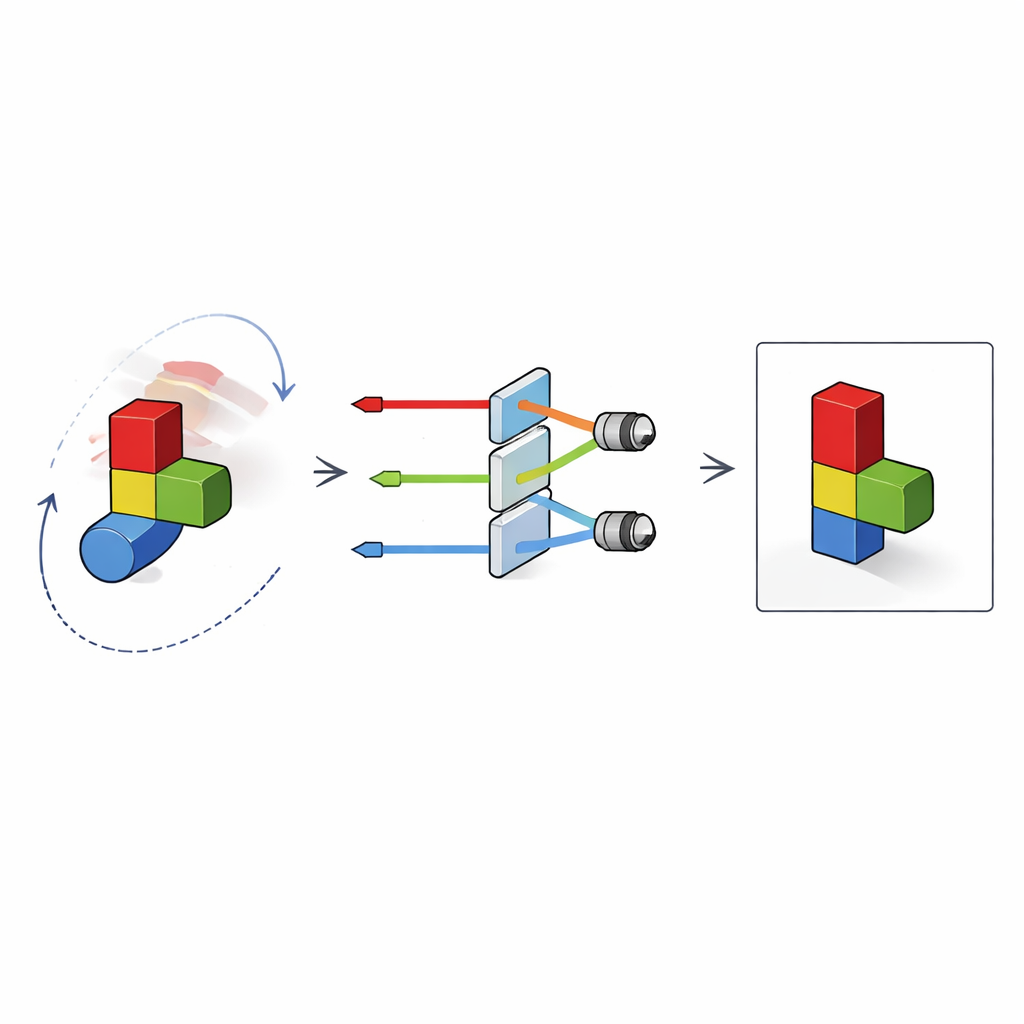
The authors introduce MC3-SPI (Multichannel Multicentroid Motion‑compensated Single‑Pixel Imaging), a method that tracks and images rigid objects undergoing any two‑dimensional motion — including arbitrary combinations of translation and rotation — without sacrificing temporal resolution. The key idea is to encode a handful of specially chosen Fourier patterns, which act like global rulers laid over the field of view. By examining how the phase of the signal from these patterns shifts, the system can pinpoint the object’s center of mass with about one‑third‑pixel precision. Because the light is split into red, green, and blue channels, each color yields its own centroid; together, these three points define both the object’s position and its orientation on every measurement frame. With this information in hand, the method then runs the movie backward, so to speak: it applies the opposite translations and rotations to the patterns themselves before combining them into an image, a procedure the authors call an inverse motion‑compensated transform.

Seeing more with fewer measurements
Through simulations and experiments, the researchers show that Fourier patterns are especially well suited to this kind of motion correction, because they remain nearly orthogonal even after being shifted and rotated, preserving reconstruction quality at low sampling rates. In contrast, another popular pattern family, Hadamard patterns, loses orthogonality more quickly under motion compensation and needs more measurements to achieve similar image quality. Using their optimized Fourier scheme, the team successfully tracks and reconstructs colored targets such as the letters "BIT," a cartoon character, and a toy rocket, all undergoing complex 2D motion. Even when the object skims along the edge of the field of view so that no single frame contains it entirely, MC3‑SPI can recover its true trajectory by exploiting the redundant centroid information from the three color channels, and can still build up a sharp, full‑color image over time.
From lab demo to fast, practical systems
A major advantage of the approach is speed. Determining motion requires only six localization patterns per frame, so at the maximum modulation rate of a standard digital micromirror device, the system could in principle track motion thousands of times per second. The basic reconstruction step — summing motion‑compensated patterns — is also extremely fast, orders of magnitude quicker than iterative optimization algorithms, yet still gives clear results at sampling rates as low as 5%. More sophisticated algorithms can be added later when higher image quality is needed and time permits. Because MC3‑SPI works with off‑the‑shelf components and plugs into standard single‑pixel setups, it can be combined with hyperspectral, three‑dimensional, or time‑resolved schemes, potentially enabling detailed imaging of fast, faint, or hard‑to‑reach targets in fields ranging from microscopy to remote sensing.
What this means for future imaging
In essence, this work shows how to turn a simple single‑pixel system into a nimble, motion‑aware camera that can keep up with agile, rotating objects while still delivering sharp pictures. By smartly choosing the illumination patterns, using color channels to define multiple reference points on the object, and compensating for its motion in software, the authors overcome the long‑standing tension between speed, resolution, and motion sensitivity in single‑pixel imaging. This opens a practical path toward compact, inexpensive imaging systems that do not merely freeze the world, but follow it in real time.
Citation: Shao, C., Cao, Y., Li, S. et al. Multichannel multicentroid motion-compensated single pixel imaging of a 2D arbitrarily moving rigid-body target. Commun Eng 5, 61 (2026). https://doi.org/10.1038/s44172-026-00619-2
Keywords: single-pixel imaging, motion tracking, computational imaging, Fourier patterns, high-speed imaging