Clear Sky Science · en
Loss of competitive strength in European conifer species under climate change
Why Europe’s Forests Are Poised to Change
Across Europe, many of the forests we know today—dark conifer stands in the mountains, light birch groves in the north—are likely to look very different by the end of this century. This study explores a simple but powerful question: as the climate warms, which trees will win the quiet, long-running contest for light, water and space, and which will lose ground? The answer matters not only for the scenery we cherish, but also for wildlife, wood production and the capacity of forests to store carbon.
How Trees Compete in a Changing World
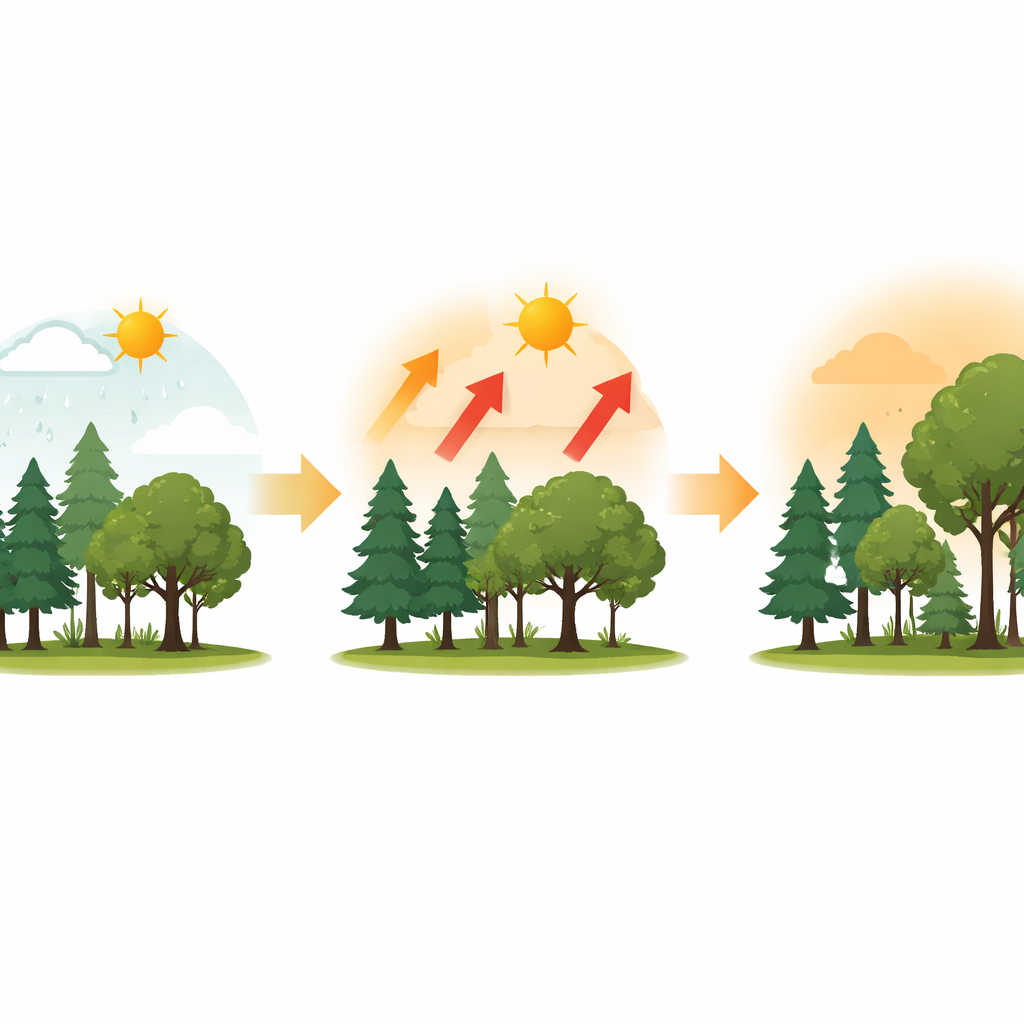
Trees compete over decades by growing taller than their neighbors and by spreading dense canopies that capture sunlight. Species also differ in how well they reach water and nutrients in the soil. Under stable conditions, these traits allow certain trees to keep their leading role over vast areas—European beech, for example, can dominate many temperate forests for centuries. Climate change disrupts this balance by shifting temperature and rainfall patterns, altering where each species can grow best and how strongly it can outcompete its neighbors.
A Continental-Scale Experiment in Silico
Because such competitive shifts unfold too slowly to observe directly, the authors turned to a vast library of computer simulations. Seventeen detailed forest models had already been run for more than 13,000 locations across Europe, producing 135 million simulated “years” of forest growth under different climates. The team trained a deep neural network—a form of artificial intelligence—to learn how forests move from one state to another: which species are present, how tall the canopy is, and how leafy it becomes. Once trained, this meta-model could quickly predict how forests would respond to future climate scenarios across the whole continent.
Winners and Losers Among Europe’s Trees
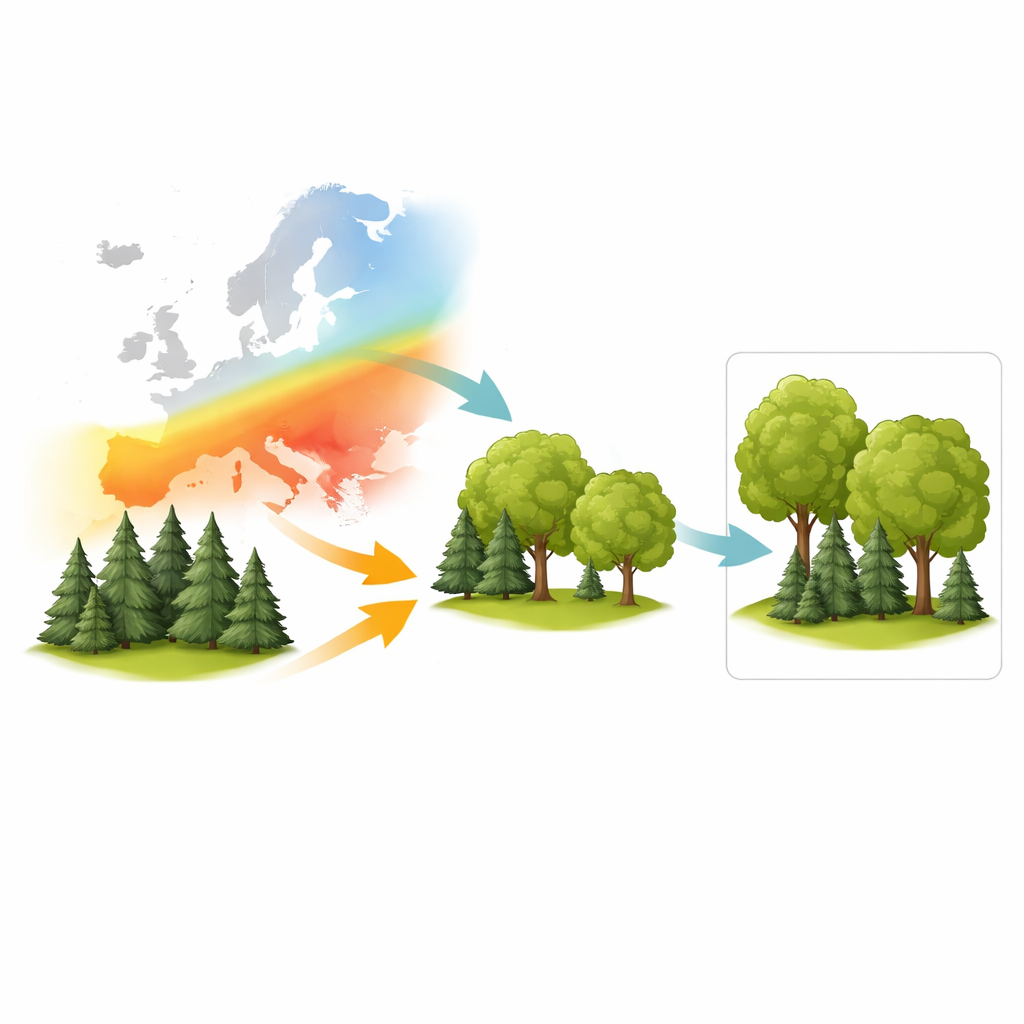
The researchers focused on nine major tree species and on two simple markers of competitive strength: how fast trees gain height, and how dense their leaf area is. Combined into a competitive strength index, these measures showed a clear pattern. Under strong climate change, most evergreen conifers—such as Norway spruce, Scots pine, silver fir and Aleppo pine—lose competitive strength across much of their current range. In contrast, broadleaved trees like European beech and pedunculate oak generally gain strength, especially in cooler and currently conifer-rich regions. Trees tend to become more competitive near the cold edges of their climatic niche, but weaken near their warm, dry limits.
Where Forest Leaders Are Likely to Change
Loss of competitive strength only translates into a visible shift if another species can take over as the main occupant of a stand. Using the meta-model, the authors estimated where today’s dominant species—those making up more than two-thirds of a stand’s wood area—are likely to be replaced. They project that, under a severe warming scenario, nearly a quarter of Europe’s forest area could see a change in the dominant tree species by 2100, affecting about 96 million hectares. Norway spruce and silver birch are among the biggest projected losers, while European beech and pedunculate oak often gain ground. Hotspots of change cluster where major biomes meet, such as along the Alps, southern Scandinavia and the transition between Mediterranean and temperate forests.
What These Shifts Mean for People and Nature
If Europe’s forests move from being largely evergreen to more dominated by deciduous broadleaved trees, the ripple effects will be far-reaching. Many animals, insects and fungi depend on particular tree hosts, so changing dominants could reorganize entire communities. Forestry will also need to adapt: widely planted conifers that lose their competitive edge may require more intensive care or gradual replacement. At the same time, rising oaks and beeches could support richer biodiversity and alter how forests store carbon. By distilling the best available process-based models into a flexible AI tool, this study offers an early warning that climate change is already tilting the playing field of Europe’s forests—and provides a map of where policy and management may need to respond first.
Citation: Grünig, M., Rammer, W., Baumann, M. et al. Loss of competitive strength in European conifer species under climate change. Commun Earth Environ 7, 401 (2026). https://doi.org/10.1038/s43247-026-03582-0
Keywords: climate change, European forests, tree competition, conifer decline, broadleaf expansion