Clear Sky Science · en
Accelerated deposition of South Asian anthropogenic emissions on southern Tibetan glaciers in the 21st century
Why distant glaciers matter to everyday life
High in the Tibetan Plateau lie glaciers that feed many of Asia’s great rivers, providing water to billions of people. This study shows how modern air pollution from South Asia is increasingly reaching these remote ice fields, changing the chemistry of the snow that will become future river water and subtly affecting how fast the glaciers melt. Understanding this hidden link between smokestacks, farm fields, and mountain ice helps us see how closely connected lowland life is to the so‑called Asian “water tower.” 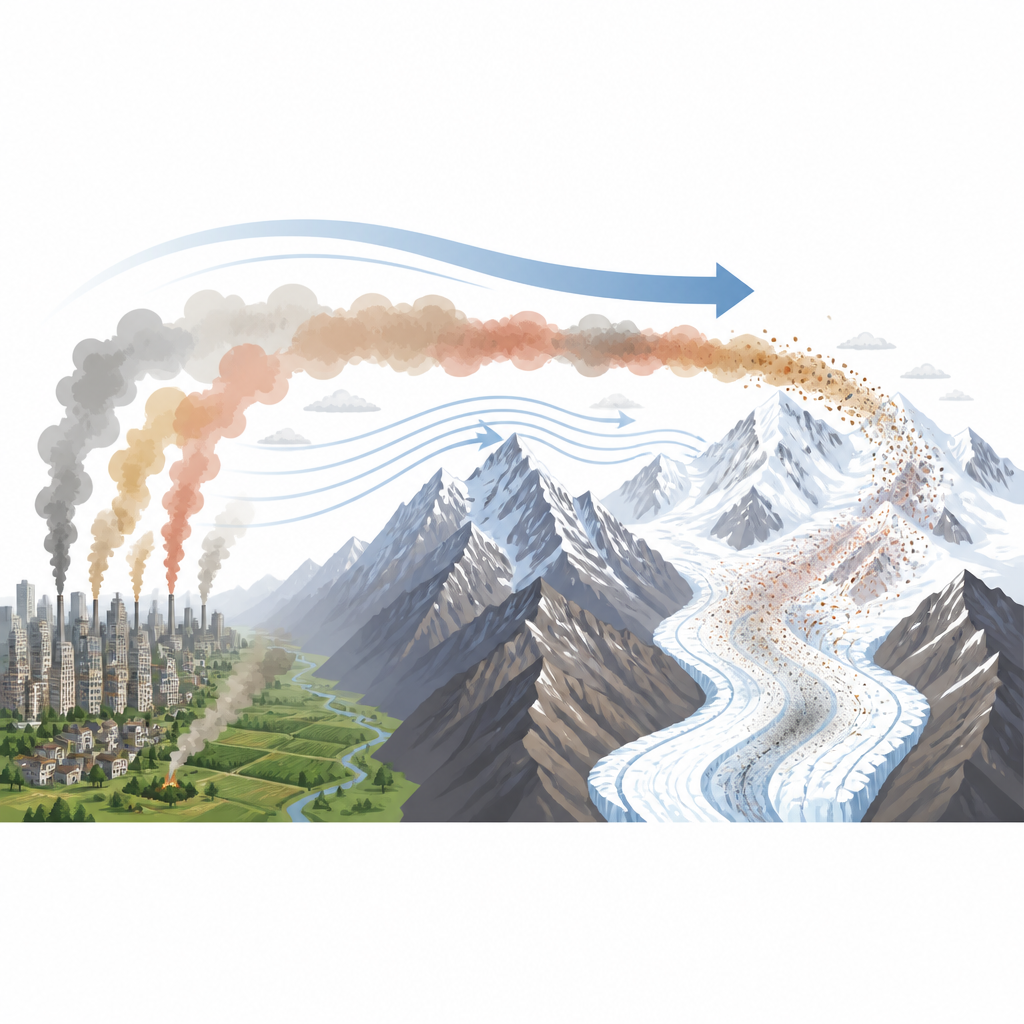
Clues frozen in mountain ice
Researchers drilled deep ice cores from two glaciers on the southern edge of the Tibetan Plateau, Bugyai Kangri and Noijin Kangsang. Like tree rings, layers in the ice build up year by year, locking in tiny traces of chemicals from the atmosphere. By measuring forms of nitrogen known as nitrate and ammonium in layers dating from 1950 to 2021, the team reconstructed how much pollution has been falling onto these glaciers over more than seventy years. Careful dating using seasonal oxygen signals in the ice and traces from past nuclear tests showed that the yearly timeline of the cores is accurate to within just a few years, giving a sharp picture of recent change.
A sharp rise in pollution after 2000
The ice reveals that deposition of nitrate and ammonium, which mainly come from car exhaust, power plants, and agricultural ammonia, rose gently during the late twentieth century but then sped up in the early twenty‑first century. After 2000, the amount of these pollutants reaching Bugyai Kangri nearly tripled for nitrate and increased by about one and a half times for ammonium compared with earlier decades. At Noijin Kangsang the rise was smaller but still clear. At Bugyai Kangri, heavier snowfall in recent years has helped scrub more pollution out of the air, while at Noijin Kangsang the buildup mostly reflects a dirtier background atmosphere rather than changing snowfall. Together, the records show that South Asian economic growth has left a strong chemical fingerprint on nearby high‑altitude ice. 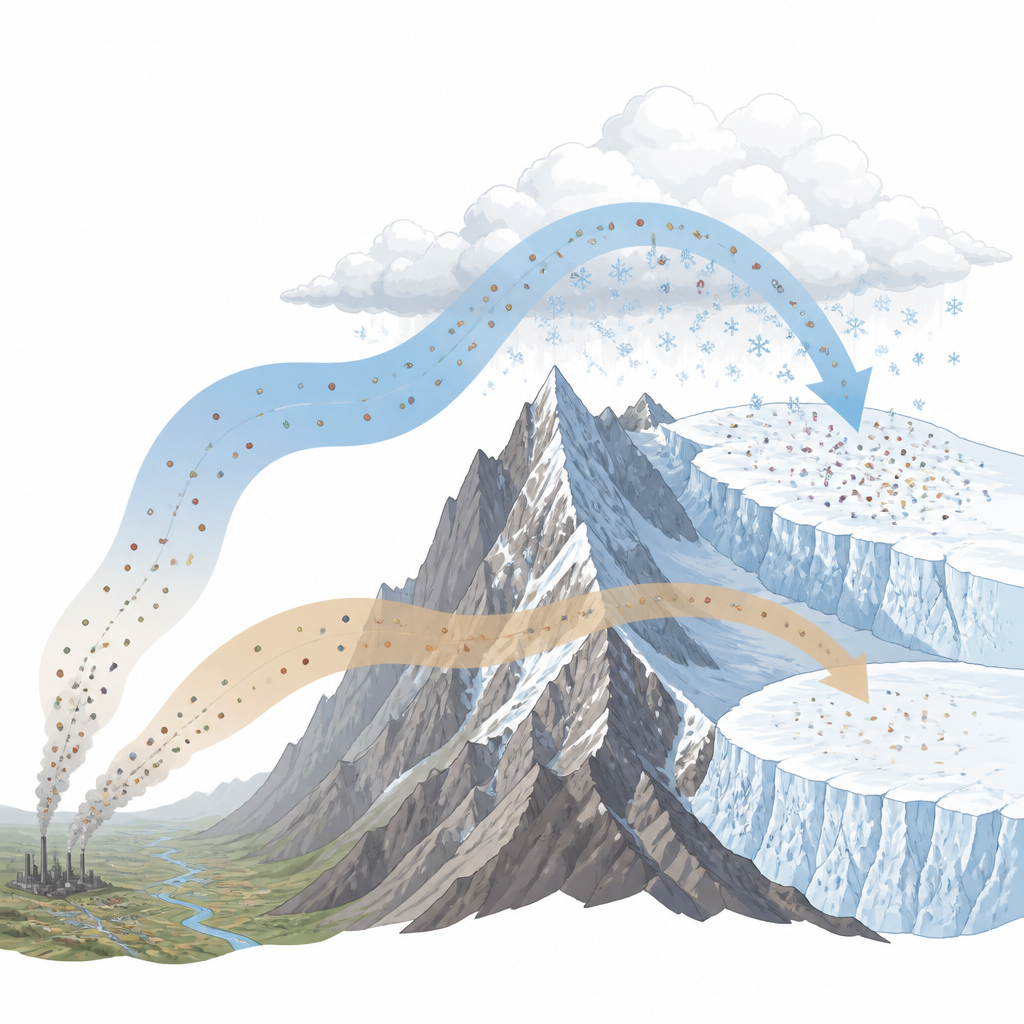
Tracing where the pollution comes from
To find the sources of this extra nitrogen, the team combined the ice chemistry with computer tools that separate different pollution “fingerprints” and track air movements. A statistical model showed that most of the nitrate and ammonium in the ice belongs to an anthropogenic factor linked to industry, vehicles, farms, and biomass burning rather than to natural dust or salt. Another model traced air parcels backward through time and highlighted two main pathways that carry air from South Asia to the glaciers. One moist route sweeps polluted air from the Bay of Bengal region and northeastern India toward Bugyai Kangri, while a drier route carries air from northern India and Nepal toward Noijin Kangsang.
Hotspots on the map
The researchers then compared year‑by‑year pollution in the ice with a high‑resolution map of nitrogen emissions from the Emissions Database for Global Atmospheric Research. Where the backward trajectories and emissions overlapped, they found strong statistical links. For Bugyai Kangri, annual nitrogen in the ice closely followed emissions across the Indo‑Gangetic Plain and Bangladesh, while for Noijin Kangsang the best match came from northern India and Nepal. Satellite records of fire activity also lined up with changes in potassium in the ice, pointing to increasing burning of crop residues as another contributor. Local Tibetan sources such as cities and roads appear to play a much smaller role than the huge industrial and agricultural belt to the south.
What this means for the Asian water tower
By tying together ice cores, atmospheric models, and emission maps, the study shows that modern human activities in South Asia are now a dominant source of nitrogen pollution reaching southern Tibetan glaciers, and that this influence has accelerated since around 2000. These pollutants can darken snow, alter how much sunlight it absorbs, and change the nutrient balance in fragile alpine ecosystems. While the work cannot yet separate in detail the roles of factories, farms, and fires, it highlights the need for regional cooperation on air quality if the health of the high‑mountain “water tower” and the rivers it feeds is to be safeguarded in a warming and rapidly developing world.
Citation: Yang, D., Xu, B., Li, Z. et al. Accelerated deposition of South Asian anthropogenic emissions on southern Tibetan glaciers in the 21st century. Commun Earth Environ 7, 447 (2026). https://doi.org/10.1038/s43247-026-03444-9
Keywords: Tibetan Plateau, South Asian pollution, glacier ice cores, nitrogen deposition, monsoon transport