Clear Sky Science · en
Biomass burning increase in Southeast Asia is dominated by char black carbon
Why smoke from fires matters for our climate
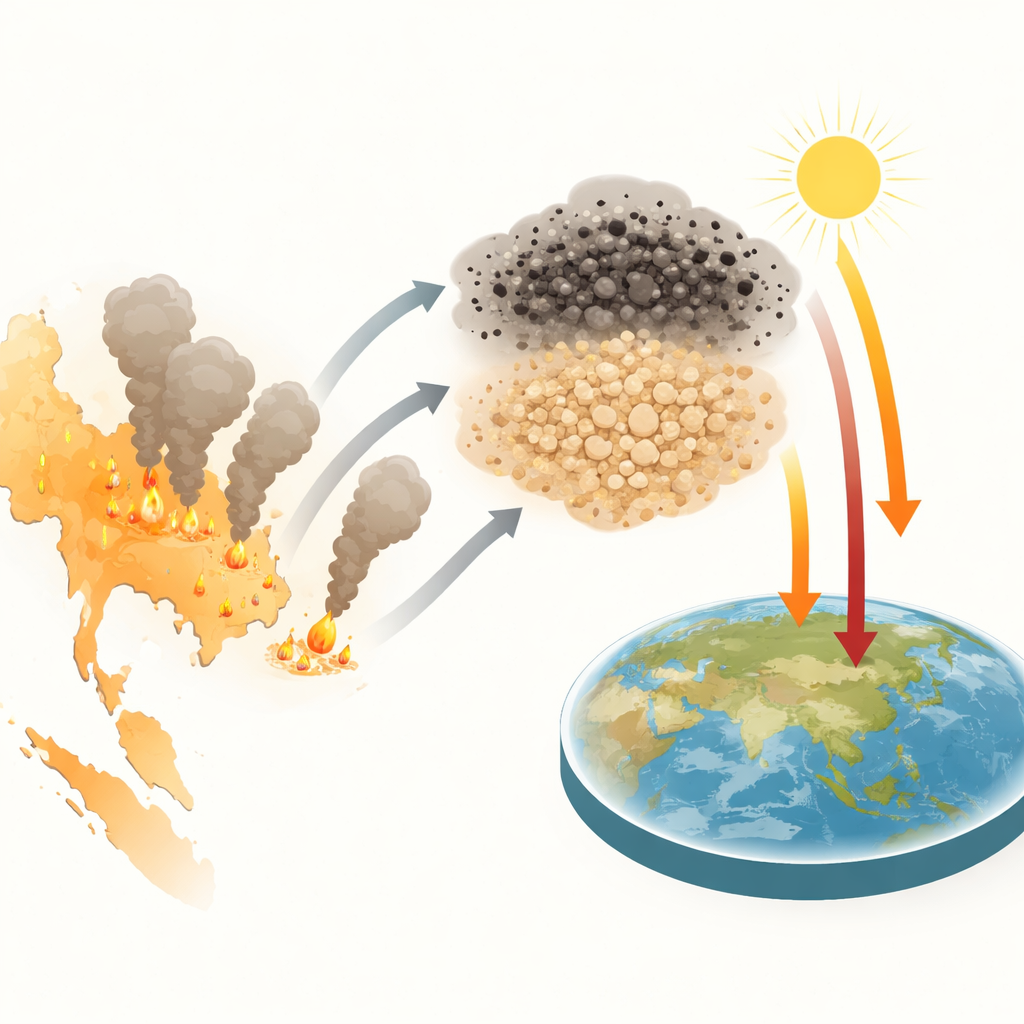
Every dry season, vast areas of Southeast Asia are shrouded in smoke from crop burning and forest fires. That haze is rich in tiny, sooty particles that warm the air and affect human health. Yet climate models have long struggled to match how much of this “black carbon” is actually in the air, and how strongly it absorbs sunlight. This study uncovers a missing piece of the puzzle: most of the increase in black carbon from regional fires comes not from classic soot, but from a less-studied form called char, which behaves very differently in the atmosphere.
Two kinds of black carbon in fire smoke
Black carbon is usually treated as a single substance in climate models, but real smoke is more complex. When plant material or fuel burns, it can form two main types of black particles. Char forms early in the burn, as solid bits left behind when organic material is heated but not completely burned. Soot forms later, in the hotter gas flame, as tiny chains of carbon-rich particles. Char tends to be more spherical and less dense in its ability to absorb light, while soot is more strongly light-absorbing. By using specialized thermal-optical measurements, the researchers could separate these two components in smoke collected at an urban site and a rural village in northern Thailand.
Fires in Southeast Asia are mostly boosting char
The team monitored fine particle pollution through both the intense burning season (February–April) and the quieter wet season (June–September). They found that, as fires ramped up, concentrations of char shot up by more than fivefold, while soot changed only slightly. In the high-burning season, char clearly dominated the black carbon mixture, especially at the rural site closer to open field and forest fires. Ratios of char to soot were far higher during the smoky months than during the rainy season, pointing to open burning as the main source. Residential burning and vehicle exhaust, by contrast, produced a more balanced mix of char and soot. This seasonal swing shows that when fire activity increases, the type of black carbon in the air shifts strongly toward char.
Char is dimmer, but models mistake it for soot
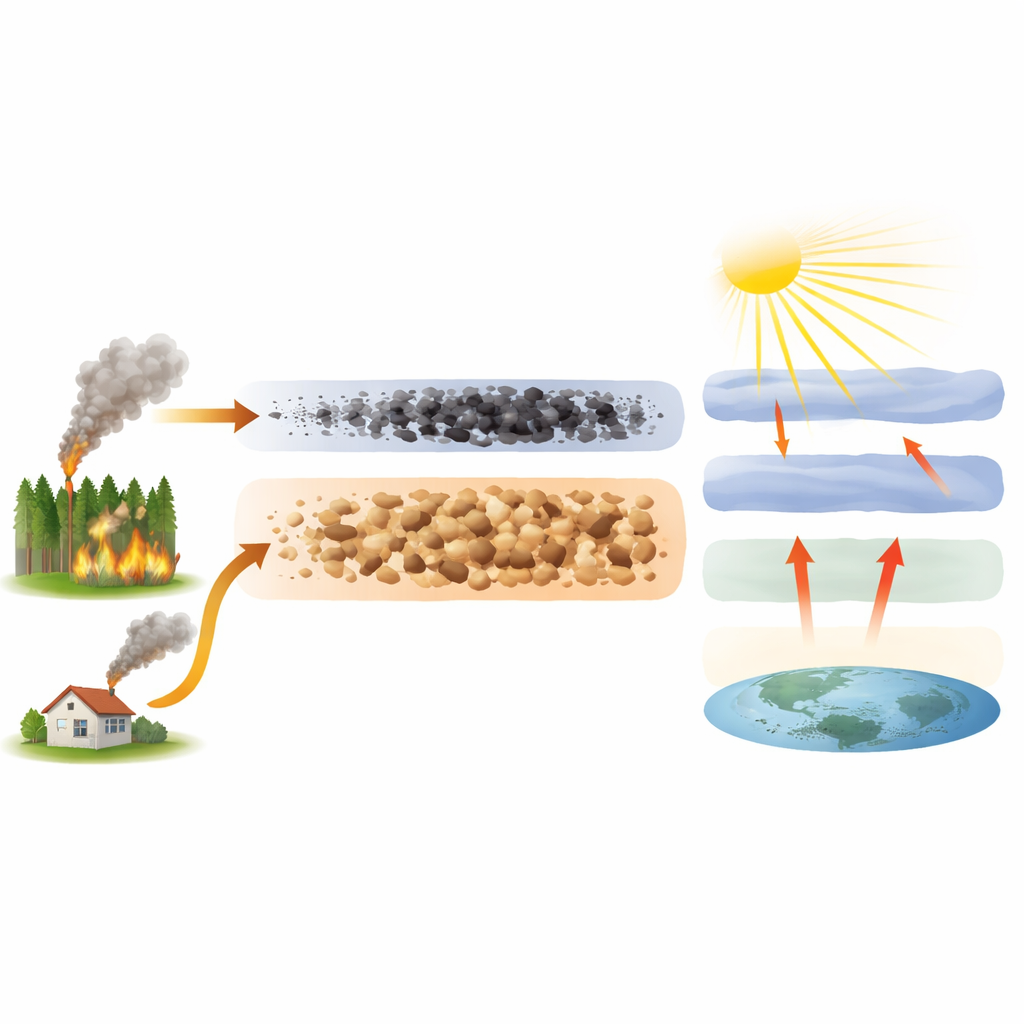
To understand how much sunlight these particles absorb, the authors combined their field measurements with radiocarbon analysis that distinguishes fossil-fuel emissions from biomass burning. They then used a statistical model to assign light-absorption strength to char and soot from different sources. A clear pattern emerged: char from biomass burning absorbs much less light per unit mass than char from fossil fuels, and less than soot from any source. However, most climate models assume that all black carbon behaves like soot in how it absorbs light. This means models not only miss a large share of char-rich emissions from fires, they also give that missing char soot-like optical properties, overstating its warming power.
How the missing char skews climate estimates
The researchers next fed their field-based char and soot data into a state-of-the-art atmospheric model. When they compared standard model output to their measurements, fossil-fuel black carbon matched well, but biomass-burning black carbon was severely underestimated—by about three times during the smoky season and up to ten times during the wet season. Correcting only the total black carbon mass roughly doubled the estimated direct warming effect over mainland Southeast Asia. But when they also corrected the light-absorption strength to reflect char’s weaker absorption, the calculated warming dropped back somewhat. This showed that simply scaling up black carbon emissions without adjusting its optical behavior can create a new kind of error in the opposite direction.
What this means for a warming world with more fires
Looking beyond Southeast Asia, the authors compiled data from many regions and found a broader pattern: as biomass burning becomes more intense and char makes up a larger share of black carbon, the average light-absorption efficiency of black carbon tends to decrease. In other words, more fire can mean more black carbon particles in the air, but those particles may, on average, absorb sunlight less strongly because char dominates. This does not cancel out their warming effect, but it does moderate it and complicates predictions. The study concludes that to assess climate impacts and design policies around fires and air quality, scientists and modelers must track char and soot separately, include char-rich emissions in inventories, and assign each subtype realistic optical properties. Only then can estimates of fire-driven warming keep pace with a future in which large wildfires and intentional burning are expected to become more common.
Citation: Song, W., Zhang, Y., Gao, M. et al. Biomass burning increase in Southeast Asia is dominated by char black carbon. Commun Earth Environ 7, 359 (2026). https://doi.org/10.1038/s43247-026-03431-0
Keywords: black carbon, biomass burning, Southeast Asia, climate forcing, aerosol particles