Clear Sky Science · en
The Martian mid-latitude subsurface ice is the remnant of a past ice sheet
Hidden Ice Under Martian Dirt
When you picture Mars, you might think of a dry, dusty desert. Yet beneath that dusty surface at middle latitudes, scientists have found large amounts of nearly pure water ice just tens of centimeters down. This study asks a simple but important question for future exploration and our understanding of Martian climate: is that buried ice a leftover from a past ice age on Mars, and how long has it been hiding there?
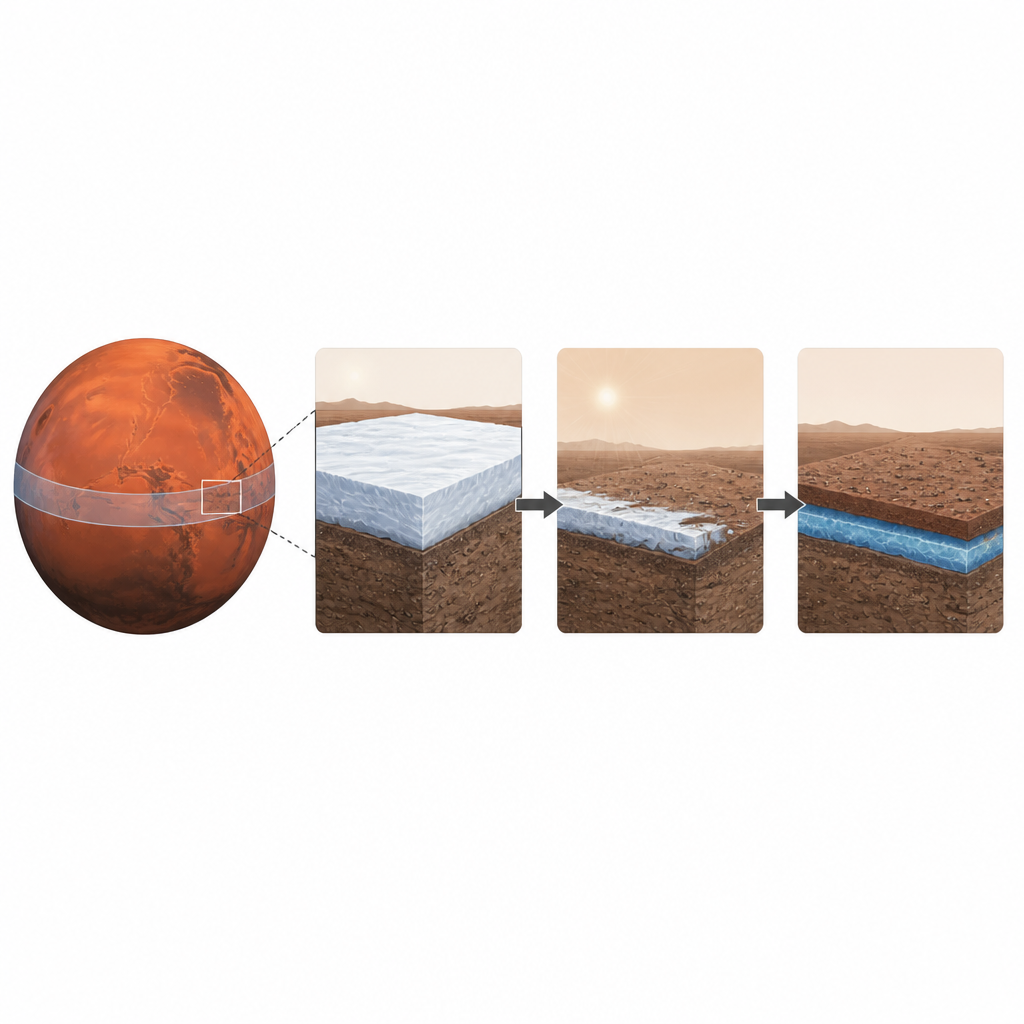
Where the Martian Ice Is Hiding
Spacecraft have detected water below the Martian surface in several ways, including neutron measurements from orbit, radar reflections, fresh impact craters that expose bright material, lander observations, and surface temperature changes through the seasons. These tools show that a relatively clean layer of ice lies just under the ground from about 40 to 55 degrees north, and even as far equatorward as 35 degrees. In many places this ice sits less than a meter below the surface, which is surprising because simple models say that, under today’s thin and cold atmosphere, ice should be stable only much closer to the poles.
How the Ice Likely Formed
There are two main ways ice can collect below the surface. It can grow slowly inside soil pores as water vapor seeps downward, or it can start as a surface blanket of snow or frost that later shrinks and leaves a dusty cover on top. The mid latitude ice that has been exposed by recent craters is almost dust free, holding less than two percent impurities. That level of purity points strongly to surface snowfall or frost as the source, followed by slow loss of ice to the air while dust is left behind to form an insulating layer. This dusty cover both slows the escape of water vapor and keeps the underlying ice cooler, helping it survive over long spans of time.
Replaying Mars Climate Through Time
The authors used an advanced Mars climate model to rewind the planet’s recent past. Mars does not spin as steadily as Earth does; its tilt, or obliquity, changes over hundreds of thousands to millions of years. When the tilt was higher than it is today, sunlight patterns shifted and the air held much more water vapor, allowing snow and frost to build up in mid latitude regions. The team ran detailed simulations of temperature, dust, carbon dioxide, and water over the last four million years to estimate how much ice would accumulate, how quickly it would shrink, and how deep it would end up below the surface as a protective dust layer developed.
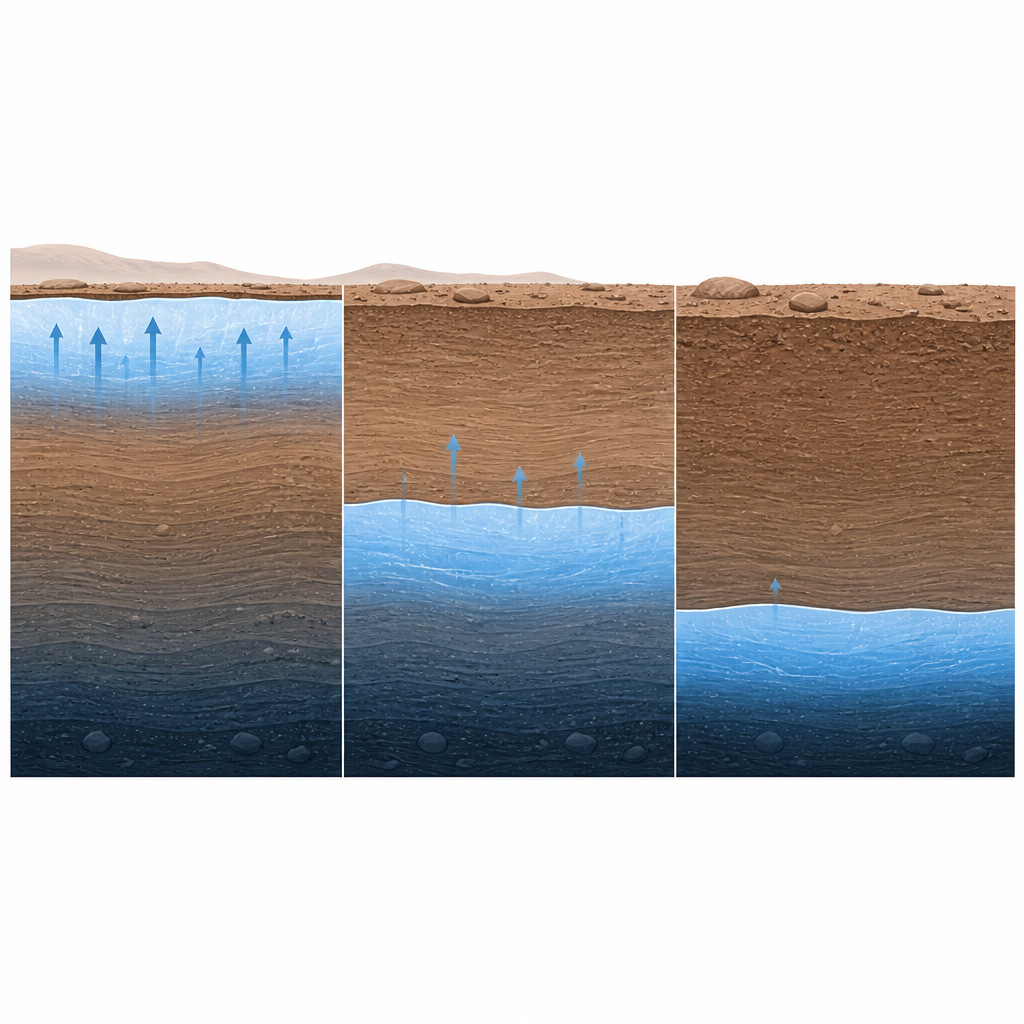
Matching Models to Real Craters
Using their model, the researchers started with a layer of surface ice placed on Mars about 630 thousand years ago, when the planet’s tilt was around 35 degrees and mid latitude ice sheets are thought to have formed. They then let the simulated ice slowly retreat as conditions changed to those we see today. For the band between 40 and 55 degrees north, they found that the remaining ice should now rest between roughly 20 and 150 centimeters deep, with depth varying around the planet according to ground properties and local climate. These predicted depths line up well with where real impact craters have uncovered ice and where orbital neutron measurements suggest shallow water. When they tested a much older starting time, about 4.18 million years ago, the predicted ice depths no longer matched observations as well.
What This Means for Mars Today
The study concludes that the buried ice in Mars’s mid latitudes is best explained as the leftover of a once thicker surface ice sheet that formed less than four million years ago and most likely around 630 thousand years ago. Since then, the ice sheet has slowly shrunk, while a dusty blanket has grown thicker and pushed the remaining ice deeper, greatly slowing further loss. This means that the ice we detect today is a direct remnant of a recent Martian ice age and serves as a natural archive of past climate. For future explorers, it also marks a widespread and relatively accessible source of water just below the Martian soil.
Citation: Vos, E., Forget, F., Lange, L. et al. The Martian mid-latitude subsurface ice is the remnant of a past ice sheet. Commun Earth Environ 7, 412 (2026). https://doi.org/10.1038/s43247-026-03418-x
Keywords: Mars ice, subsurface water, Martian climate, planetary obliquity, mid latitude permafrost