Clear Sky Science · en
Seismic events drive pollution in Japan Trench hadal basins
Shaking the Deepest Seas
Far beneath the waves off Japan lies a chain of trenches deeper than Mount Fuji is tall. For years, scientists assumed these places were quiet graveyards where bits of dead plankton and stray pollutants slowly rained down and stayed put. This study upends that picture, showing that powerful earthquakes and tsunamis can suddenly flush huge pulses of human-made contaminants from the coast and shallow seafloor into these ultra-deep basins, tying our industrial life on land directly to the most remote corners of the ocean. 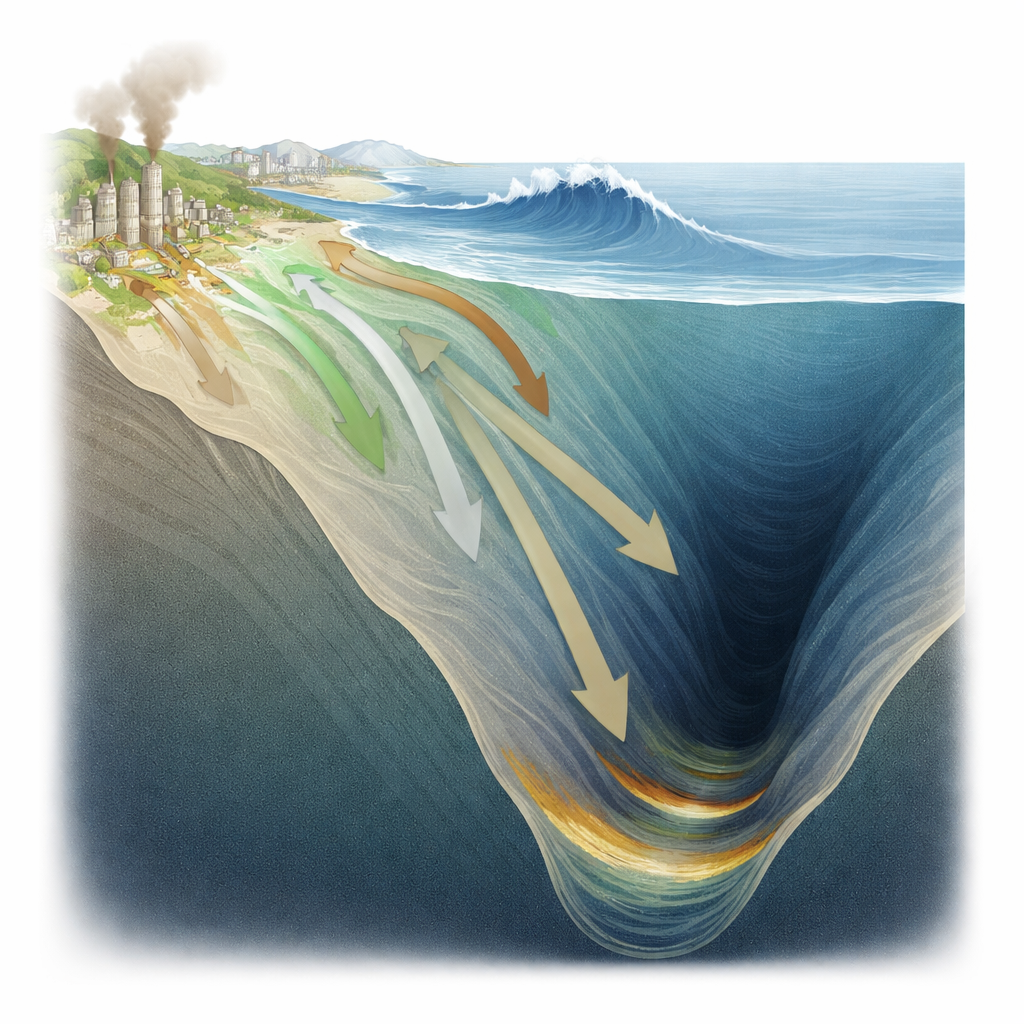
The Hidden World of Ocean Trenches
Ocean trenches more than six kilometers deep, called hadal zones, are among the least explored environments on Earth. The Japan Trench, where the Pacific Plate dives beneath Japan, reaches over seven kilometers below the surface. Its steep walls and narrow, V-shaped basins act like gutters that collect material washing off the continent and continental shelf. Because Japan’s coasts are densely populated and heavily industrialized, scientists suspected these deep basins might store a legacy of pollution, but technological challenges and high costs have left major gaps in our understanding of what actually accumulates there and how it gets transported.
Sampling the Abyss
To investigate, researchers used deep-sea coring systems during an international drilling expedition to collect sediment from seven separate basins along the axis of the Japan Trench, all deeper than 7.4 kilometers. They sliced the upper tens of centimeters of these cores into layers representing material laid down before and after recent major earthquakes, including the 2011 Tōhoku-Oki event. In the laboratory, they measured both organic pollutants—such as oily hydrocarbons, pesticide residues, and industrial additives—and a suite of heavy and trace metals. They also tracked total organic carbon and molecular “fingerprints” that reveal whether the buried material came from land plants, marine plankton, or petroleum.
Pollution Fingerprints in the Mud
The sediments turned out to be laced with a broad mix of human-made contaminants. Oily compounds linked to fossil fuels, combustion, and petroleum products were widespread, with certain basins acting as hot spots where these substances accumulated. Legacy pesticide breakdown products related to DDT, long banned for its toxicity, were present across the trench, sometimes at surprisingly high levels. A modern flame-retardant additive also appeared where other pollutants were most concentrated, hinting at ongoing inputs from industry and shipping. Potentially toxic metals such as zinc, chromium, and lead were enriched in the more recently deposited layers, especially in basins that receive large volumes of incoming sediment. These patterns show that the deepest seabed is not pristine; it archives decades of coastal and offshore pollution in its fine mud.
Earthquakes as Pollution Conveyer Belts
Rather than trickling down slowly, much of this contamination appears to arrive in sudden, violent bursts. By comparing pollutant levels, organic carbon content, basin shape, and calculations of how sediment flows across the seafloor, the team concluded that earthquake-triggered processes dominate delivery. Strong shaking can strip the thin, organic-rich upper skin from the continental shelf and slope, sending dense underwater avalanches of sediment hurtling into the trench. Tsunami backwash can also drag debris and polluted soil off the devastated coastline and out to sea. These gravity-driven flows travel along the trench axis and settle in its deepest basins, leaving stacked layers of pollutant-rich mud that match known earthquake and tsunami events over decades to centuries. 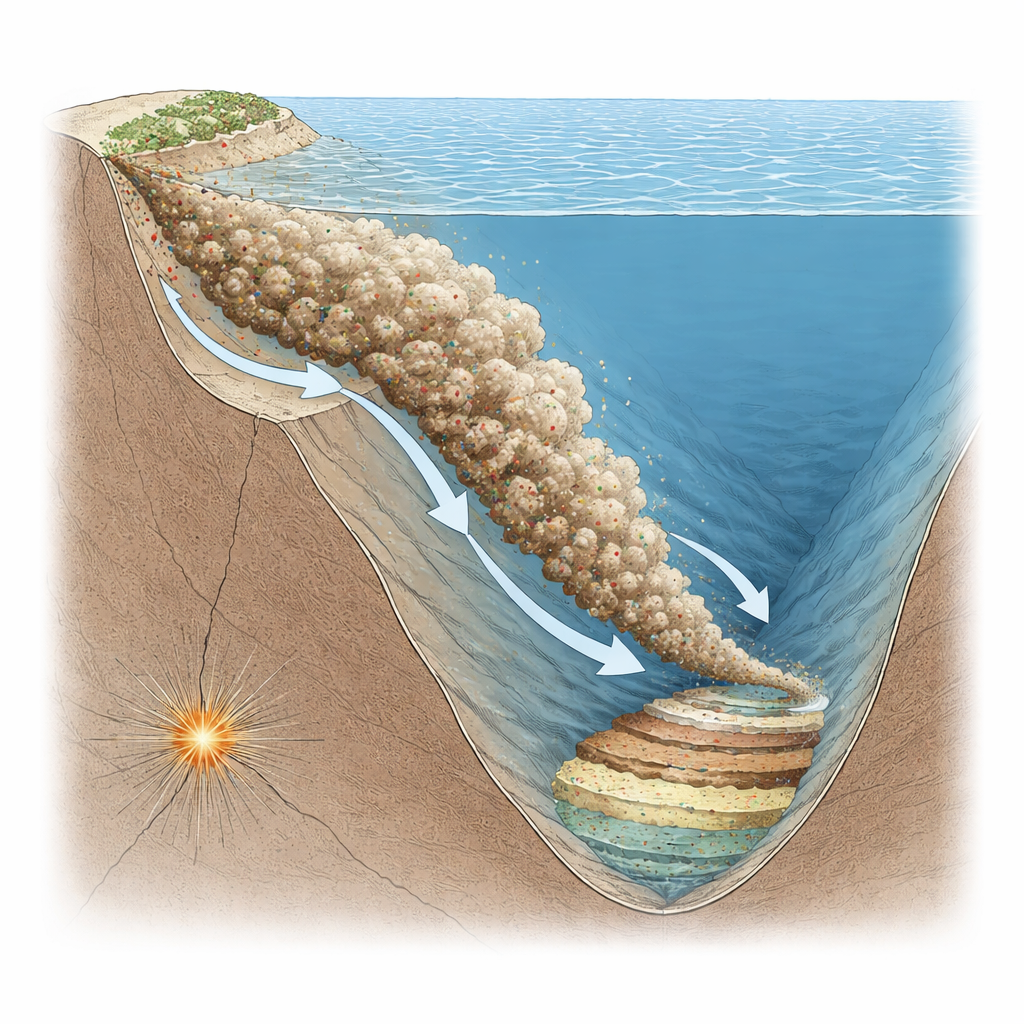
A Dynamic and Vulnerable Deep Sea
The study reveals that the Japan Trench is both a filter and a long-term storage site for human-made chemicals. Sticky, particle-loving pollutants—whether oily compounds, legacy pesticides, or certain metals—are preferentially trapped and buried during major seismic events, while more soluble or reactive substances may be transformed or re-mobilized within the sediment. Because similar earthquake and tsunami processes operate along many subduction zones worldwide, these findings suggest that giant quakes can periodically shake loose and redistribute coastal pollution into the deepest parts of the ocean. For a general reader, the takeaway is stark: our activities on land do not stop at the shoreline. Through the violent pulse of earthquakes and tsunamis, they reach all the way into the hadal dark, altering environments that until recently we barely knew existed.
Citation: Trotta, S., Schwarzbauer, J., Michetti, A.M. et al. Seismic events drive pollution in Japan Trench hadal basins. Commun Earth Environ 7, 346 (2026). https://doi.org/10.1038/s43247-026-03401-6
Keywords: deep-sea pollution, Japan Trench, earthquake-driven sediment flows, hadal zone, marine contaminants