Clear Sky Science · en
Weakening vegetation control on global terrestrial evapotranspiration in a warmer world
Why the planet’s “green boost” might not last
As the world warms, satellites reveal that much of Earth is getting greener: plants are growing more leaves. That extra foliage helps pull carbon dioxide from the air and, by releasing water vapor, can cool the land surface—one reason tree planting is often promoted as a climate solution. This study asks a crucial but less discussed question: will plants keep controlling how much water returns to the atmosphere as the climate and carbon dioxide levels continue to rise, or will that influence weaken over time?
How plants move water to the sky
Water leaves the land for the atmosphere through a combination of processes known as evapotranspiration. Some water evaporates directly from bare soil or from raindrops caught on leaves. The rest moves through plants: roots draw water from the ground, pipes inside stems deliver it to leaves, and tiny pores on the leaf surface release it as vapor. Leafiness, often measured by how much leaf area covers a patch of ground, therefore plays a key role in deciding how much water goes back into the air and how much remains in rivers, lakes, and soils.
What global observations already show
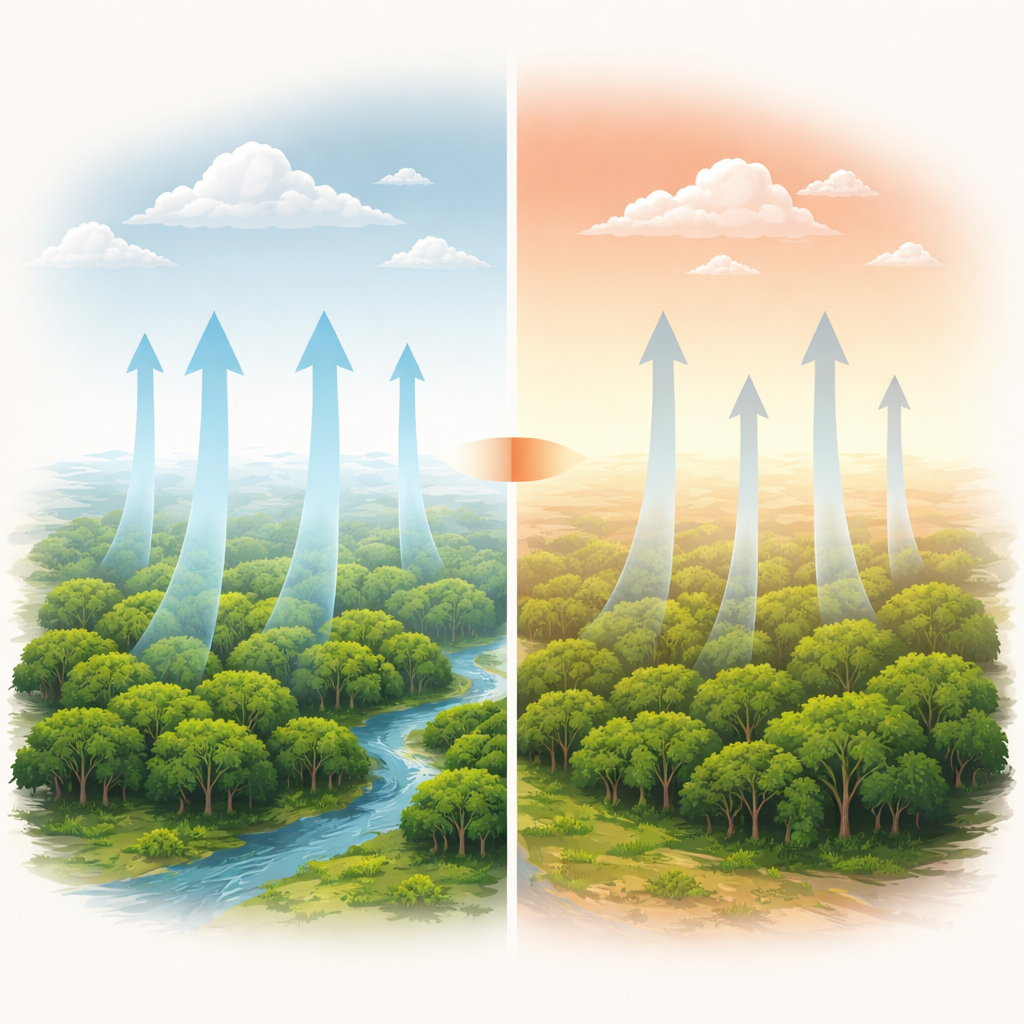
Using several decades of satellite records, the authors confirm that most vegetated land has been greening since the early 1980s. On average, more leaves have meant more evapotranspiration, especially in warm, dry regions where additional foliage has a strong impact on water loss. When the researchers separated the processes, they found that plant transpiration accounts for by far the largest share of this extra water flux, while evaporation from wet leaves and bare soil plays a smaller role and sometimes even declines because denser canopies shade the ground. Overall, today’s land surface behaves much like an expanding natural sprinkler system powered by plant growth.
Peering into the future with models and machine learning
To explore what happens next, the study combines satellite data with simulations from 18 advanced Earth system models and a machine-learning method that can tease apart overlapping influences. Instead of simply comparing two distant periods, the authors treat the sensitivity of evapotranspiration to leaf area as something that evolves year by year through this century under four different emissions pathways. Across all scenarios, models project continued greening, with particularly strong increases in colder regions under high emissions. Yet the boost in water loss per unit of added leaf area is expected to weaken over most vegetated land—by about four-fifths of the global surface in even the mildest scenario, and over more than nine-tenths under the highest emissions.
Why more leaves will not always mean more cooling
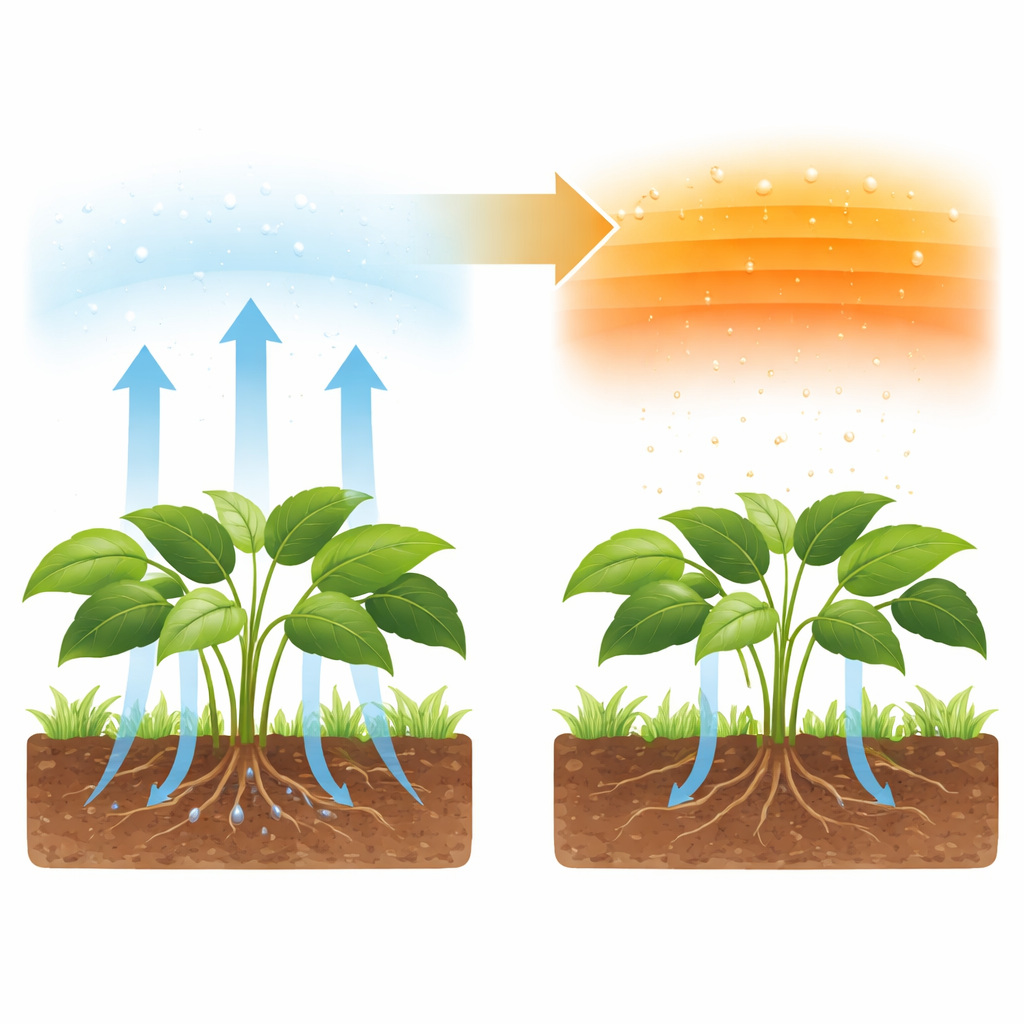
The key lies in how plants react to rising carbon dioxide. Extra CO2 in the air makes photosynthesis more efficient, encouraging plants to grow more leaves. At the same time, it allows them to partially close their leaf pores while still taking up enough CO2, which reduces the flow of water through each unit of leaf area. The authors use physics-based calculations to show that the atmosphere’s “gateways” for water vapor in plant canopies effectively narrow with increasing CO2. Even as canopies become denser, the conductance per unit leaf area declines, so the extra surface for evaporation brings diminishing returns. In many regions, especially warm ones, this water-saving response outweighs the greening-driven increase in evaporative surface.
Shifting drivers of the water and energy cycle
Because these physiological adjustments reduce the added cooling from each new increment of leaf area, the study finds that vegetation’s direct control over evapotranspiration will steadily weaken. Early in the century, greening still tends to enhance water loss and surface cooling. By late century under low emissions, that contribution shrinks and can even reverse in some places, meaning greening no longer boosts evapotranspiration as it once did. Under high emissions, very strong greening can still increase water loss overall, but the relative importance of climate factors such as radiation, heat, and atmospheric dryness grows, gradually overtaking vegetation as the main driver of changes in evapotranspiration.
What this means for climate and water planning
For non-specialists, the central message is that there are limits to how far “more green” can go in cooling the planet through extra evaporative water loss. As carbon dioxide and temperatures rise, plants increasingly protect themselves by conserving water, so each additional unit of leaf area has less power to move water to the air and cool the surface. The findings do not argue against restoring forests or managing vegetation for climate benefits, but they highlight that such strategies will yield smaller returns for evaporative cooling in a high-CO2 world. Policymakers and water managers should therefore treat greening as one tool among many and design plans that account for a future in which climate conditions, more than vegetation itself, have the final say over how much water leaves the land.
Citation: Li, H., Wang, W., Chen, Z. et al. Weakening vegetation control on global terrestrial evapotranspiration in a warmer world. Commun Earth Environ 7, 365 (2026). https://doi.org/10.1038/s43247-026-03372-8
Keywords: evapotranspiration, vegetation greening, climate change, carbon dioxide, water cycle