Clear Sky Science · en
Enhanced carbon burial in seagrass meadows under ocean acidification revealed by carbon dioxide vents
Why underwater lawns matter for climate
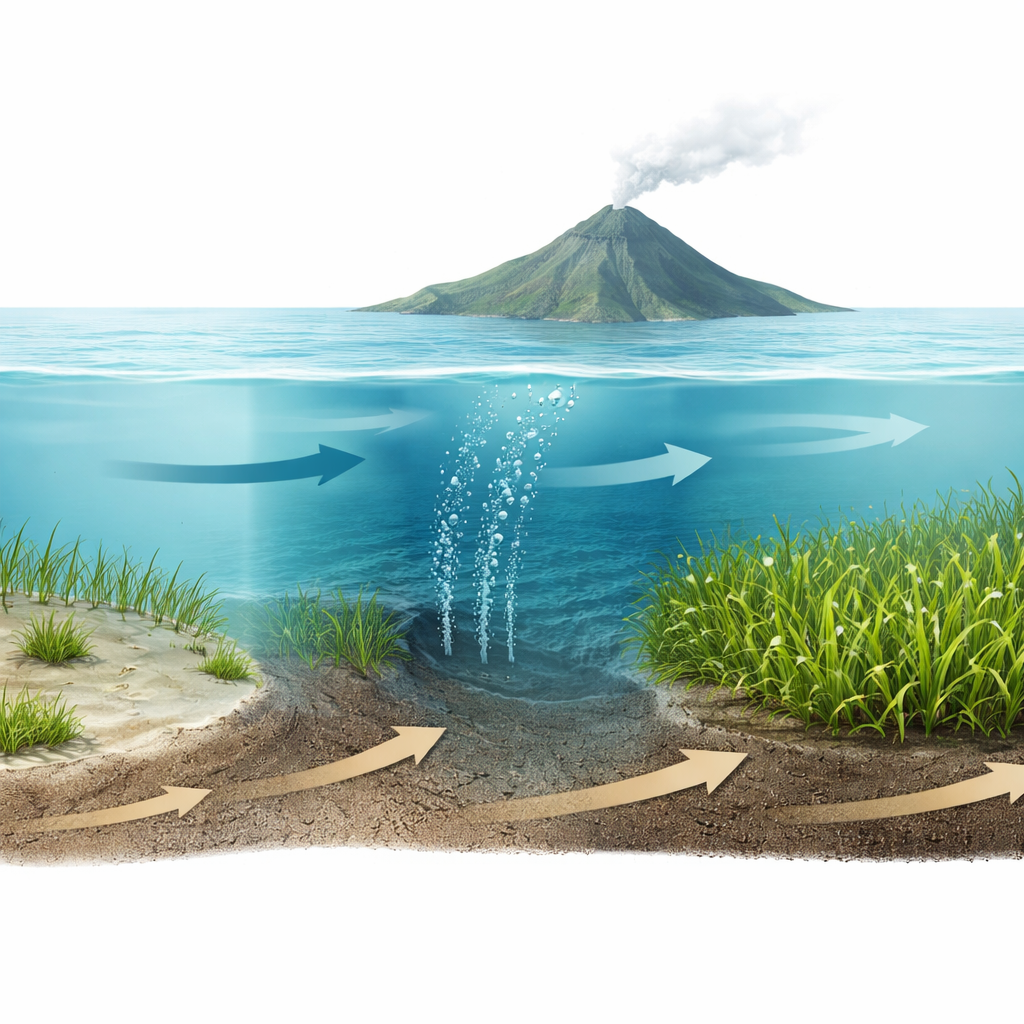
Along many coasts, underwater meadows of seagrass quietly pull carbon dioxide from the water and lock part of it into the seafloor for decades to centuries. These "blue carbon" ecosystems are being promoted as natural allies in the fight against climate change. Yet the oceans are also becoming more acidic as they absorb human-made CO₂, and scientists are still working out whether this chemical shift will weaken or strengthen seagrass meadows as long-term carbon vaults. This study takes advantage of a natural laboratory off the Italian island of Ischia to see how future ocean chemistry might reshape the climate role of these hidden habitats.
A natural preview of future oceans
Off Ischia, volcanic activity leaks CO₂ gas through the seafloor, creating zones where seawater is mildly, strongly, or extremely acidified compared with normal conditions nearby. The study focused on meadows of a Mediterranean seagrass, Posidonia oceanica, that grow across this gradient. By collecting long sediment cores from 14 spots and dating the layers back about 70 years, the researchers could reconstruct how much carbon has been buried over time under three types of water: today’s typical pH, the level expected by the end of this century under high emissions, and a more extreme scenario. They then measured how much of the buried material was organic carbon from plants and algae, and how much was inorganic carbon in the form of calcium carbonate, the mineral that forms shells and many seafloor particles.
More plant carbon locked away as waters turn sour
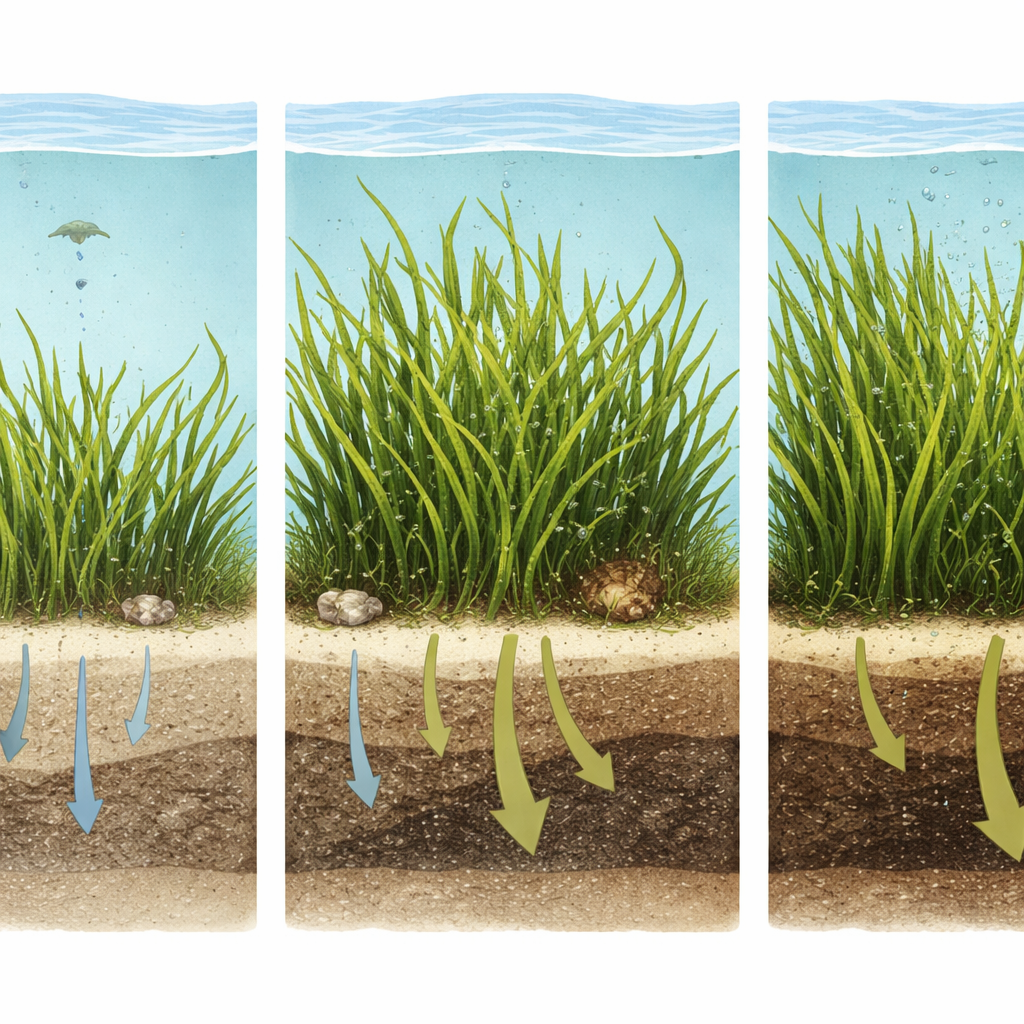
The cores revealed a striking pattern: as pH dropped and waters became more acidic, the rate at which organic carbon was buried in the seafloor rose sharply. Under present-day conditions, meadows stored only about 1.5 grams of organic carbon per square meter each year. In the low-pH zones, that rate jumped to around 7 grams, and in the most acidified sites it reached roughly 10 grams per square meter per year—up to seven times higher. Total stocks of buried organic carbon since the mid‑1950s showed the same trend, with the most acidified meadows holding many times more organic matter in their sediments than the sites at normal pH. These differences could not be explained by faster sediment buildup, which was similar across sites, pointing instead to changes in what was being buried.
Shifting roles of seagrass, algae, and shell builders
To understand where the extra carbon came from, the team analyzed the natural chemical fingerprints of carbon and nitrogen in the sediments and in the tissues of seagrass, attached microscopic algae, and free‑living seaweeds. These signatures act like barcodes that reveal the source of the buried material. At normal pH, most of the sediment carbon could be traced back to seagrass itself. In the more acidic zones, however, epiphytic algae and larger seaweeds contributed a much bigger share, signaling a community shift in who is capturing carbon. At the same time, the amount of calcium carbonate buried did not rise with acidity; if anything, its relative importance declined. This suggests that acidified conditions encourage more plant and algal growth or more efficient trapping of their remains, while discouraging shell-forming organisms whose hard parts can generate CO₂ during formation.
Balancing carbon gains and hidden emissions
Whether a seagrass meadow truly helps cool the climate depends on the trade‑off between organic carbon it locks away and the CO₂ released when calcium carbonate is produced and buried. When the researchers combined both sides of this ledger, they found that meadows under normal pH were, on average, slight sources of CO₂ to the atmosphere once carbonate effects were included. Low‑pH meadows hovered around climate neutrality, with large variation among cores. Only the most acidified meadows emerged as clear long‑term CO₂ sinks, where extra organic burial outweighed emissions tied to carbonate. This means that simply counting organic carbon in sediments can overstate the climate benefit of many seagrass beds, especially where shell formation is intense.
What this means for the future ocean
For non-specialists, the main message is that ocean acidification does not automatically spell disaster for all blue‑carbon habitats. In these Italian meadows, lower pH appears to favor plant and algal communities that bury more organic carbon while curbing some of the shell-building that counteracts this benefit. In the most acidified zones, the balance tips so that the meadows become genuine long‑term CO₂ sinks. However, the study also warns that many present‑day meadows may be close to climate neutral or even net sources once hidden carbonate emissions are counted. Effective climate strategies will therefore need to both protect and restore seagrass where it truly acts as a sink, and reduce processes and locations where these habitats quietly leak CO₂ back to the air.
Citation: Kindeberg, T., Teixidó, N., Comeau, S. et al. Enhanced carbon burial in seagrass meadows under ocean acidification revealed by carbon dioxide vents. Commun Earth Environ 7, 350 (2026). https://doi.org/10.1038/s43247-026-03349-7
Keywords: seagrass meadows, blue carbon, ocean acidification, carbon burial, calcium carbonate